


Figuring out the "most powerful wet dry vac" isn't as simple as picking the one with the biggest horsepower number on the box. For serious industrial jobs, especially for hydrovac operators, real power is all about matching the right performance specs to the work in front of you. In the hydrovac industry, a truly powerful machine has a finely tuned balance of high suction (water lift) to pull up heavy, water-soaked soil and strong airflow (CFM) to keep that material moving down the hose without clogging. This guide provides an industry overview of what metrics truly matter for effective digging.
Decoding Power Metrics for Industrial Wet Dry Vacs
When you're sizing up an industrial-grade wet dry vac for hydro excavation, you have to look past the marketing hype. Two numbers matter more than anything else: Cubic Feet per Minute (CFM) and Water Lift. That "peak horsepower" figure you see advertised? It's often just a measure of a motor's potential in a lab, not what it can sustain on a tough job site. The actual muscle needed for hydrovac work comes from the dynamic relationship between airflow and raw suction strength.
Once you get a feel for these core concepts, you can start choosing equipment based on real-world performance instead of flashy advertising claims.
The Two Pillars of Vacuum Power
At its heart, vacuum performance is a trade-off. CFM measures the volume of air the vacuum moves, which is fantastic for cleaning up light debris spread over a wide area. On the other hand, water lift (also called sealed pressure) measures the pure, raw suction force—its ability to lift heavy things straight up.
For hydrovac jobs, where you're fighting gravity to pull dense, wet slurry out of the ground, water lift is almost always the more important metric. It’s the brute force that gets heavy material moving up from the bottom of a hole and keeps it from settling and creating clogs. This is the cornerstone of effective digging in the hydrovac industry.
These two specs work against each other. A vacuum built for massive CFM will likely have less water lift, and a high-water-lift machine might move less air. The secret is finding the sweet spot for the kind of work you do. If you want to get into the weeds, you can explore a deeper dive into how vacuum suction power is measured in our related article.
Comparing Industrial Vacuum Metrics
To see how this plays out on a job site, let's break down what each metric is really for.
| Metric | What It Measures | Ideal for... |
|---|---|---|
| CFM (Cubic Feet per Minute) | The volume of air a vacuum moves per minute. Think quantity. | Clearing lighter debris or dust from a surface, like a shop floor. |
| Water Lift (Inches of H₂O) | The maximum height a vacuum can lift a column of water. Think strength. | Pulling heavy, dense materials like wet soil or slurry out of a trench. |
But even with a beast of a motor, you need the right tools to put that power to work. This is where a solution like The Hydrovac Attachment Tool comes in. It's designed to take all that raw power and focus it with precision. By integrating a high-pressure water jet with concentrated suction, it transforms a powerful wet dry vac into a non-destructive digging machine. This setup ensures every bit of your vacuum's CFM and water lift is channeled directly into effective digging, the primary goal of any hydrovac operation.
When you're shopping for a powerful wet/dry vac, it’s easy to get bogged down in the specs. Marketers love to plaster "Peak Horsepower" (HP) all over their packaging, making it seem like the ultimate measure of strength. But for serious industrial work like hydro excavation, that number is often just smoke and mirrors.
True power isn't about one flashy metric. It's a careful balance between airflow volume (CFM), raw suction force (Water Lift), and a motor's ability to keep chugging along under punishing, real-world conditions.
Understanding this interplay is what separates a decent tool from the right tool for the job. A vacuum with incredible CFM might clear a workshop floor of sawdust in seconds, but it'll choke when asked to pull heavy, water-logged soil from the bottom of a trench.
Why Peak Horsepower Can Be Deceptive
So, what's the deal with Peak HP? It's a measurement taken in a lab, usually without any load on the motor, and only for a split second. It tells you absolutely nothing about the continuous, usable power you'll have on a demanding job. A much better indicator is the motor's duty cycle and overall build quality, which reveal its stamina for the long haul.
This is also where motor design comes into play. Most consumer-grade vacuums use flow-through motors, where the air you're vacuuming is also used to cool the motor. It’s a compact design, but it leaves the motor dangerously exposed to moisture and fine grit.
Industrial machines, on the other hand, almost always feature bypass motors. These have a separate, dedicated fan to keep the motor cool, completely isolating it from the wet, abrasive materials you're suctioning. This design is non-negotiable for longevity and reliability on a professional job site.
The Critical Difference: CFM vs. Water Lift
The real muscle behind any vacuum is the dynamic duo of CFM and Water Lift. Think of it like this: CFM is how wide of a path you can clear, while Water Lift is how much force you have to shove heavy obstacles out of the way.
-
High CFM is for Volume: This is your go-to for moving large amounts of light, dry material fast. It's perfect for sucking up leaves, dust, or wood chips across a big surface. The high airflow keeps the material moving smoothly through the hose.
-
High Water Lift is for Weight: This is pure, unadulterated brute force. It measures the vacuum's ability to fight gravity by lifting a column of water. That translates directly to its power to pull dense, heavy materials like wet clay, slurry, or gravel straight up and out of a hole.
For anyone doing hydro excavation, water lift is the make-or-break metric for effective digging. When you're using a tool like The Hydrovac Attachment to liquefy soil, you need massive suction to lift that heavy slurry. A vacuum with weak water lift will simply leave the material behind, leading to constant clogs and wasted time.
To get a feel for some of the top-performing models out there, check out our guide on the highest CFM shop vacs currently available.
To help clarify which metric matters most for your work, here's a simple breakdown.
Industrial Vacuum Performance Metrics Compared
This table breaks down the key performance indicators for hydro excavation and industrial cleanup, showing where each metric shines.
| Performance Metric | What It Measures | Ideal Hydrovac Application | Less Critical For |
|---|---|---|---|
| Water Lift | Vertical suction power; its ability to lift heavy, dense material against gravity. | Lifting heavy soil slurry, wet clay, and gravel from trenches. | General surface cleanup (sawdust) |
| CFM | Airflow volume; how much air the vacuum moves in one minute. | Quickly clearing large areas of light, dry debris. | Precision excavation of dense soil |
| Bypass Motor | A motor cooled by a separate fan, isolated from the vacuumed airstream. | Any wet or fine dust application to ensure motor longevity. | Occasional dry, light-duty use |
| Duty Cycle | The motor's ability to run continuously without overheating or failing. | All-day industrial jobs, trenching, and continuous fluid removal. | Short, intermittent tasks |
Ultimately, while a balance is good, the extreme demands of hydro excavation will always lean heavily toward prioritizing water lift.
Filtration and Its Impact on Power
A beast of a motor is worthless if its airflow gets choked off by a clogged filter. A robust, industrial-grade filtration system is absolutely essential for maintaining peak performance and protecting the motor from damage.
For wet hydrovac applications, you need a foam sleeve or a specialized wet filter to stop water from getting into the motor. When you switch to dry work, a high-efficiency cartridge filter is crucial for trapping the fine dust that can kill a motor over time. The most powerful wet/dry vac models often feature multi-stage filtration systems designed to handle mixed debris without ever skipping a beat.
Even top-tier consumer models prove this point. For instance, Craftsman’s 6.5 HP Shop Vac (model CMXEVBE17595) was named the overall winner in comprehensive 2025 tests by Vacuum Wars, where it aced both debris pickup and raw suction. Its success, even as a consumer favorite, shows how a smart balance of power, capacity, and filtration creates a machine that punches above its weight. The lesson here scales directly to industrial gear: every single component has to work in harmony to deliver consistent, reliable power. You can see the full breakdown of the test results here.
Matching Vacuum Power to Real-World Industrial Tasks
Figuring out how specs like CFM and Water Lift translate to the messy reality of a job site is what separates the pros from the rookies. For hydrovac operators, construction crews, and industrial maintenance teams, picking the most powerful wet dry vac isn't about grabbing the one with the biggest motor. It's about matching the right kind of power to some seriously tough jobs. Get it wrong, and you're looking at wasted time, busted equipment, and a job that’s going nowhere fast.
Think about it: using a beast of a vacuum for a simple water cleanup is just burning fuel for no reason. On the other hand, trying to suck up heavy slurry with an underpowered unit is a recipe for clogs, frustration, and costly delays. The trick is knowing whether you need high airflow or pure lifting power for the material you’re moving.
Precision Digging Around Utilities
Hydro excavation around sensitive utilities is all about finesse. You're not just moving dirt; you're trying to do it without slicing through a fiber optic cable, gas line, or water main. For this kind of surgical work, a vacuum with exceptionally high Water Lift is non-negotiable.
Once you turn soil into a liquid slurry, it gets incredibly heavy. You need a vacuum that can generate some serious vertical pull to lift that dense muck straight up and out of a pothole or trench.
- Ideal Power Profile: High Water Lift is everything. CFM is less of a concern since you're working in a tight, concentrated area.
- Real-World Scenario: Imagine an operator daylighting a nest of electrical conduits encased in compacted clay. They need that intense suction to pull the heavy slurry up and away, keeping it from settling back over the lines. This ensures the utilities are exposed cleanly and safely.
This is the exact job The Hydrovac Attachment Tool was built for. It channels the vacuum's raw suction into a single, focused point while simultaneously using a water jet to break up the soil. This combination allows an operator to perform precision excavation with a powerful wet dry vac, delivering the effective digging solution the industry demands.
Trenching and Bulk Soil Removal
When you scale up to bigger jobs like digging trenches for irrigation or clearing large areas, the power equation changes a bit. High Water Lift is still crucial for getting that heavy soil off the ground, but now CFM becomes a major player in keeping the job moving efficiently, especially over longer distances.
A balanced power profile is key here. It ensures that once the heavy material is lifted, there's enough airflow to carry it smoothly through a long hose run. Without enough CFM, the slurry loses momentum and you end up with clogs, particularly in bends or fittings.
A common mistake in trenching is obsessing over suction alone. A system with balanced CFM and Water Lift not only lifts the material but clears the hose faster, letting you dig continuously without stopping to clear jams.
Heavy Sediment and Sludge Cleanup
Industrial environments like sump pits, car wash bays, and retention ponds offer up a whole different kind of nasty. We're talking thick, semi-solid sludge—a goopy mix of water, sand, grease, and whatever else has settled in there. This heavy, sticky mess requires maximum Water Lift just to break the surface tension and get it moving.
Here are a few classic examples:
- Industrial Sump Cleaning: Sucking up settled metal shavings and thick coolant sludge from the bottom of a pit.
- Car Wash Pits: Clearing out caked-on sand, dirt, and soap scum that has turned into a solid mass.
- Property Water Management: Unclogging culverts or storm drains packed with dense, waterlogged leaves and mud.
In every one of these scenarios, the vacuum's ability to generate raw lifting force is what matters most. The material is so dense that a vacuum built for high airflow (CFM) would just spin its wheels, unable to even budge the sludge. This is a job for pure, brute-force suction.
The Hydrovac Attachment: A True Power Multiplier
Having one of the most powerful wet/dry vacs on the market gives you a massive head start with raw suction and airflow. But let's be honest—raw power alone doesn't get the job done efficiently or profitably. Without the right tools to focus that force, you’re just wrestling with an unwieldy system that’s useless for precise work like hydro excavation.
This is where a specialized tool becomes a genuine power multiplier. It’s the critical link between your high-performance vacuum and the delicate, demanding work of non-destructive digging. By integrating a focused water jet with concentrated suction, you can turn your existing equipment into a precision hydrovac system.
The Hydrovac Attachment Tool is the solution engineered specifically for this. It takes all that incredible power from your vacuum and funnels it into a controlled, highly effective excavation stream, bridging the gap between brute force and surgical accuracy for effective digging.
From Raw Power to Precision Performance
A standard, wide-mouth vacuum nozzle is built for surface cleaning, not digging. It spreads the suction over a large area, which is perfect for clearing a shop floor but terrible for pulling heavy, saturated soil out of a deep hole. The Hydrovac Attachment completely changes this dynamic.
It creates a sealed, high-velocity zone where pressurized water liquefies compacted soil, and the vacuum’s full suction force immediately rips out the resulting slurry. This integrated approach delivers tangible benefits that directly boost job site efficiency and safety.
This decision tree helps visualize how to match your industrial vacuum's capabilities to specific materials you'll encounter on the job.
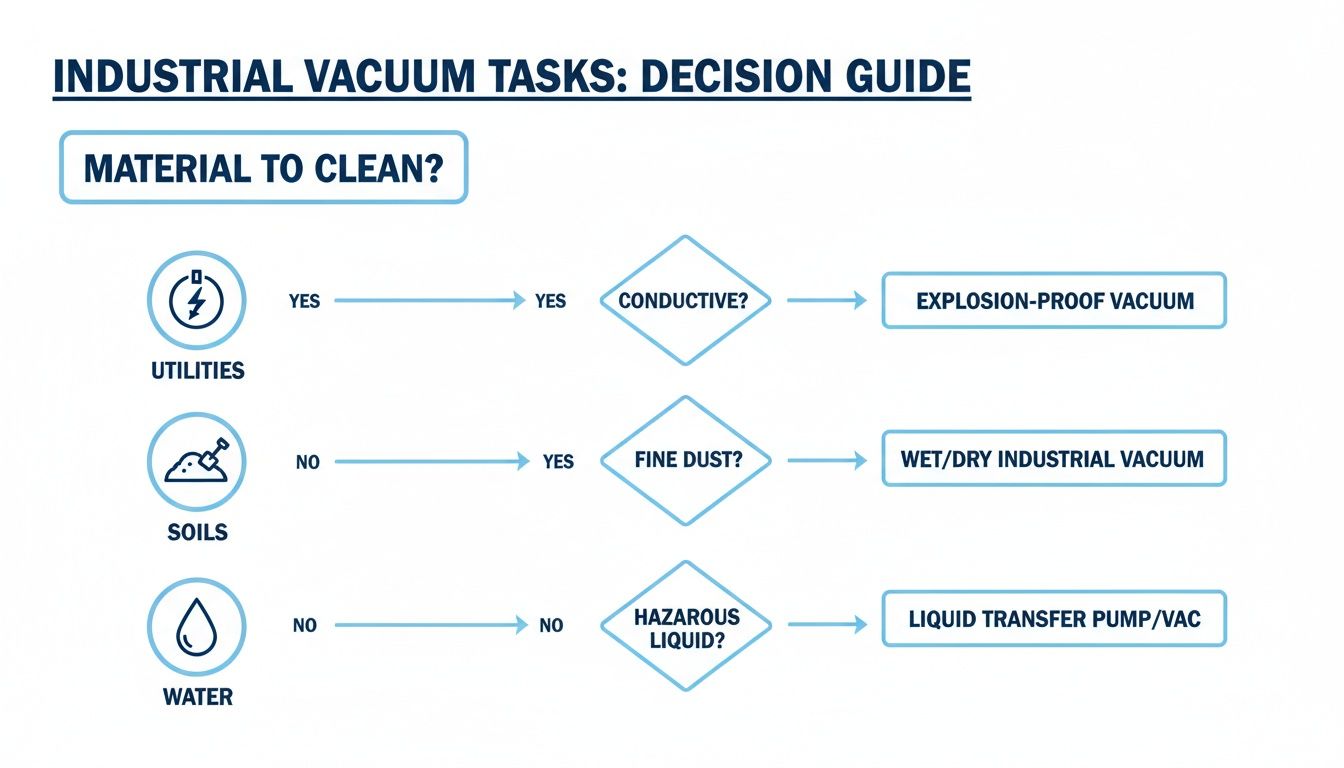
As you can see, while raw power is the foundation, the nature of the material itself dictates the specific tooling needed for effective removal.
Unlocking Key Hydrovac Capabilities
By focusing the power you already own, the attachment unlocks capabilities that were once reserved for much larger, more expensive equipment. This is a game-changer for operators who need hydrovac performance without the logistical headache of a full-sized truck.
-
Enhanced Digging Accuracy: The design lets you safely expose delicate infrastructure like fiber optic lines, gas pipes, and electrical conduits. With a precise water stream and immediate slurry removal, you always have eyes on what you're doing, drastically cutting the risk of costly utility strikes.
-
Significant Water Reduction: Traditional hydro excavation can be incredibly water-intensive. The attachment’s focused jet uses just a fraction of the water compared to open-ended hoses. That means less slurry volume, fewer trips to empty the tank, and less time spent refilling water.
-
Cost-Effective Mobilization: It completely removes the need to deploy a huge hydrovac truck for smaller jobs. Tasks like setting fence posts, installing irrigation systems, or potholing for utilities can now be knocked out efficiently with a powerful wet/dry vac and this one attachment.
The Hydrovac Attachment doesn't just make your vacuum stronger; it makes it smarter. It channels every bit of available Water Lift and CFM into a productive, controlled force, turning a cleanup tool into a specialized excavation machine that generates revenue.
Even highly-regarded commercial units get a massive boost from this focused application of power. Take the Ridgid 12-Gallon NXT Wet/Dry Vac HD1200, which has proven itself as one of the most powerful wet/dry vacs for heavy-duty commercial use with its robust 5.0 peak HP motor. While its raw suction is fantastic for general cleanup, pairing it with the Hydrovac Attachment concentrates that power for specialized digging. It’s proof that even top-tier machines become more valuable with the right accessories. You can dig into this model's performance in some of the detailed tests and reviews available online.
Ultimately, buying the most powerful wet dry vac is only step one. To truly get a return on that investment in the hydrovac industry, you have to equip it to perform specialized, high-value tasks. The Hydrovac Attachment provides that essential capability, transforming raw power into profitable, precision work on any job site.
Optimizing Your System With the Right Hoses and Fittings
You can have the most powerful wet/dry vac motor on the market, but that power is worthless if it never makes it to the nozzle. Think of your vacuum as a complete system. Every single component between the motor and the muck matters, and that’s where hoses and fittings come in. These aren't just accessories; they're the critical conduits that either deliver or destroy your vacuum's performance.
It’s a common and costly mistake to overlook these parts. The wrong hose or a leaky fitting makes your motor work overtime for subpar results. This leads to premature burnout and just plain slow, frustrating work on the job site.
How Hose Diameter and Length Impact Power
The physics of vacuum power don't lie. As air and debris move through a hose, they create friction, which kills both CFM and Water Lift. The longer the hose and the smaller its diameter, the more power you lose along the way. For any hydrovac operator, this is a calculation you can't afford to get wrong.
A hose that’s too narrow acts like a bottleneck, choking the airflow and severely limiting how much material you can actually pull. On the flip side, a hose that’s too wide for your vacuum's power can cause the airflow to slow down, letting heavy slurry settle and create clogs.
- Hose Length: A good rule of thumb is that for every 10 feet of hose you add, you'll see a noticeable drop in suction. A 50-foot hose run can easily slash your vacuum’s effective Water Lift by a huge margin.
- Hose Diameter: A wider diameter, like the 2.5-inch standard for industrial work, reduces friction and is crucial for moving larger debris and thick slurry. A narrow hose might feel like it has strong suction right at the inlet, but it will clog instantly with anything more than fine dust or clear water.
The key takeaway is simple: use the shortest, widest hose that's practical for the job. Never leave excess hose coiled up; every unnecessary bend and loop adds friction and sabotages your performance at the nozzle.
Selecting Fittings to Preserve System Integrity
Even with the perfect hose, your system is only as strong as its weakest link—and that's often a poorly sealed fitting. In the high-pressure world of hydro excavation, the tiniest air leak at a coupler can cause a massive drop in suction. These leaks are like a hole in a straw, forcing the vacuum to pull in useless ambient air instead of focusing its power on the target.
When you're picking out fittings, you're looking for one thing: a secure, airtight seal.
- Camlock Fittings: These are the go-to in the hydrovac industry. They provide quick, solid connections that hold up under intense pressure without leaking.
- Heavy-Duty Couplers: Always choose robust materials like reinforced polymer or metal. They won’t crack under pressure or get worn down by abrasive materials.
Making sure every connection is tight and secure is fundamental to getting your motor's raw power to the point of excavation. The Hydrovac Attachment Tool was designed with this exact principle in mind, creating a sealed suction zone that stops power loss right where the work happens. To get a full rundown on connectors, you can learn more about how to choose the right shop vac hoses and fittings in our detailed guide. When you build a fully optimized system, every component works in harmony to give you maximum power and rock-solid reliability.
Keeping Your Gear Running and Your Crew Safe
Owning a beast of a wet/dry vac is one thing. Keeping it running like new while making sure your crew goes home safe every day is what really separates the pros from the amateurs. High-powered industrial vacuums, especially when you're doing hydro excavation, bring serious risks to the job site that demand strict protocols. Smart maintenance and a "safety first" culture aren't just good ideas—they're what protect your bottom line and prevent accidents.
You're dealing with high-pressure water, heavy slurry, and powerful suction. Every part of the hydrovac process needs to be handled with care. If you cut corners on safety, you're not just putting your team in danger; you're opening your business up to huge liabilities and expensive downtime. And if you skip routine maintenance, you'll watch your vac's power fade until it's just an inefficient, clog-prone headache.
Non-Negotiable Safety for Hydro Excavation
Let's be clear: mixing powerful suction with high-pressure water creates a whole new set of hazards. A rock-solid safety checklist isn't optional—it's a must for every single hydro excavation job, from a simple pothole to a major commercial dig.
Here are the absolute essentials:
- Proper Grounding: The friction of air, water, and debris flying through a vacuum hose builds up a surprising amount of static electricity. You have to ground the vacuum unit and the hoses properly. This prevents a nasty static shock or, even worse, a spark that could ignite fumes in the wrong environment.
- Personal Protective Equipment (PPE): Your crew needs the right gear, period. This means waterproof boots, good gloves, and a full-face shield or safety glasses to guard against spray and flying debris. Depending on what you're digging up, you might even need respirators.
- Respect the Water Pressure: That water jet is a cutting tool. Operators need to be trained to handle the wand safely, always keep their footing, and never, ever point it at another person.
A well-defined safety plan is the backbone of any hydrovac operation. It makes sure everyone on site knows the risks and how to handle them, protecting both your people and your equipment.
The Proactive Maintenance Checklist
To keep your system pulling with maximum force, you can't just fix things when they break. A quick daily or weekly check-up will head off most performance problems and make your investment last a lot longer. This is especially true for tools like The Hydrovac Attachment Tool, which needs the vac to be at its best to do its job right.
A simple operator's checklist should cover these critical points:
- Inspect Filters Daily: Before you fire it up, check and clean your wet and dry filters. A clogged filter is the #1 killer of suction power and puts a huge strain on your motor.
- Check Hoses and Fittings for Leaks: Take thirty seconds to make sure every connection is tight. Even a tiny air leak can kill your water lift and make the job take twice as long.
- Examine the Motor and Power Cord: Look for any frayed wires, cracks, or damage to the motor housing. Fix any problems right away to avoid electrical hazards.
- Clean the Tank After Each Use: Never let slurry or debris dry inside the tank. A quick rinse-out prevents gunk from hardening and keeps the unit from stinking up your truck, so it's ready to go for the next job.
Frequently Asked Questions
Choosing the right industrial wet/dry vac isn't just about reading a spec sheet. Let's dig into some of the most common questions we get from professionals in the hydrovac industry to help you get the most out of your equipment on the job site.
High CFM or High Water Lift: What Really Matters for Hydro Excavation?
This is a big one. For hydro excavation, high water lift is far more important than high CFM. Think of water lift as the raw muscle—the pure suction force needed to pull heavy, dense materials like wet soil and slurry straight up against gravity. It's the brute strength that clears spoils from the bottom of a deep trench.
CFM (Cubic Feet per Minute) is all about moving air and lighter debris. While it has its place, it doesn't do you much good when you're trying to lift the sheer weight of hydrovac spoils. A system with superior water lift will be much more effective, preventing clogs and keeping your digging performance consistent, especially when you're working in deep holes or with tough, compacted soil.
Can I Just Slap the Hydrovac Attachment Tool on Any Powerful Wet/Dry Vac?
Not exactly. While our Hydrovac Attachment Tool is designed for versatility, its performance is directly linked to the vacuum it's paired with. For the best results, you need to connect it to a true industrial-grade wet/dry vac.
What does that mean? You're looking for a machine with high water lift, a robust bypass motor built for a long duty cycle, and a large-capacity tank. The attachment's whole job is to feed a continuous flow of heavy, wet slurry into the vacuum. Hooking it up to an underpowered, consumer-grade shop vac will throttle its digging power and could even burn out the vac's motor over time. The right pairing is everything.
How Can I Stop Hoses from Clogging When I'm Removing Heavy Sediment?
Preventing clogs comes down to the right gear and the right technique. First, make sure your hose diameter is up to the task. A 2.5-inch hose is a good standard because it can handle a high volume of heavy debris without creating a bottleneck.
When you're working, maintain a steady, controlled pace. Don't get tempted to jam the nozzle into the ground and pull up huge clumps all at once. It also helps to keep the hose as straight as you can—sharp bends and kinks are where clogs almost always start.
The single best strategy is to break down the material before it even enters the hose. This is exactly what a solution like the Hydrovac Attachment Tool does. It liquefies compacted soil with a pressurized water jet, turning dense clumps into a smooth, manageable slurry that flows right through the hose, providing the most effective digging solution.
Ready to turn your powerful wet/dry vac into a precision digging machine? The Hydrovac Attachment Tool is the key to unlocking true hydro excavation capabilities.