


Choosing the right shop vac hoses and fittings isn't just a minor detail—it's the difference between a job that runs smoothly and one that's a constant battle against clogs and lost suction. For professionals in the hydrovac industry, these components are the lifeline connecting your vacuum's power to the precision digging required on site. Getting this right is critical for efficiency and safety.
Why Your Shop Vac Hoses and Fittings Matter
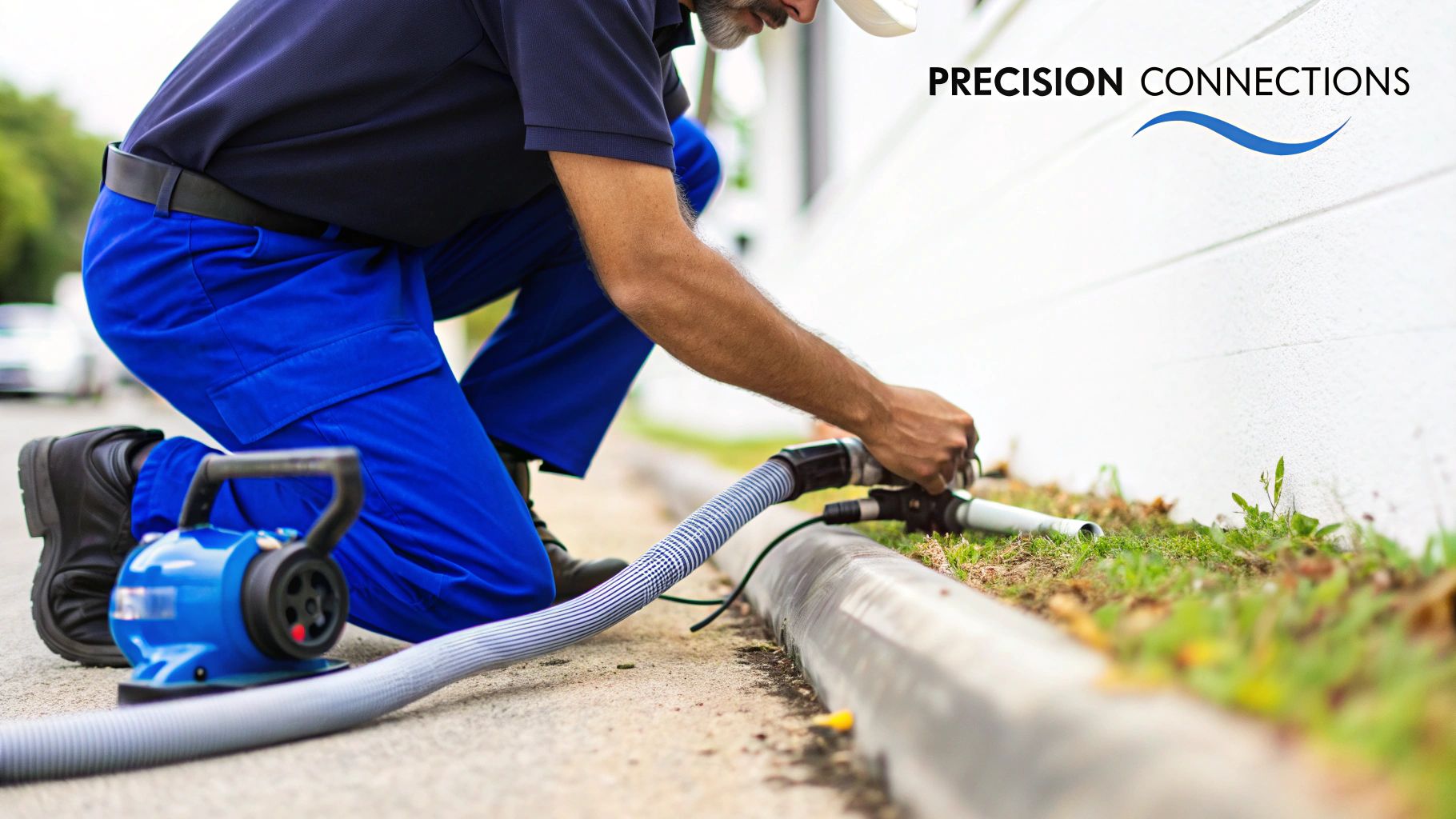
In hydro excavation, success often comes down to precision and reliability at the ground level. While the hydrovac truck provides the immense power, it’s the ground crew with portable vacuum systems that handles the delicate work—exposing fragile utilities or cleaning out confined spaces. In these scenarios, your shop vac hoses and fittings are either your most reliable asset or your biggest liability.
Think about it like a chain: the entire system is only as strong as its weakest link. A cheap hose that kinks easily or a fitting that doesn't seal properly can kill your vacuum's suction power right at the source. For anyone in the hydrovac business, that's not just an annoyance; it’s a critical failure that costs time, money, and can compromise safety.
The Impact of Quality Connections
Let’s be honest, the material being moved isn't dust bunnies. Abrasive slurry, sharp debris, and the general abuse of a hydrovac job site will tear standard, off-the-shelf hoses to shreds in no time. That’s why professional-grade gear is built differently, designed to handle the tough conditions while keeping suction at its peak. This isn't a niche concern; the industrial hose market was valued at USD 14.5 billion in 2024 and is projected to hit USD 28.25 billion by 2033. This growth is fueled by industries like hydrovac that demand durability and performance.
Investing in solid connections pays off in a few key ways:
- Better Efficiency: A perfectly sealed, airtight connection means no suction loss. You move more material, faster, and complete jobs on schedule.
- Less Downtime: Hoses that are crush-proof and puncture-resistant don't fail you mid-job, saving you from frustrating and expensive field repairs.
- Greater Precision: When your equipment works flawlessly, tools like the Hydrovac Attachment Tool can perform as designed, enabling precise, surgical digging around critical infrastructure without the risk of damage.
Ultimately, getting the hose and fitting setup right turns your shop vac from a simple cleanup tool into an essential piece of your hydrovac excavation equipment. A well-built system provides the confidence to tackle any precision digging task, knowing your gear won't let you down.
Choosing the Right Hose Size and Material
Let's be honest—not all shop vac hoses are created equal. If you've ever tried to use a standard, flimsy hose for serious hydrovac work, you already know the result: frustrating clogs, a hose that collapses on itself, and a massive drop in suction power right when you need it most. To get peak performance, you have to match the hose to the job, and that comes down to two things: diameter and material.
Hose Diameter: Finding the Sweet Spot
Think of your hose as a highway for all the mud, rock, and slurry you’re pulling out of the ground. Common industrial sizes like 1.5-inch and 2.5-inch directly impact your airflow (CFM) and the sheer power you have for lifting heavy debris. A wider "lane"—a larger diameter—lets more material move at once, but you also need enough velocity to keep everything moving. If the speed drops, heavy stuff settles and you've got a blockage on your hands.
This balance is exactly why tools like The Hydrovac Attachment Tool are designed to work with a 2.5-inch hose. It’s the sweet spot for hydrovac applications. You get the high-volume airflow needed to clear material quickly, plus the concentrated suction required to lift it efficiently, making it the ideal solution for effective digging.
Material Matters: Don't Bring a Toy to a Gunfight
Beyond size, the hose material itself is what determines whether it will last a week or a year on a real job site. That standard vinyl hose that came with your shop vac might be fine for sawdust in the garage, but it will get shredded by the abrasive slurry and sharp-edged rocks you'll encounter in excavation work.
This demand for tougher gear is pushing the industry forward. The global market for industrial hoses was valued at USD 26.0 billion in 2024 and is projected to hit USD 36.2 billion by 2031. That growth isn't just happening; it's driven by professionals in the hydrovac sector who need reliable equipment that won’t kink, crack, or fail under pressure. You can read more about the growing industrial hose market to see how the demand for durability is shaping new products.
For hydrovac work, the goal is flexibility without weakness. You need a hose that can snake around a foundation or into a tight trench without kinking, but it also has to be tough enough to survive being stepped on or dragged over gravel.
This is where heavy-duty, reinforced hoses come in. They are the go-to for a reason. They're typically built with a thick, abrasion-resistant polymer and often have a wire helix running through the walls. That internal structure is what keeps the hose from collapsing under the intense vacuum pressure your system generates.
To help you choose, here's a quick comparison of the most common materials you'll find out there.
Shop Vac Hose Material Comparison for Hydrovac Work
When you're dealing with the demanding conditions of hydro excavation, the material of your hose is just as critical as its diameter. The table below breaks down the pros and cons of common hose types to help you decide which one is right for your needs.
| Material Type | Key Advantages | Best For | Considerations |
|---|---|---|---|
| Standard Vinyl | Lightweight and very flexible. Inexpensive. | Light-duty workshop cleanup (sawdust, dust). | Prone to punctures, tearing, and kinking. Not suitable for wet, abrasive materials or high-suction applications. |
| Reinforced PVC | Good abrasion and chemical resistance. More durable than standard vinyl. | General-purpose use, moderate debris, and occasional wet cleanup. | Can become stiff in cold weather. May still kink under extreme negative pressure without proper reinforcement. |
| Polyurethane (PU) | Excellent abrasion, tear, and puncture resistance. Stays flexible in low temperatures. | Professional hydrovac work, abrasive slurries, and demanding industrial environments. | Higher initial cost, but offers a much longer service life under tough conditions. |
| Crush-Proof/Wire-Reinforced | Extremely durable and resists collapse under high vacuum. Maximizes airflow. | The gold standard for hydrovac, utility work, and any job where hose collapse is a critical failure point. | Can be heavier and less flexible than non-reinforced options. The highest cost, but the best investment for professional use. |
Ultimately, investing in a high-quality, crush-proof hose is the best path for any serious hydrovac or utility work. While reinforced PVC can work in a pinch for lighter tasks, a purpose-built, wire-reinforced hose is the only way to guarantee consistent, powerful suction without the risk of a collapsed line stopping you mid-job.
By taking the time to select the right size and the right material, you're making sure that all the power your vacuum generates actually makes it to the nozzle. That means more effective digging, less frustration, and zero time wasted on equipment failures.
Mastering Fittings for a Leak-Proof System
All the vacuum power in the world is useless if it's leaking out before it gets to the nozzle. In hydrovac work, your system is only as strong as its weakest connection. This is where high-quality fittings, adapters, and clamps become your most valuable players. They’re the unsung heroes that create a secure, airtight seal, making sure every bit of suction your vacuum generates actually makes it to the business end of the hose.
Think of it like a high-pressure water line. Even a tiny pinhole leak will kill the pressure at the nozzle. It's the exact same principle with your vacuum setup. If you don't have a perfect seal at every connection point, you're bleeding performance and leaving efficiency on the table. That’s why putting some thought into your shop vac hoses and fittings isn't just a good idea—it's essential for getting the job done right.
The Must-Have Fittings for Any Serious Setup
Putting together a reliable vacuum system means having the right parts in your toolbox. While you can find a fitting for just about anything, there are a few core types that form the foundation of any versatile setup for utility work.
- Hose Cuffs: These are your primary connectors, the pieces that live on the ends of your hose. A good cuff creates a bulldog grip on both the hose and whatever you're plugging into, whether it’s a tool or the vacuum itself. You don't want it pulling loose mid-job.
- Reducers and Adapters: These are the ultimate problem-solvers. A reducer lets you connect a big hose to a smaller tool, or the other way around. Adapters are lifesavers when you need to join hoses from different manufacturers that just don't want to play nice together.
- Swivel Connectors: A swivel fitting is a total game-changer for maneuverability. It lets the hose spin freely without twisting or kinking up. When you're crammed into a tight spot trying to work around pipes and conduits, this little piece of hardware is worth its weight in gold.
This simple process shows what you should be thinking about when selecting components.
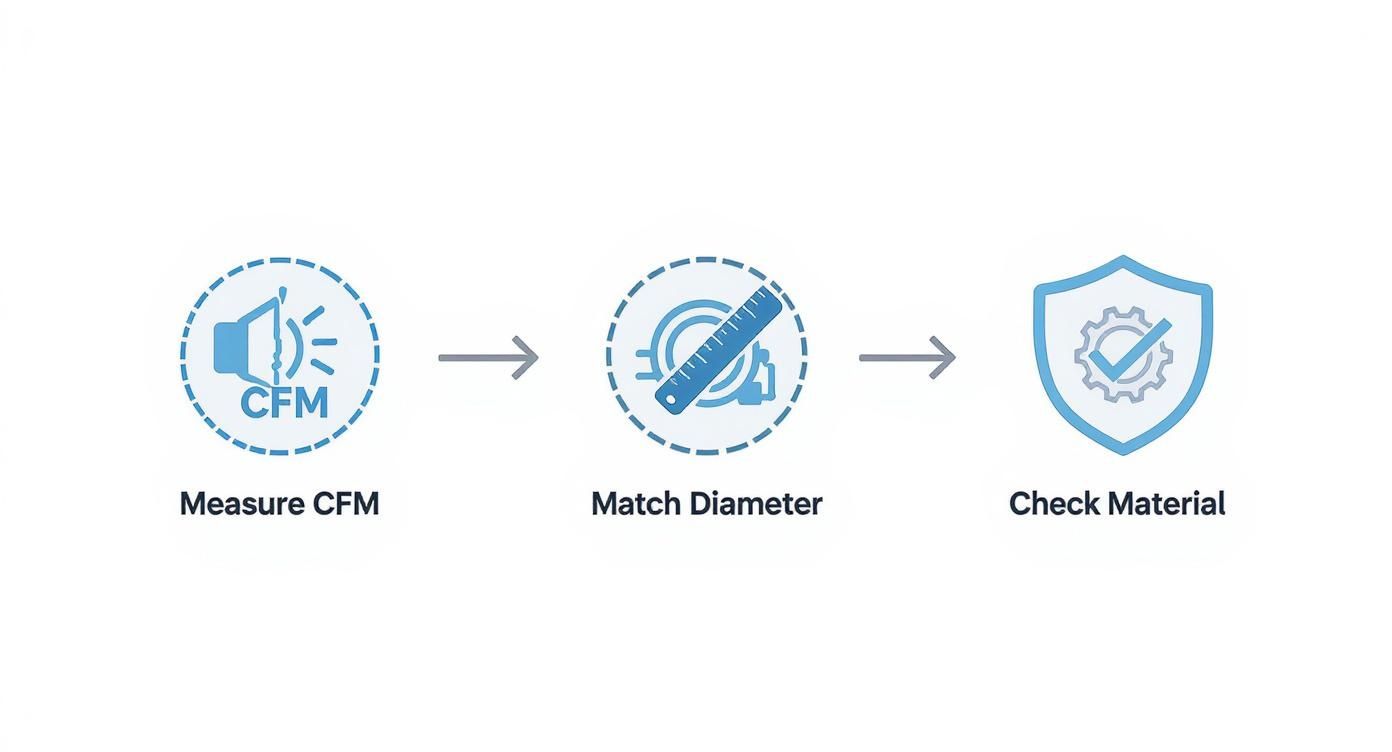
It all comes down to a simple formula: match your airflow, diameter, and materials, and you'll build a system that won't let you down.
Connecting Specialized Tools for Precision Work
The real test of your setup is how easily it integrates specialized tools. Take The Hydrovac Attachment Tool, for example. It’s engineered for surgical digging, but it needs a rock-solid connection to a standard 2.5-inch wet-vac hose to deliver that precision.
Thankfully, the connection is dead simple. The tool's base is designed to fit perfectly into the hose cuff, creating an airtight seal that focuses all that suction right at the tip where you need it most. This kind of seamless fit is what stops the tool from popping off during a critical dig, giving you consistent power and control for effective digging.
And if you find yourself needing to adapt your hose to different materials on the job site, figuring out how to properly set up a hose adapter to PVC can give you a ton of extra flexibility for custom rigs.
The demand for these kinds of reliable connections is only growing. The global market for vacuum fittings was valued at USD 1.5 billion in 2024 and is expected to climb to USD 2.8 billion by 2033. That tells you just how important these small but mighty components have become. When you master these connections, you're not just plugging in a hose—you're building a dependable, custom vacuum system that's ready for any challenge you throw at it.
A Case Study in Precision Digging
https://www.youtube.com/embed/bAgZ99-_UGI
Knowing the theory behind hoses and fittings is one thing, but seeing it all come together in the field is where it really clicks. This is where theory meets the trench. You get to see how a well-planned system can turn a powerful shop vac into a pinpoint-accurate, non-destructive digging tool. It all comes down to combining the right parts for a very specific, and often very tough, job.
Let’s say you need to expose a delicate fiber optic line buried in compacted soil, tucked right up against a building's foundation. Bringing in a full-sized hydrovac truck might be total overkill, or maybe it just can't get into the tight space. This is a perfect job for a portable, high-powered shop vac setup—but only if it’s properly equipped. You can’t just show up with a flimsy, standard hose and expect good results.
From Cleanup Tool to Surgical Instrument
This is exactly the kind of problem the Hydrovac Attachment Tool was built to solve. It’s a specialized piece of gear designed for these tricky digging situations. By combining a high-pressure water stream right at the point of suction, it focuses both forces into a small, controlled area. This lets an operator surgically blast away soil with a level of precision that bigger, clumsier equipment just can't touch.
Essentially, this attachment turns your vacuum system into a hydro-excavation wand. Instead of just sucking up loose dirt, you're actively and safely cutting through tough ground. It’s a game-changer for several key jobs in the utility and hydrovac world:
- Potholing: Safely creating small, deep holes to confirm the exact location of buried utilities.
- Daylighting: Exposing a section of a utility line for a quick inspection or repair without risking damage.
- Valve Box Cleanout: Blasting out years of hardened mud and debris from inside tight valve boxes.
In these situations, a secure connection isn’t just a nice-to-have; it's absolutely critical. The combined force of the water and vacuum can easily pop off a loose-fitting attachment, creating a huge mess and a potential safety hazard. A solid, airtight seal makes sure all that power goes exactly where you point it.
The System Behind the Success
The Hydrovac Attachment Tool is powerful, but it doesn't work alone. Its performance is only as good as the shop vac hoses and fittings that support it. The tool itself is designed to connect directly to a standard 2.5-inch wet-vac tube, which hits the sweet spot between airflow and suction velocity for this kind of work.
Using a heavy-duty, crush-proof hose is key. It ensures the intense vacuum pressure won’t cause a collapse and kill your suction mid-job. From there, a secure hose cuff and a good clamp create an airtight seal, maximizing every bit of suction power right at the tool's tip. This setup makes The Hydrovac Attachment Tool the ultimate solution for effective digging in tight spaces.
This complete, portable system allows utility pros to get into tight spots a truck could never dream of reaching, bringing serious hydro-excavation power to almost any job site. It proves a simple but important principle: when you pair the right specialized tools with the right foundational gear, you can solve surprisingly complex problems with impressive efficiency and control.
Troubleshooting Common Equipment Failures
Downtime on the job is a project killer. When your gear goes down, every minute you're not working is money flying out the window. In hydrovac work, some of the most frustrating hang-ups come from the simplest parts of your setup: your shop vac hoses and fittings. Getting a handle on issues like suction loss, clogs, and leaks keeps your crew moving and your project on track.
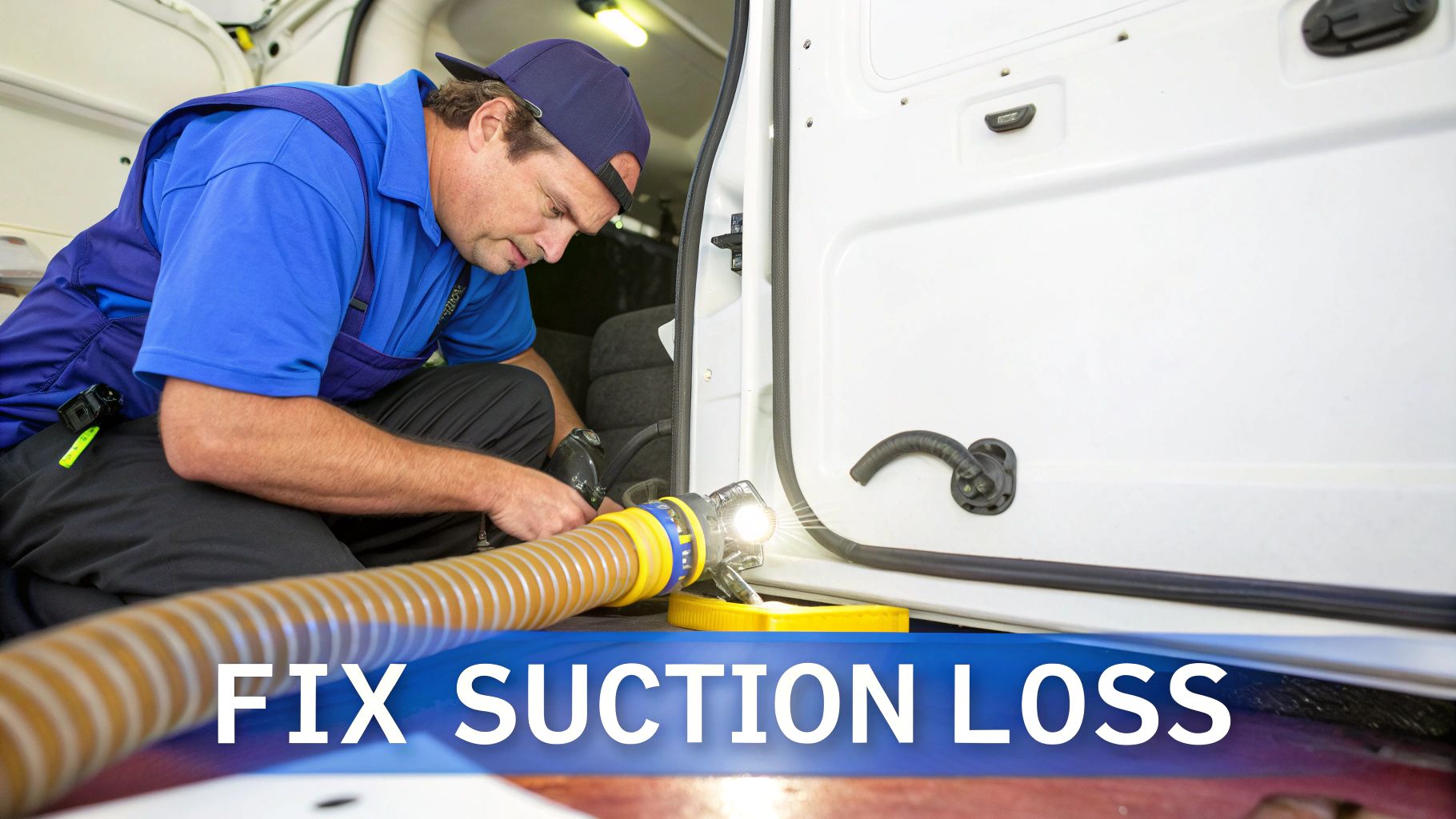
When your suction suddenly tanks, the culprit is almost always a leak or a blockage. Start your troubleshooting at the connection points, working your way from the vacuum unit all the way to the tool at the business end of the hose. A loose cuff, an adapter that isn't seated quite right, or a failing clamp can create an air gap that just bleeds away your performance.
After checking the connections, inspect the hose itself. Kinks are a huge offender, especially with cheaper, non-reinforced hoses. A sharp bend can choke off airflow just as effectively as a full-on clog. A good practice is to run your hand along the entire length to feel for collapses or soft spots, which are sure signs of structural failure.
Diagnosing and Solving Frequent Hose Issues
If all your connections are tight and the hose isn't kinked, it's time to hunt for a clog. You might have a partial obstruction from debris like large rocks, chunks of root, or thick clay that’s reducing suction without stopping the airflow completely. The easiest way to check is to disconnect the hose and look through it toward a light source to spot any blockages.
When you do find a clog, resist the temptation to just jam a sharp object down the hose to break it up. That's the fastest way to puncture the hose wall, turning a temporary problem into a permanent one. A much safer bet is to use reverse airflow from another vacuum or a careful burst of compressed air to dislodge the material.
A common mistake is overlooking small tears or punctures in the hose. Even a tiny hole can cause a significant drop in vacuum pressure, making precision tools like The Hydrovac Attachment Tool far less effective for digging purposes.
The best way to deal with these problems is to prevent them from happening in the first place. Make preventative maintenance a habit. Before each job, give your hoses a quick once-over, looking for wear and tear, and make sure every single clamp is tight and secure. This simple five-minute check can save you hours of headaches out in the field.
Common Hydrovac Hose Problems and Solutions
When you're out on a job, you don't have time to guess what's wrong. This quick-reference guide is designed to help you diagnose and fix the most common hose issues you'll run into. Keeping your shop vac hoses and fittings in top shape is absolutely essential for staying efficient.
| Problem Symptom | Likely Cause | Solution |
|---|---|---|
| Sudden Suction Loss | A leak at a fitting or a kink in the hose. | Systematically check and tighten all connections. Straighten the hose and inspect for damage. |
| Hose Collapse | Using a non-reinforced hose with a powerful vacuum. | Replace the hose with a heavy-duty, crush-proof, or wire-reinforced model designed for industrial use. |
| Stubborn Clogs | Sucking up material larger than the hose diameter can handle. | Disconnect the hose and use reverse airflow or gentle pressure to clear the blockage. Avoid sharp tools. |
| Leaky Fittings | Worn-out gaskets, loose clamps, or mismatched components. | Inspect gaskets and replace if cracked. Tighten clamps securely or upgrade to higher-quality fittings. |
Think of this table as your first line of defense. By quickly identifying the symptom, you can jump straight to the most likely cause and get back to work without wasting precious time.
Tying It All Together: From Good to Great
Hopefully, you've seen that your shop vac hoses and fittings are far more than just accessories—they're the very backbone of your hydrovac system. We’ve walked through everything from matching the right hose size to the job at hand to understanding why the right material can make or break your performance. It all comes down to one thing: a secure, airtight connection is what delivers consistent, powerful suction when you need it most.
A little bit of planning and maintenance goes a long way. Taking a few minutes to check your connections is always better than dealing with a blowout and frustrating downtime in the middle of a job. The real lesson here is that a small investment in quality connections pays huge dividends in efficiency and, ultimately, your bottom line.
A specialized tool is only as good as the system that supports it. A dialed-in vacuum setup is what turns potential power into real-world results on the job site.
When you bring a game-changer like The Hydrovac Attachment Tool into the mix and connect it to a properly configured system, you're not just digging—you're working smarter and safer. For anyone in the hydrovac world, this setup gives you the confidence to take on delicate, precision digging with total control. If you're looking to expand that system's flexibility, our guide on choosing the perfect shop vac hose coupler is a great next step.
Now’s the perfect time to take a hard look at your own equipment. Think about where a few simple upgrades could take your operation from basic cleanup to a precision excavation powerhouse.
Common Questions from the Field
When you're out on a job, you don't have time to second-guess your equipment. Here are some quick, no-nonsense answers to the questions we hear most often about getting your shop vac set up right for hydrovac work.
What's the Best Hose Diameter for Hydrovac Cleanup?
For most hydrovac cleanup and digging, you'll want a 2.5-inch diameter hose. This is the sweet spot. It strikes the perfect balance between high airflow for lifting power and enough room to suck up mud, gravel, and slurry without constantly getting jammed.
Go any smaller, and you'll fight clogs all day. Go any bigger, and you're in industrial hose territory that your shop vac just can't support effectively. Stick with 2.5 inches for the best results.
How Can I Stop My Hose from Collapsing?
A collapsed hose is a job-stopper. It happens when the powerful suction of your vac is too much for a standard, flimsy hose to handle. The negative pressure simply flattens it.
The fix is simple: upgrade to a crush-proof or wire-reinforced hose. These are built for the abuse of industrial work. Their internal structure is tough enough to hold its shape under extreme suction, so you get reliable, uninterrupted airflow every time.
A collapsed hose isn’t just a drop in suction—it’s a full stop. Spending a little extra on a reinforced hose is the single best move you can make to prevent this headache and keep your project moving.
Can I Mix and Match Hoses from Different Brands?
Absolutely, but you can't just jam them together. You'll almost certainly need a universal adapter or a specific coupler to bridge the gap between brands.
To get the right fit, measure the outer diameter of one hose and the inner diameter of the other. Once they're connected, always lock it down with a quality hose clamp. This ensures the connection is airtight, so you don't lose an ounce of that precious suction power.
What Fitting Do I Need for the Hydrovac Attachment?
Good news here. We designed the Hydrovac Attachment to be as straightforward as possible. It connects directly to a standard 2.5-inch shop vac hose cuff.
No special adapters needed. Just slide the tool into a quality 2.5-inch hose, make sure it’s snug, and you're ready to dig. This direct connection is key to getting maximum power and control for precision hydrovac tasks, making it the superior solution for effective digging.
Ready to turn your shop vac into a serious digging tool? The Hydrovac Attachment gives you the power and precision you've been missing. Visit our website to learn more and see it in action!