


For professionals in yard care and residential digging, an industrial vacuum hose is the lifeline of your operation. It’s not just an accessory; it's the critical link between your wet vac’s power and the job at hand. The right hose directly impacts your speed, safety, and efficiency when digging fence post holes, exposing buried pipes, or handling any precision excavation task.
The Overlooked Key to Efficient Residential Digging
If you're a landscaping contractor, fence installer, or utility locator, you know the daily grind of digging. It’s tedious, back-breaking, and fraught with risk. One wrong move with a shovel can slice through an irrigation line or crack a client's sidewalk, leading to expensive repairs and unhappy customers.
Manual digging is slow, especially for precise jobs like setting fence posts right next to a patio or carefully uncovering buried pipes without causing damage. This is where non-destructive vacuum excavation, scaled down for residential projects, becomes the smarter, safer approach.
But here’s the crucial point: your portable vacuum system is only as strong as its weakest link, and that's often the hose. A cheap, flimsy hose will collapse under pressure, kink at the worst moment, and clog constantly, turning a simple job into a major headache.
Beyond the Basics: Hoses for Wet Vac Digging
It's a common mistake to view a hose as just a simple tube. Its material, diameter, and construction have a massive impact on your performance. The right hose works in tandem with your equipment, delivering maximum suction and keeping you on the job, not on the sidelines fixing a problem.
This becomes crystal clear when you pair a quality hose with specialized tools.
A perfect example is how the right hose enables a tool like the Hydrovac Attachment Tool. This device transforms a standard wet vac into a high-precision digging machine, but it’s entirely dependent on a solid hose to function correctly. This tool is not for large hydrovac trucks; it's a mobile solution designed to work with your wet vac for clearing small amounts of debris. Without a quality industrial hose built to handle a slurry of wet soil, small rocks, and debris, even the best attachment is useless.
In the world of hydro excavation, industrial vacuum hoses are the unsung heroes, allowing crews to safely expose underground utilities without the danger of mechanical digging. The global market for these critical components reflects their importance; valued at USD 11.81 billion, it's expected to climb to USD 13.92 billion by 2030. You can get more insights on the industrial hose market growth.
This guide will break down what makes a great hose for residential digging. We'll get into the details of materials, diameters, and features so you can choose the right one to elevate your performance on every job.
Choosing the Right Hose Material and Build
Picking the right industrial vacuum hose is a lot like choosing the right tires for your truck. You wouldn't put highway tires on a rig you're taking through deep mud, and you wouldn't waste money on heavy-duty off-road tires for a truck that only sees pavement. It’s the same with hoses—the material and build have to match the job you’re doing.
It’s easy to just look at the price tag, but that’s a rookie mistake. You’ve got to think about how each type of hose will hold up under real-world conditions. Will it be flexible enough to snake through a customer's prized rose bushes? Or is it tough enough to suck up jagged rocks and clay when you're digging out a footing? Getting this right saves you from killer clogs, makes you more efficient, and ultimately, protects the investment you've made in your equipment.
Thinking this through upfront keeps you from making costly mistakes and dealing with annoying delays on site. This flowchart really boils down the first big decision: when to dig by hand versus when to bring in the vacuum.
As you can see, vacuum excavation is the safer, more professional way to go for most digging jobs around a home. And that makes your hose choice even more important.
The Big Three Hose Materials
When it comes to wet vac work for landscaping and residential digging, you’ll mostly run into three types of hose materials. Each one has its own unique mix of flexibility, toughness, and price.
-
PVC (Polyvinyl Chloride): Think of PVC as the lightweight, nimble option. It's fantastic for jobs where you need to be agile, like cleaning out debris from around delicate sprinkler heads or getting into tight spots. It's easy on the wallet, but it's not the toughest guy in the group—it won't hold up as well against sharp rocks or gravel.
-
Rubber: This is your all-around workhorse. Rubber hoses have great flexibility and can take a decent beating. They handle a wider range of temperatures and materials than PVC, but the trade-off is weight. Lugging a heavy rubber hose around a big yard all day can be a real drag.
-
Polyurethane: If you need maximum durability, this is your hose. Polyurethane is the champion of abrasion and tear resistance, making it the perfect choice for tough jobs like digging fence post holes in rocky soil or clearing construction debris. It’s surprisingly lighter than rubber, but you'll definitely pay a premium for that performance.
The inside of the hose is just as critical as the outside. Always look for a hose with a smooth interior bore. Debris like wet soil, clumpy mulch, and small stones will snag on any ridges or corrugations, causing an instant clog that brings your entire job to a screeching halt.
Comparing Industrial Vacuum Hose Materials
To make the choice a little clearer, here’s a quick guide comparing how these materials stack up for the kinds of jobs you'd tackle around a home.
| Hose Material | Ideal Use Case | Flexibility | Abrasion Resistance | Typical Cost |
|---|---|---|---|---|
| PVC | General debris, leaf cleanup, soft soil | High | Low | $ |
| Rubber | Mixed soils, moderate gravel, all-weather use | High | Medium | $$ |
| Polyurethane | Rocky soil, abrasive debris, heavy-duty jobs | Medium | High | $$$ |
Ultimately, the best material depends on the kind of work you do most often. If you're mainly doing light cleanup, PVC is a great, cost-effective choice. But if you’re regularly digging in tough conditions, investing in polyurethane will pay for itself in the long run.
Why Hose Construction Matters
Beyond the material itself, the way an industrial vacuum hose is built is what really determines how it performs. Two things you absolutely need to check are the bore and the helix.
A smooth interior—the bore—is all about flow. Think of it like a waterslide. Any bumps or ridges will just slow everything down and cause a pile-up. For a tool like the Hydrovac Attachment Tool, which is constantly pulling a slurry of mud and water, a smooth bore isn't just a nice-to-have; it's essential for keeping suction power at its peak.
The helix is the rigid spiral on the outside of the hose; it’s basically the hose’s skeleton. This is what keeps the hose from collapsing on itself from the intense vacuum pressure your machine creates. A hose that flattens out is completely useless. A strong helix means your airflow stays strong and steady. When you're shopping for a hose, make sure its construction is tough enough to handle your vac's power. You can dive deeper into the benefits of flexible vacuum hoses and their construction in our other guide. A well-built hose doesn't just work better—it lasts a whole lot longer, saving you from having to buy a new one every season.
How Hose Diameter Impacts Suction Power
When you're setting up a vacuum system for digging, the hose diameter is a critical balancing act. It's not just a number on a spec sheet—it's the single biggest factor determining your airflow, lifting power, and how often you'll have to stop and clear a frustrating clog. Get it wrong, and you'll either choke your vacuum's potential or create a bottleneck that grinds the whole job to a halt.
Think of it like trying to drink a thick milkshake. A skinny coffee stirrer is going to make you work like crazy to get anything through, and the first chunk of ice cream will plug it instantly. On the flip side, a massive four-inch pipe would make it easy to sip the liquid, but you wouldn't get enough velocity to lift the heavy stuff off the bottom. Industrial vacuum hoses are exactly the same.
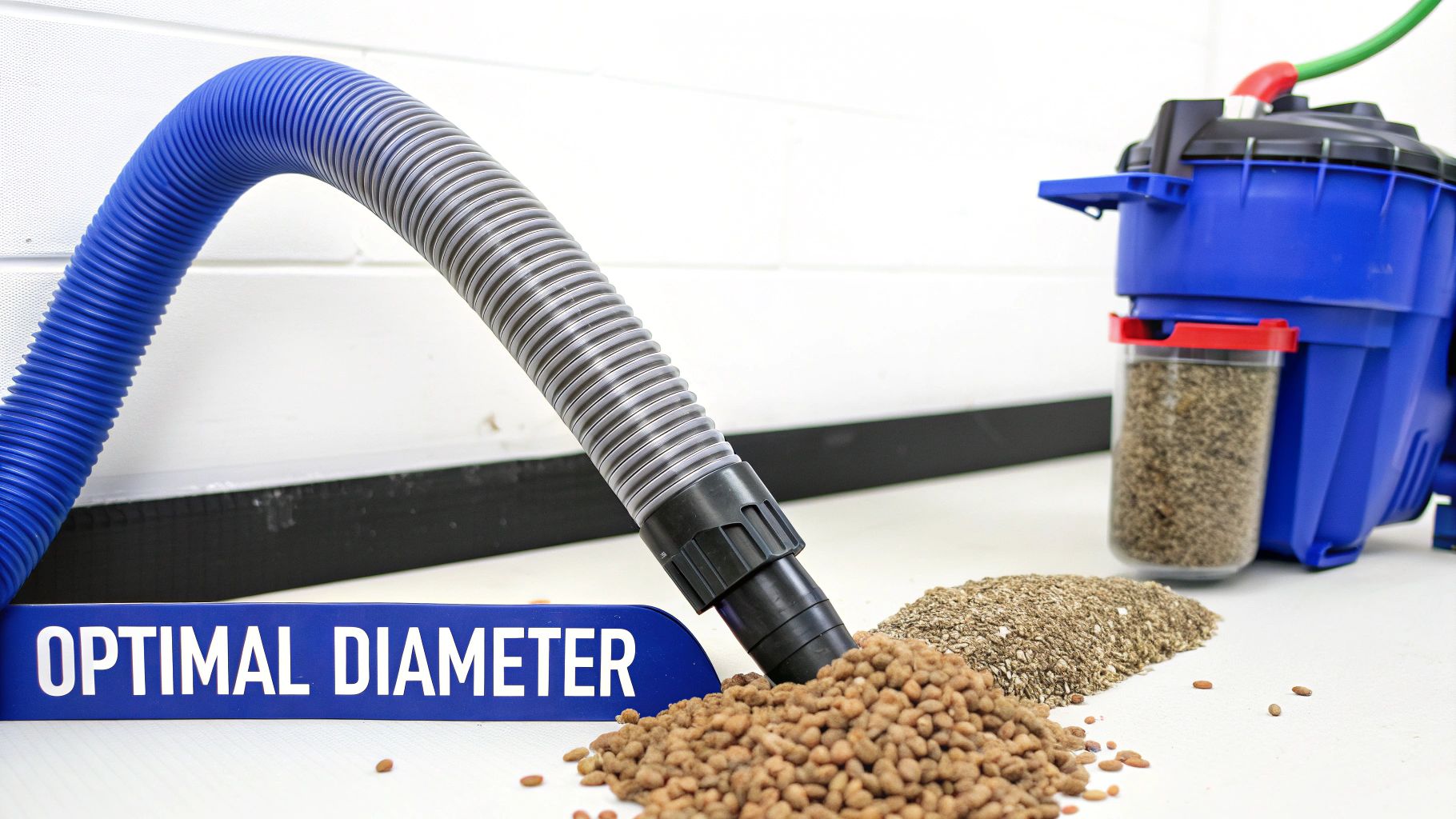
A narrower hose ramps up the air speed, giving you incredible lifting force for heavy, dense materials like wet clay. But that speed comes at a cost: it’s far more likely to get jammed by chunky debris like rocks. A wider hose boosts your overall airflow (measured in Cubic Feet per Minute or CFM), letting you move a huge volume of lighter material fast, but it might lack the focused punch needed to pull up dense, saturated soil from the bottom of a post hole.
The Sweet Spot for Portable Digging
For the kind of work most of us are doing in landscaping or on residential job sites—digging fence post holes, carefully exposing buried pipes—a 2.5-inch diameter hose is the undisputed sweet spot. It’s the standard for a reason, matching up perfectly with powerful wet/dry vacuums and tools like the Hydrovac Attachment Tool.
So, what makes this size the go-to choice?
- Serious Lifting Power: It keeps the air velocity high enough to generate powerful suction, easily pulling heavy, wet soil and gravel out of the hole.
- Clog Resistance: At the same time, it’s wide enough to swallow the small rocks, roots, and clumps of mud that would instantly choke out a smaller hose.
This magic combination lets you work smoothly without the constant stop-and-start of clearing blockages. When you’re trying to delicately dig around an irrigation pipe, the last thing you want is a sudden clog that kills your suction and your control.
Matching Your Hose to Your Vacuum
Here's a crucial point: just grabbing any 2.5-inch hose won't cut it. Your high-horsepower wet vac creates a massive amount of negative pressure. If your hose isn't built for it—with a strong, crush-resistant wall and a rigid internal helix—that suction will literally cause the hose to collapse on itself. It's like pinching a straw; your airflow drops to zero instantly.
This is why you have to invest in a true industrial vacuum hose. These are engineered to withstand the intense forces of commercial-grade vacuums, ensuring your hose, attachment, and vac all work together as a cohesive system. A flimsy shop hose will not only fail but could also put a serious strain on your vacuum's motor.
Portable industrial vacuum systems are a game-changer for hydro excavation, allowing operators to perform precise, surgical digging in tight spaces like backyards or crowded urban job sites. This isn't a niche market, either. The portable segment is booming, with a projected compound annual growth rate of 10.4%—blowing past the growth of stationary units. For a deeper dive into this trend, you can explore the full industrial vacuum market report.
This move toward powerful, mobile vacuums makes smart hose selection more important than ever.
Your goal is to build a seamless, efficient system from the vacuum motor all the way to the tip of your digging tool. By pairing your machine with a tough, 2.5-inch industrial hose that can handle the power, you set yourself up for maximum efficiency on any digging task. It’s this attention to detail that prevents equipment failure and makes your work faster, cleaner, and a whole lot less frustrating. To get a better handle on the physics at play, discover more about how vacuum suction power works in our detailed guide.
Transform Your Wet Vac with the Hydrovac Attachment
A tough, reliable industrial vacuum hose is the backbone of any serious hydro excavation setup, but it’s only one part of the puzzle for precision jobs. To really get surgical with your wet vac, you need to focus its suction power. That’s exactly what the Hydrovac Attachment Tool does—it turns your vacuum’s raw power into a pinpoint digging tool perfect for residential and yard care work.
Think about it: a standard wet vac hose is built for general cleanup. It sucks up debris from a wide area, which is great for a flooded basement but terrible for digging a clean hole. This is why trying to excavate a sprinkler head or expose a buried pipe often turns into a muddy disaster, splashing slurry all over your client's lawn.
The Hydrovac Attachment Tool completely changes the game with its patented three-part design. It brilliantly integrates a pressure washer wand right into the vacuum stream, creating a super-focused column of air and water. It’s a simple concept, but it’s what separates a messy amateur job from a clean, professional one.
Turning Chaos into Controlled Excavation
The real genius here is how the attachment wrangles two powerful forces: the water that breaks up the soil and the suction that removes it. Instead of fighting each other and making a mess, they’re forced to work together in a single, clean action.
Picture trying to dig a small hole with just a water hose—you'd have mud flying everywhere. Now, imagine it with the Hydrovac Attachment Tool.
- Water Injection: The pressure washer jet blasts through and liquefies compacted soil, clay, or even gravel.
- Contained Suction: The attachment's body acts like a shroud around that water jet, meaning the vacuum instantly sucks up the slurry before it has a chance to escape.
- Clear Visibility: By removing the muddy water immediately, the tool keeps your line of sight open. This is absolutely critical when you’re trying to find a sensitive utility line or work right up against a foundation.
This system takes the guesswork—and the cleanup—out of the equation. For any contractor, the goal is to work faster, cleaner, and safer. This tool helps you do all three.
Seamless Integration for Maximum Power
One of the best things about the Hydrovac Attachment Tool is its straightforward, universal design. It was built to connect directly to any standard 2.5-inch industrial vacuum hose, which is the go-to size for most powerful wet/dry vacs in North America. No need to hunt down special adapters or rig a custom setup.
The connection itself is solid and secure, which prevents the air leaks that kill your vacuum’s performance. A loose fit at the end of your hose is a classic weak point, causing a massive drop in suction right where you need it most. By creating a tight seal, the attachment makes sure every bit of your vacuum's horsepower goes directly into digging.
The connection point between a hose and an attachment—often called the cuff—is a make-or-break component. A bad fit leads to air leaks, surprise disconnections, and premature wear, tanking the whole system’s efficiency. This is why you'll often see custom-molded cuffs on OEM equipment, designed for a perfect, leak-free seal.
This focus on a secure fit means your wet vac and hose operate like a single, cohesive unit. This principle of combining suction with high-pressure water is used across many industries. You can see a similar approach in professional hydro jetting services used for clearing tough blockages.
Redefining Residential Digging Tasks
The advantages of this system really shine on common residential jobs. Tasks that used to be slow, messy, or risky suddenly become simple and clean.
Think about these everyday challenges:
- Digging Fence Post Holes Next to a Driveway: Using a shovel risks cracking the concrete. The Hydrovac Attachment Tool lets you dig a perfect hole right up against the edge with zero impact damage.
- Exposing a Buried Irrigation Pipe for Repair: One wrong move with a spade can turn a small leak into a huge replacement project. The non-destructive water-and-vacuum method safely uncovers the pipe without any danger of nicking it.
- Clearing Debris from a Window Well: Shoveling out soggy, compacted leaves and mud from that tight space is slow and awkward. With the attachment, you can stand outside the well and surgically suck out all the gunk in minutes.
In every case, pairing a durable industrial vacuum hose with the Hydrovac Attachment Tool delivers a level of precision that old-school tools just can't touch. If you're looking to upgrade your digging game, knowing how to match the right tool to the right hose is the first step. To see how this specific tool can elevate your setup, check out our detailed guide on the vacuum hose attachment and its applications.
Precision Digging in the Real World: From Theory to the Job Site
It’s one thing to talk about specs and materials, but what really matters is how this gear performs when the pressure is on. Let's step away from the theory and onto the job site to see how a tough industrial vacuum hose and the Hydrovac Attachment Tool solve real-world digging problems in landscaping and residential work. We aren't talking about giant hydrovac trucks here—just common, everyday jobs that become faster, safer, and a whole lot cleaner with a mobile setup.
The magic happens when you combine a durable hose with a tool that concentrates its power. All it takes is a standard 16-gallon wet vac, a quality 2.5-inch polyurethane hose, and the Hydrovac Attachment Tool. Suddenly, your trusty shop vac turns into a surgical digging tool.
Setting Fence Posts Right Next to a Patio
Every fencing contractor knows the feeling—that moment you have to dig a post hole right beside a customer's brand-new concrete patio. One wrong move with a shovel or post-hole digger, and you’ve cracked a slab or chipped a paver. It's a high-stakes job where a single mistake can eat up your entire profit.
This is exactly where vacuum excavation becomes your best friend. With the Hydrovac Attachment Tool, you can carve out a perfectly straight, clean hole mere inches from the concrete without any fear of impact. The water jet liquefies the soil, and the vacuum whisks the slurry away through the wet vac hose instantly.
The result?
- No Damage: The client's hardscaping stays in perfect condition.
- A Clean Site: Forget about shoveling dirt piles off the patio later.
- Serious Speed: It's worlds faster than trying to dig by hand in such a tight, unforgiving spot.
This kind of clean, efficient work really wows clients. It shows a level of care and professionalism that makes you stand out from the competition still using brute force.
Uncovering a Buried Irrigation Line Without Damage
For landscapers, digging anywhere near a known irrigation line is a tense situation. One bad shovel strike can puncture a pipe, turning a small job into a messy, time-consuming repair. Using a non-destructive digging method is the only way to work with complete confidence.
When you think about jobs where industrial vacuum hoses truly prove their worth, like exposing delicate infrastructure, it brings to mind the importance of effective maintenance of pipelines and the need for absolute precision. The Hydrovac Attachment Tool lets you gently wash away soil, layer by layer. The immediate suction pulls the muddy water away, giving you a clear view of the pipe as it comes into view.
This technique, known as "daylighting" or "potholing" in the big leagues, is the gold standard for safely finding underground utilities. Bringing that same level of precision to a residential job protects your client’s property and your reputation.
The gentle force of water and vacuum means you can clear the entire area around the pipe without ever physically touching it with a hard tool. This is the definition of digging without damage.
Clearing Out a Clogged Drainage Culvert
Those corrugated drainage pipes running under driveways and paths are magnets for compacted silt, leaves, and other gunk. After a few years, they can get completely blocked. Trying to clear them with traditional tools is often a losing battle; a plumbing snake might break up the clog, but it does nothing to remove the actual material.
This is a job tailor-made for a powerful, focused suction system. You can feed the Hydrovac Attachment Tool right into the culvert opening. The water jet blasts apart years of compacted muck, and the vacuum sucks the thick sludge out into your wet vac. You can methodically work your way down the pipe, restoring full drainage without having to dig a single trench.
In all of these scenarios, the gear is straightforward, but the results are anything but. By pairing the right industrial vacuum hose with a smart tool like the Hydrovac Attachment Tool, you elevate a basic wet vac into a specialized problem-solver for those tricky residential jobs.
Care and Maintenance to Protect Your Investment
Your industrial vacuum hose is a workhorse, but even the toughest gear needs some attention to earn its keep. A few minutes of simple, consistent maintenance can be the difference between a hose that lasts for years and one that fails mid-job. Think of it less as a chore and more as protecting your investment in efficient digging.
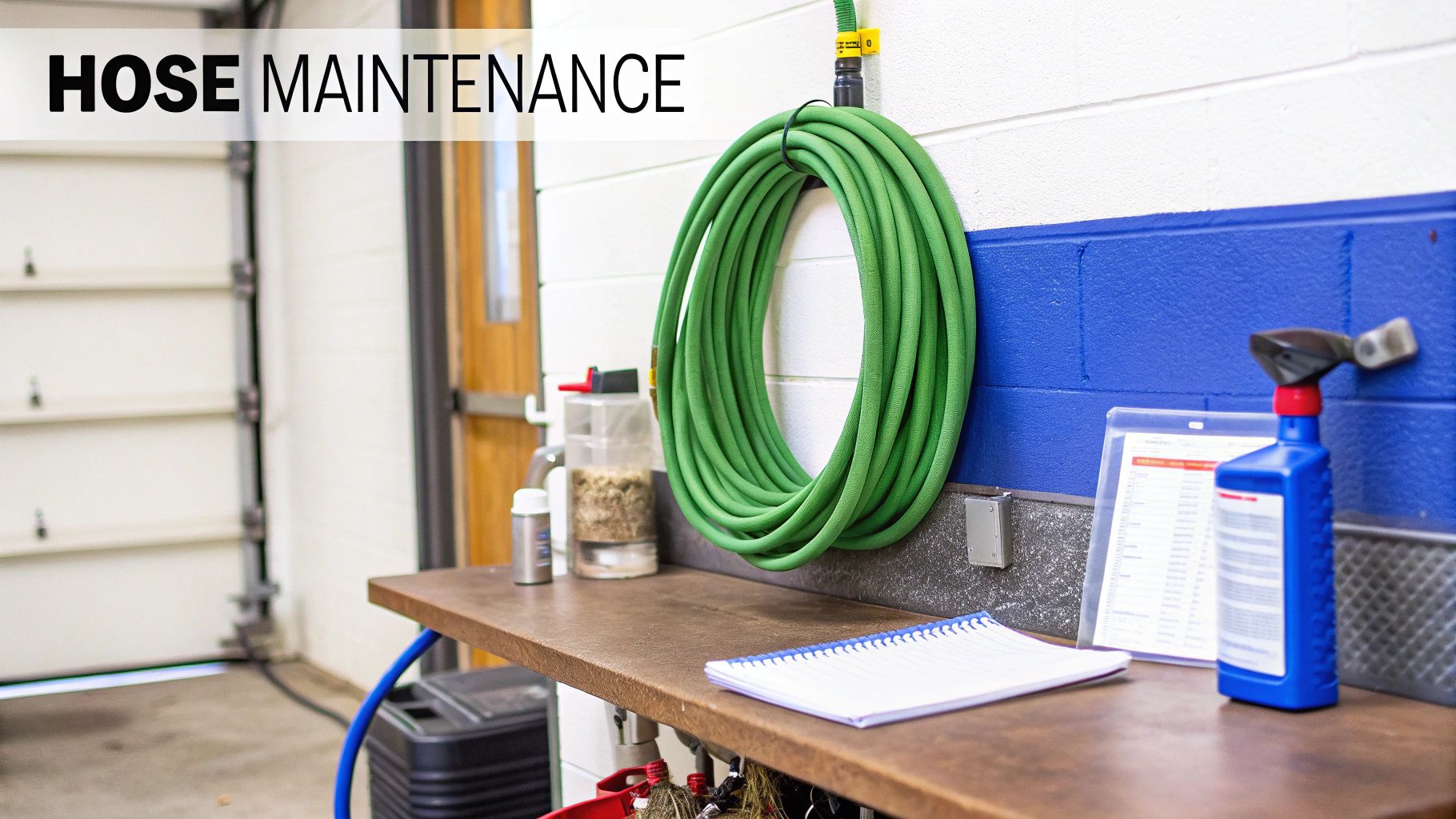
Neglecting your hose is just asking for trouble. The constant flow of soil, gravel, and debris is like hitting the interior with sandpaper on every job. Meanwhile, the sun's UV rays are silently working to make the exterior brittle and weak. A little proactive care goes a long way in keeping you up and running.
A Simple Maintenance Checklist
Before you head out, a quick visual once-over can save you a massive headache later. Look for obvious cracks, punctures, or spots where the outer helix is getting thin. These are the weak points just waiting to fail under pressure.
Once the job’s done, especially a mucky one, take a few minutes to flush your equipment.
- Rinse Immediately: Before anything has a chance to dry and harden, suck a few gallons of clean water through the wet vac hose and into the tank. It’s the easiest way to clear out grit and sticky clay.
- Inspect the Interior: Give the cuffs and connection points a quick look. It's common for rocks or debris to get wedged in there, creating the perfect setup for a clog on the next job.
- Dry Thoroughly: If you can, let the hose air out completely before coiling it up. A dry hose prevents mold and mildew from growing on the inside.
Proper storage is just as important as cleaning. Coil your hose loosely and keep it out of direct sunlight. This prevents kinking and stops UV degradation, which is one of the biggest reasons hoses fail prematurely.
Troubleshooting Common Hose Frustrations
Even with the best care, things can go wrong. If you see your hose collapsing on itself, that's a dead giveaway it’s either too weak for your vacuum's suction or it’s simply worn out.
For a stubborn clog, never use a sharp object to try and clear it. You're far more likely to puncture the hose wall than fix the problem. A better approach is to disconnect the hose and use a blunt, flexible rod or a blast of compressed air to push the blockage out. Following these simple steps will keep your industrial vacuum hoses in prime condition for every project.
Frequently Asked Questions
Got questions about picking the right hose for residential hydro-digging? You're not alone. Let's clear up a few common points so you can get the right gear for the job.
Can I Just Use Any 2.5-Inch Hose with the Hydrovac Attachment Tool?
Not all hoses are created equal, even if they fit. While the Hydrovac Attachment Tool is built for standard 2.5-inch ports, you'll get the best results—and avoid a lot of headaches—by sticking with a genuine industrial vacuum hose.
A cheap shop vac hose will collapse under the intense suction of a powerful wet vac. You need something with a tough, crush-resistant wall. Look for a hose with a smooth interior lining; this is key to preventing rocks and debris from getting snagged and causing a clog. Materials like polyurethane or heavy-duty rubber are your best bet for handling abrasive dirt and gravel day in and day out.
Will a Longer Hose Weaken My Vacuum's Suction?
Yes, absolutely. Every foot of hose adds friction, which robs your vacuum of suction power right where you need it—at the nozzle. Think of it like trying to drink a milkshake through a really long straw.
For most residential jobs with a portable wet vac, try to keep the hose length to 25 feet or less. This will give you the best balance of reach and raw lifting power. If you find yourself needing to go longer, you'll likely need to upgrade to a more powerful vacuum to make up for the performance loss.
Is This System Strong Enough to Dig Fence Post Holes?
You bet it is. When you pair a solid wet vac (look for 5 HP or more) with a proper industrial hose and the Hydrovac Attachment Tool, you’ve got a surprisingly powerful setup. It's perfect for digging fence post holes, especially when you're working in tight spots or right up against a patio, foundation, or underground sprinkler line.
The system works because the water jet does the heavy lifting by breaking up compacted soil, and the powerful suction instantly pulls the slurry away. It’s a fast, clean, and incredibly precise way to dig without damaging property.
The real magic is in how the components work together. The vacuum provides the muscle, the water loosens the soil, and the Hydrovac Attachment Tool focuses all that energy into a surgical digging instrument. You get precision control without the mess and risk of a shovel.
Ready to turn your standard wet vac into a high-precision digging machine? The Hydrovac Attachment Tool gives you the control and power you need for any residential excavation project. Get your Hydrovac Attachment Tool today.