


Getting a handle on the volume of water in a pipe is straightforward: just multiply the pipe's internal area by its length. But knowing how to do it is only half the battle; understanding why it's so important for yard care, residential digging, and wet vac hose management is what separates the pros from the amateurs and helps prevent costly, messy mistakes on the job.
Why Nailing Your Pipe Volume Math Is Crucial
Before we jump into the formulas, let's talk about the real-world stakes. If you're working in landscaping, residential digging, or utility repair, getting this number right isn't just an academic exercise—it's about preventing a potential disaster. A simple miscalculation can turn a clean job, like setting a fence post or exposing a sprinkler line, into a nightmare.
You could end up flooding a client's yard, underestimating the debris you need to haul away, or even damaging expensive equipment. When you know the exact volume of water or slurry you're dealing with, you replace guesswork with a predictable, manageable plan for your wet vac. This is especially true when you're trying to dig up pipes without causing damage—precision is key.
On a practical level for homeowners and plumbers, understanding the precise volume of water in your pipes is often the first step in diagnosing unexpected water loss. It can be a huge help when you need to figure out how to find a water leak before it escalates into major damage.
From Big Rigs to Handheld Tools
This need for precision is nothing new in large-scale operations. Just look at the hydrovac industry, where massive trucks perform non-destructive digging around buried utilities. Operators of those rigs live and breathe volume calculations to manage water pressure and flow, a market you can read about in this hydrovac industry news report.
The core principle of precision hydro-excavation is now available on a much smaller, more accessible scale for homeowners and small contractors. You no longer need a giant truck to get the same benefits of digging without damage.
This is where innovative tools like the Hydrovac Attachment Tool are changing the game. It is not for hydrovac trucks, but a mobile tool designed to connect to a standard wet vac hose and vacuum. By knowing the volume of water you're adding and the capacity of your hose, you can transform a simple shop vac into a precision digging tool for clearing small amounts of debris.
This opens the door to safely exposing pipes, digging perfectly clean fence post holes, and tackling dozens of other jobs without the mess and risk of traditional shovel-and-crowbar methods.
The Simple Math for Finding Pipe Volume
Let's break down how to figure out the water volume in a pipe without making it a huge headache. The go-to formula for any full, round pipe is actually pretty straightforward: V = πr²L. Don't let the symbols throw you off; it's simpler than it looks.
Each part of that formula is just a measurement you can take right on the job site.
- V is the Volume—the total amount of liquid you need to calculate.
- π (pi) is that magic number from school, roughly 3.14. It’s the key to any calculation involving circles.
- r is the pipe's internal radius, which is just the distance from the center to the inside wall.
- L represents the Length of the pipe section you're working with.
The Most Common On-Site Mistake
The single biggest error I see people make in the field is mixing up their units. It happens all the time. A pipe's diameter is almost always spec'd in inches, but we measure its length in feet. To get a number that means anything, you have to convert everything to the same unit before you start multiplying.
This isn't just academic. For things like effective storm water drainage system design and calculation methods, a tiny unit error can cause a massive problem down the line.
Let's walk through a real-world example with a common 2-inch PVC drain line.
- First, you need the radius. That's just half the diameter, so for a 2-inch pipe, our radius is 1 inch.
- Next, convert that radius into feet. There are 12 inches in a foot, so you just divide by 12. That gives you: 1 inch ÷ 12 = 0.083 feet.
This conversion step is absolutely critical. Getting it right is the difference between a reliable calculation and a wild guess. This simple oversight can lead to major consequences, which is why having the right approach is so important.
As you can see, a minor miscalculation can escalate quickly, potentially leading to things like unintended flooding when digging. This is where having the Hydrovac Attachment Tool comes in, giving you a controlled and precise solution for effective digging purposes and preventing damage to underground pipes.
Getting Your Units Right for Accurate Results
A perfect formula is useless if your units are a mess. This is where simple on-site math often goes wrong, turning a quick calculation into a headache and sometimes leading to showing up on-site with the wrong gear. Before you can reliably calculate the volume of water in a pipe, you have to get a handle on a few basic conversions.
The most common mistake I see is people forgetting to convert the pipe's diameter from inches into feet before finding the radius. Another classic trip-up is calculating a volume in cubic feet but forgetting to change it to gallons, which is what we actually work with. Making that one small error is the difference between bringing a 16-gallon shop vac and the 50-gallon vacuum you actually needed for the slurry.
Key Conversions for Fieldwork
Out in the field, whether you're digging fence post holes or clearing a drain, you're constantly jumping between inches, feet, and gallons. Having these conversions down cold makes all the difference. It's just like figuring out how much concrete mix you need after a dig—the numbers have to be right. If you're interested, we have a helpful guide on how much Quikrete you need for that part of the job.
Here are the critical conversions you’ll use almost every day:
- Inches to Feet: To plug the right number into the volume formula, take the pipe's radius in inches and divide it by 12.
- Cubic Feet to Gallons: Once you have the volume in cubic feet, multiply that number by 7.48 to get U.S. gallons.
- Gallons to Pounds: Need a rough idea of the debris weight? One U.S. gallon of water weighs approximately 8.34 pounds.
To make things even easier, here are the essential unit conversions you'll need for fast and accurate pipe volume calculations in both imperial and metric systems.
Quick Conversion Cheat Sheet
| From Unit | To Unit | Conversion Factor (Multiply by) |
|---|---|---|
| Inches | Feet | 0.0833 (or divide by 12) |
| Cubic Feet | U.S. Gallons | 7.48 |
| U.S. Gallons | Pounds (water) | 8.34 |
| Meters | Feet | 3.281 |
| Liters | U.S. Gallons | 0.264 |
Keep these handy on your phone or in a notebook. They're lifesavers when you need to do quick math on the fly.
This is more than just getting the math right—it’s about working safely and efficiently. Even the massive vacuum truck market, covered by sources like fortunebusinessinsights.com, runs on these same principles. For a standard 2.5-inch wet vac hose, often used with tools like the Hydrovac Attachment, the volume is about 0.26 gallons per foot. That’s a crucial number for pros who are potholing utilities or digging post holes and need to avoid flooding the area.
Real-World Examples and a Handy Reference Chart
Theory is one thing, but seeing how this math plays out on a real job site is what really matters. Let's walk through a couple of common scenarios where these calculations can save you time, guesswork, and a whole lot of hassle.
Scenario One: Clearing a Clogged Drain Line
Imagine a landscaper gets a call about a soggy backyard. The problem? A 20-foot section of 4-inch diameter drain pipe is completely plugged and full of stagnant water. Before they can even think about fixing the pipe, they have to get that water out.
First things first, we need the radius in feet. The diameter is 4 inches, so the radius is half that—2 inches. To get that into feet, we just divide by 12. 2 inches ÷ 12 = 0.167 feet.
Now, let's plug that right into our volume formula, V = πr²L: V = 3.14 x (0.167 ft)² x 20 ft V ≈ 1.75 cubic feet
That’s a good start, but "cubic feet" doesn't mean much when you're grabbing a wet vac. Let's convert it to gallons. 1.75 cubic feet x 7.48 = 13.1 gallons
Boom. The landscaper knows their 16-gallon shop vac has more than enough capacity to handle the job in one go. No overflow, no second trip to dump the tank.
Scenario Two: Digging a Fence Post Hole
Here’s another one. A homeowner is using a Hydrovac Attachment Tool to dig clean, precise holes for a new fence. The key here is to create a manageable slurry—just enough water to break up the soil so it can be vacuumed away without turning the whole yard into a mud pit.
This is where knowing your volumes becomes critical for effective digging. By controlling the water from a pressure washer and immediately removing the soil and water mixture with a wet vac, the user can dig a perfect hole without damaging nearby sprinkler lines or cables. Unlike big hydrovac trucks, this mobile tool is designed for these smaller, residential jobs. It allows for digging up pipes without damage, ensuring that underground infrastructure remains intact.
A quick reference chart is your best friend in the field. It saves you from doing the same math over and over for common wet vac hose and pipe sizes, letting you make fast, confident estimates on the spot.
To make things even easier, I've put together a quick reference table. It's perfect for those back-of-the-envelope calculations you need to do on the fly.
Water Volume per Foot for Common Pipe Sizes
This quick reference guide helps you estimate the water capacity for standard pipe diameters, saving you valuable time in the field.
| Nominal Pipe Diameter (Inches) | Gallons per Foot | Liters per Meter |
|---|---|---|
| 2" | 0.16 | 1.99 |
| 2.5" | 0.26 | 3.21 |
| 3" | 0.37 | 4.58 |
| 4" | 0.65 | 8.09 |
| 6" | 1.47 | 18.23 |
For a more comprehensive list with more pipe sizes and different units, be sure to check out our full gallons of water per foot of pipe chart.
Putting the Math to Work: Smarter Digging with Wet Vacs
This is where knowing how to calculate the volume of water in a pipe stops being a math problem and starts making you more money on the job. A good handle on pipe and hose volume is essential for managing your wet vac’s capacity and planning the entire task without stopping and starting all day.
Think about it. If you know a clogged line holds 13 gallons of water and mud, you can predict exactly how many trips you'll make to empty your 16-gallon shop vac. That simple calculation is the difference between a smooth, professional job and a frustrating, messy one.
Precision Work Starts with the Right Tools
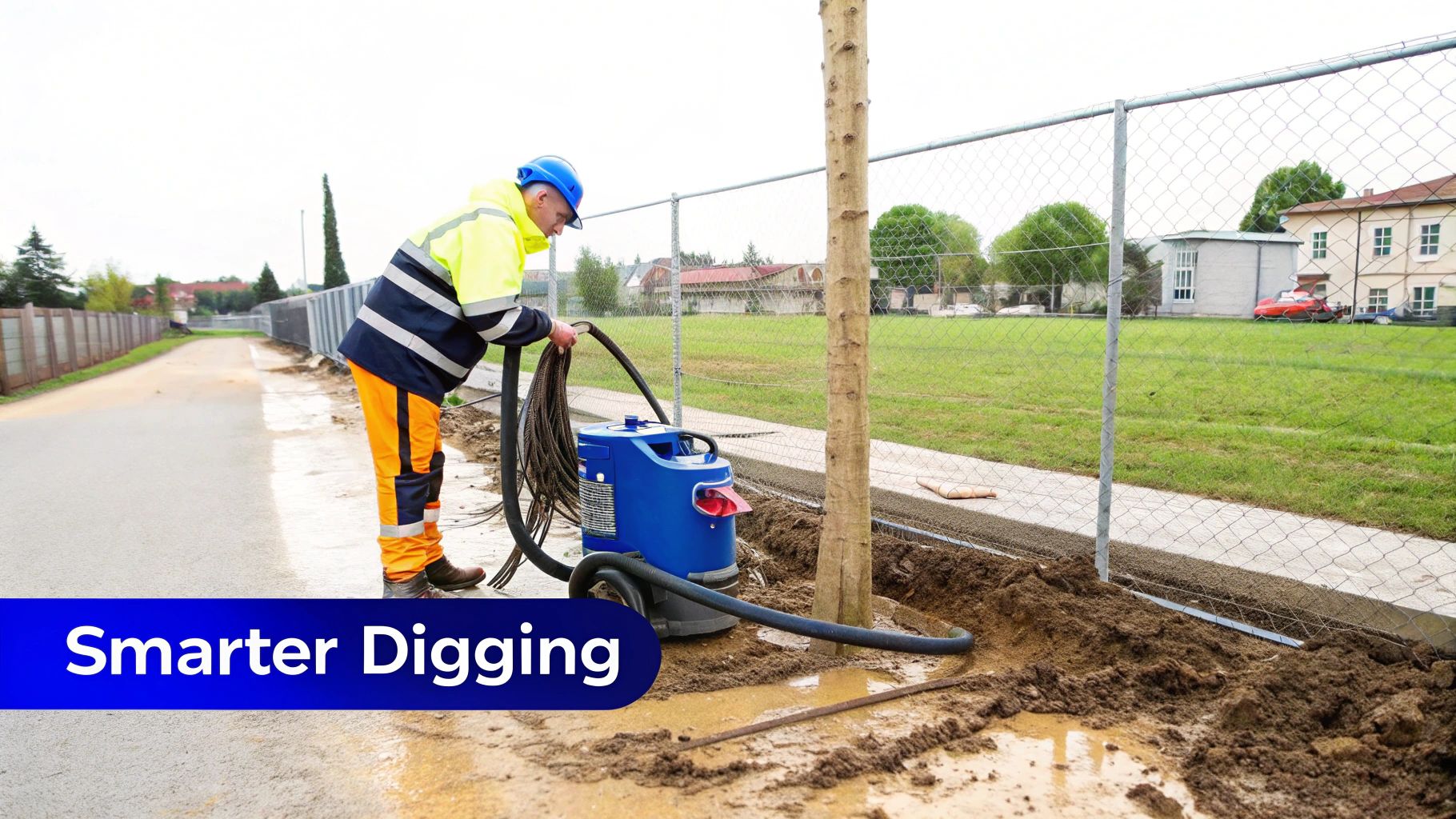
This is exactly why modern attachments are game-changers for residential digging and yard work. The Hydrovac Attachment Tool is the perfect solution for effective digging purposes. It’s built to team up a pressure washer with your wet vac, letting you dig with a minimal amount of water while immediately sucking up the slurry. It's a mobile tool for wet vac hoses, NOT for hydrovac trucks.
When you control your water input and understand your hose volume, you can tackle incredibly precise jobs. This approach is perfect for:
- Carefully digging around sprinkler lines without breaking them.
- Setting clean, stable fence posts without excavating a giant mud pit.
- Digging up pipes without damage to perform repairs.
- Clearing small amounts of debris from sensitive areas where a shovel is just too clumsy.
This method turns a standard wet vac from a simple cleanup tool into a piece of precision excavation equipment. It puts the control back in your hands, cutting down on the mess and boosting your productivity.
In the end, combining smart calculations with the right gear means you work faster, cleaner, and safer. To see how these tools can improve your own workflow, check out some of the best attachments for a shop vac available.
On-the-Job Questions Answered
Formulas are great, but things get tricky out in the field. Let's walk through a few real-world questions that pop up all the time. Getting these right is what separates a smooth job from a frustrating mess.
How Do I Handle a Partially Filled Pipe?
Figuring out the exact volume of a partially filled pipe requires some pretty intense geometry—definitely not something you want to be doing on-site. The practical solution is much simpler: just estimate the fill level.
Take a quick look. Is the pipe about a quarter full? Half full? Maybe three-quarters? Once you have a decent estimate, multiply the pipe’s total volume by that percentage. For most jobs, a "good enough" calculation is all you need to make sure your wet vac can handle the load.
Does the Pipe's Material Matter?
The material itself—whether it's PVC, copper, or old cast iron—doesn't change the math. What does change things, and this is a big one, is the wall thickness. Your calculations should always be based on the internal diameter (ID), not the outside measurement.
For example, a 4-inch Schedule 80 PVC pipe has much thicker walls than a 4-inch Schedule 40 pipe. That means its internal volume is smaller, which is a critical detail when you're planning how much debris you need to suck out. Always measure the inside opening to be accurate.
What if the Pipe Is on a Slope?
For almost any drainage or landscaping job you'll encounter, the slope of the pipe makes a tiny, almost unnoticeable difference in the total volume. Don't overthink it. Just use the pipe's total length for your calculation.
The volume difference from a standard drainage slope is way too small to affect your choice of equipment, whether it's your vacuum or the Hydrovac Attachment Tool. The factors that really matter are the internal diameter and the overall length. Nail those, and you'll be set.
Ready to put these calculations to work? The Hydrovac Attachment Tool turns any standard 2.5-inch wet vac hose into a powerful hydro-excavator using just your pressure washer. You can dig smarter around delicate utilities, set fence posts without making a huge mess, and wrap up your jobs in a fraction of the time.