


Think about trying to perform delicate surgery with a sledgehammer. It’s the wrong tool for the job. That’s exactly what it feels like for a hydrovac operator trying to dig around congested underground utilities with a massive 8-inch boom.
In these high-stakes environments, a single slip can mean a catastrophic utility strike, costly downtime, and a damaged reputation. This is where a seemingly simple piece of gear, the 2-inch vacuum hose, becomes an operator's most strategic tool for precision, safety, and profitability.
How a 2 Inch Vacuum Hose Unlocks Surgical Precision in Hydrovac Digging
When it comes to hydrovac excavation, the industry has long held that bigger is better. For wide-open bulk excavation, that holds true. But the moment you start working near fiber optic lines, gas mains, or water pipes, that massive hose becomes a high-risk liability.
The sheer, indiscriminate force of an 8-inch hose can easily grab and snap a line before the operator even realizes what's happening. It’s not about a lack of skill; it’s a fundamental mismatch of equipment. This is where downsizing your hose for precision work is a game-changer.
The Challenge of Precision Digging in the Hydrovac Industry
Working in tight quarters is all about control and visibility. Operators need a clear line of sight and the ability to dial in suction with pinpoint accuracy. A large-diameter hose simply can't deliver that level of finesse. It’s like trying to write your name with a paint roller instead of a fine-tipped pen—you get the job done, but it’s messy and lacks the precision required for sensitive jobs.
This lack of control leads to a cascade of real-world problems on the job site:
- Increased Risk of Utility Strikes: The wide mouth of a large hose can easily snag a utility line you're trying to expose, not damage.
- Poor Visibility: Too much suction from a wide opening creates a chaotic slurry, obscuring what’s right in front of you and making it impossible to see buried assets clearly.
- Operator Fatigue: Fighting a heavy, rigid 8-inch hose all day in a confined space is exhausting. It wears down the crew, slows down the job, and increases the chance of costly mistakes.
The core principle is simple: match the tool to the task. For surgical excavation, a 2 inch vacuum hose provides the focused power needed to remove soil and debris carefully, layer by layer, without disturbing adjacent utilities.
This is the exact problem The Hydrovac Attachment Tool was engineered to solve. It’s a purpose-built system that lets you harness the focused power of a smaller hose, effectively turning any standard hydrovac truck into a precision digging machine. It's the solution for effective digging when precision matters most.
For any contractor looking to enhance safety, reduce risk, and take on more delicate, high-value work, understanding this difference is crucial. And if you're looking to get even more control and reach, you should check out our guide on choosing the right vacuum wand extension.
Understanding Hose Materials and Key Specs for the Hydrovac Industry
Picking the right 2 inch vacuum hose goes way beyond just the diameter. You've got to understand what makes it tick—or, more accurately, what keeps it from cracking under pressure on a tough hydrovac job. The material it's made from is everything; it's the single biggest factor in how it performs when you're sucking up abrasive slurry all day.
Think of your hose as the lifeline of your operation. A cheap hose is going to wear out fast, leading to cracks, leaks, and—worst of all—unplanned downtime. Get the material right from the get-go, and you'll have equipment that can actually handle the grind of hydro excavation.
As you can see, the right gear isn't just about digging a hole. It’s about navigating a maze of underground utilities where precision is directly tied to safety and your bottom line.
What’s It Made Of? Materials That Matter
When it comes to hydrovac work, a few materials really stand out. Knowing the difference helps you pick the right tool for your typical job site conditions and the type of soil you're excavating.
Choosing the right material isn't just a suggestion; it's a critical decision that impacts your hose's lifespan and your crew's efficiency. Let's break down the common options.
Comparing Common 2 Inch Vacuum Hose Materials
A comparison of common materials for hydrovac vacuum hoses, highlighting their key characteristics and best-use scenarios in excavation.
| Material | Abrasion Resistance | Flexibility | Ideal Application |
|---|---|---|---|
| Polyurethane (PU) | Excellent | Good, but can stiffen in extreme cold | Day-to-day vacuuming of sharp rock, sand, gravel, and other highly abrasive materials. |
| Rubber | Good to Very Good | Excellent, especially in cold weather | Jobs in freezing temperatures where a pliable hose is needed to prevent cracking. |
| PVC | Fair | Good, but can be prone to kinking | Lighter-duty applications, often for water transfer or less abrasive slurry. |
At the end of the day, polyurethane and high-quality rubber blends are the go-to choices for serious hydrovac work. PVC might work in a pinch for certain tasks, but it just can't compete on durability when things get rough.
Turning Specs into On-the-Job Performance
Beyond the raw material, a few other numbers on the spec sheet tell you a lot about how a hose will perform in the real world. These are the details that separate a decent hose from a truly reliable one.
A 2 inch vacuum hose is just one piece of a huge puzzle. The global market for industrial hoses was valued at nearly USD 12 billion in 2025, and it's still growing. This demand is pushing for better, more durable materials, with natural rubber leading the pack for heavy-duty jobs like ours. You can read the full market research about industrial hoses to see where things are headed.
The right hose isn't just an accessory; it's a critical system component. A hose that fails due to poor material choice can bring an entire operation to a halt, turning a profitable day into a logistical nightmare.
This is exactly why integrated systems, like The Hydrovac Attachment Tool, are so effective. They're designed from the ground up to work with high-quality hoses, making sure the entire system—from the truck's boom to the tip of the tool—works together as one tough, reliable unit built for precision work.
Performance Metrics That Directly Impact Your Job Site
It's easy to get lost in the weeds with technical specs like airflow (CFM) and pressure ratings. Those numbers on a sheet can feel abstract, but on the job site, they're the difference between a smooth, profitable day and a frustrating one. In the hydrovac world, understanding what these numbers actually mean is the key to picking the right gear for the job.
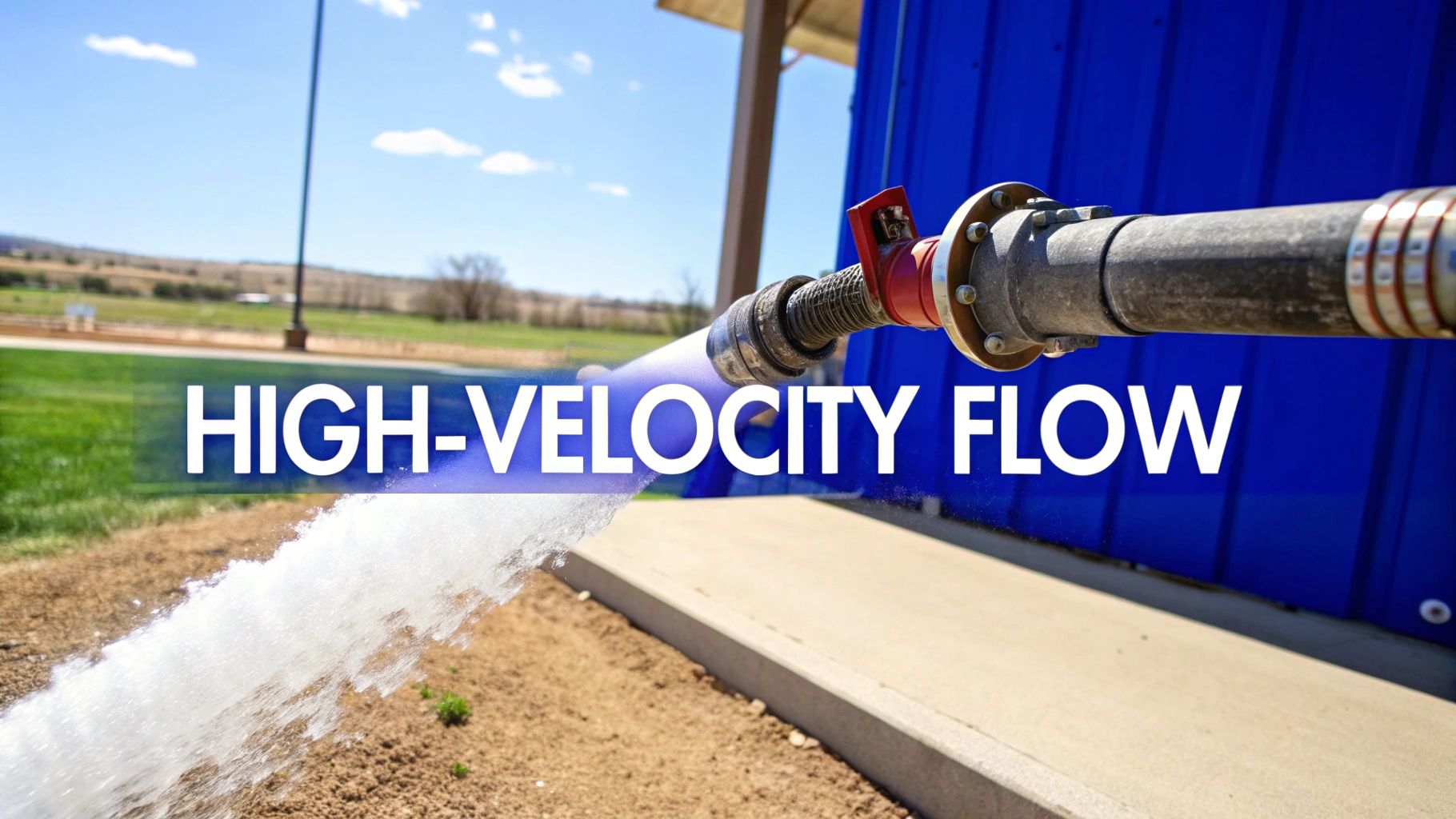
Think of your hydrovac truck's CFM rating as its raw horsepower. But just like a race car, a powerful engine is useless if you can't get that power to the pavement effectively. That's where your hose diameter comes in—it's the transmission that delivers the power.
Airflow Versus Velocity: The Critical Trade-Off for Effective Digging
There's a common myth in the hydrovac industry that a bigger hose is always better. Sure, if you're hogging out a massive pit in an open field, an 8-inch boom is great for moving a lot of material quickly. The problem is, it spreads your vacuum's suction power over a really wide area. For any kind of detail work, that's the last thing you want.
This is where a 2 inch vacuum hose changes the game. It’s like putting a precision nozzle on a fire hose. You’re taking all the airflow your truck produces and forcing it through a much smaller opening. This bottleneck effect skyrockets the air velocity, creating a focused, high-speed jet of suction.
That intense velocity is the secret sauce for surgical digging. Instead of ripping out uncontrolled chunks of earth, you're precisely lifting away the soil and slurry you’ve just loosened. This gives your operator incredible control, which is non-negotiable when you’re digging inches away from a fiber optic line. You can learn more about how vacuum suction power is measured and optimized in our detailed guide.
Maximizing Performance with the Right System
Here’s the catch: you can't just slap a small hose on a big boom and expect magic to happen. A poorly designed setup creates turbulence and bottlenecks, killing your airflow and leading to constant clogs. You end up spending more time fighting your equipment than digging. The entire system has to be designed to maintain a smooth, uninterrupted flow from start to finish.
The goal is not just to move air, but to move it with focused intensity. A 2 inch vacuum hose transforms raw vacuum power into surgical precision, allowing for detailed excavation that larger hoses simply cannot achieve.
This is exactly why The Hydrovac Attachment Tool was developed. It’s not just a reducer; it's an engineered system built to manage that transition from the large boom down to a 2-inch hose. Every component is designed to maintain that high-velocity airflow, eliminating the choke points that cause clogs and kill suction. It is the definitive solution for effective digging purposes.
By creating a sealed, efficient pathway, the tool ensures every bit of your truck’s power makes it to the tip of the hose. It turns a standard hydrovac from a blunt instrument into a precision tool for your most delicate and demanding jobs.
Connecting Smaller Hoses to Your Hydrovac Fleet
One of the first questions hydrovac contractors ask is, "How do I actually connect a smaller hose to my 8-inch boom?" It’s a great question because getting this wrong is a surefire way to kill a job. A bad connection doesn't just leak; it kills your suction and grinds your whole operation to a halt.
Switching from bulk digging to precision work isn't just about buying a 2 inch vacuum hose. You need a solid, reliable plan to hook it up. The aim is to create a completely airtight seal that maintains full vacuum power from the truck all the way down to the business end of the hose. Throwing a bunch of mismatched parts together is a recipe for disaster.
Getting the Connection Right: Reducers and Adapters
Connecting a small hose to a massive boom is all about managing that transition smoothly. You’ll be using a series of reducers and adapters to get the job done right. Here’s what’s typically in every smart operator's toolkit:
- Reducers: Think of these as cone-shaped funnels. They take you from the big 8-inch opening on your boom down to the smaller hose size. A good reducer keeps the airflow smooth, which is key to preventing the kind of turbulence that causes clogs and kills suction speed.
- Camlock Fittings: These are your best friends for fast, secure, and leak-proof connections. A male adapter on one end snaps into a female coupler on the other, locking down with simple lever arms. No tools needed, just a quick and reliable seal every time.
- Adapters: These are the little problem-solvers that bridge the gap between different connection types, like hooking up a camlock to a threaded pipe. Don’t cheap out here—you need industrial-grade materials that won’t crack under pressure. If you're working with different pipe materials on-site, knowing how to connect them properly is critical. We've got some good advice on connecting hose adapters to PVC pipes if you need it.
A proper connection is an engineered system, not just a random collection of parts. Every single fitting has to work in harmony to maintain a perfect, airtight path for debris. If one part fails, the whole setup underperforms.
You can see the growing need for better gear reflected in the market itself. The industrial hose industry, worth around USD 11.81 billion in 2024, is booming. Its specialized vacuum hose segment alone is expected to climb to USD 750 million by 2033. That tells you just how much demand there is for efficient, reliable equipment. You can discover more insights about the industrial hose market on marketsandmarkets.com.
Why an Integrated System Beats a DIY Setup
Sure, you can piece together reducers and adapters yourself. But this DIY approach is often a frustrating game of trial and error. A loose camlock here or a reducer that doesn’t seal quite right there, and suddenly you’ve got air leaks that are robbing you of vacuum power right when you need it most.
This is exactly where a purpose-built system like The Hydrovac Attachment Tool comes in. It’s not just a bag of adapters; it’s a complete, engineered solution designed specifically for this job.
The tool provides a single, rock-solid connection point. It takes all the guesswork and weak links out of the equation, making the switch from bulk digging to precision work simple, secure, and incredibly effective for any hydrovac crew.
A Contractor's Checklist for Picking the Right Vacuum Hose
Choosing the right 2 inch vacuum hose is about more than just matching a diameter and length. You have to think like you're already on the job site, picturing the punishment that hose is about to take. A little bit of planning upfront saves you from buying a hose that fails when you need it most, ensuring you get the best value for your hydrovac operation.
Think of this as your practical, industry-focused guide to making sure the hose you buy is an asset, not a liability.
What Kind of Ground Are You Breaking?
First things first: what are you actually sucking up? The material you’re moving is the number one factor that dictates how long your hose is going to survive.
- Tough, Abrasive Stuff: If you're constantly dealing with sharp rock, gravel, sand, or gritty, hard-packed clay, you need a hose built for a fight. This is where a polyurethane (PU) hose really shines—it's engineered to handle that constant grinding and friction without wearing thin.
- Softer Debris & Slurry: For jobs involving looser soil, mud, or a watery slurry, you have more options. A high-grade rubber or even a robust PVC blend can do the trick, and they often give you a bit more flexibility, which is always a plus.
How's the Weather Out There?
Where you work is just as important as what you're digging. A hose that works perfectly in the summer sun might turn into a brittle mess in the dead of winter. Extreme temperatures can completely change a hose's properties.
Think about your year-round climate. Are you frequently working in sub-zero conditions? You'll need a hose specifically rated for cold weather. Standard materials can get stiff and crack, but a flexible rubber compound is usually a much better bet in freezing temperatures.
Remember, the right hose is an investment in your uptime. A hose that splits open mid-job doesn't just cost you a replacement—it costs you hours of lost work and can ding your reputation for getting the job done on time.
The demand for this kind of durable equipment is only growing. The global industrial hose market is expected to hit an impressive USD 36.2 billion by 2031, pushed by the need for tough gear in fields like hydro excavation. This boom is driving real innovation in materials science. You can dive deeper into these global hose market trends on stratviewresearch.com.
What Are the On-Site Risks?
Finally, think about the specific hazards of your typical job site. Are you often digging around sensitive utility lines or in areas where flammable gases could be present? If that's the case, an anti-static hose isn't a "nice-to-have," it's a necessity. These hoses are built to dissipate static charge safely, preventing a random spark from turning a routine job into a disaster.
Running through these points will help you land on a 2 inch vacuum hose that’s truly fit for your purpose. It's this kind of proactive thinking that makes sure all your gear, including specialized solutions like The Hydrovac Attachment Tool, performs reliably and safely every single time.
Maintenance and Troubleshooting to Maximize Hose Life
Your 2 inch vacuum hose is a workhorse, but it’s not invincible. Treating it like just another piece of gear is a fast track to downtime, project delays, and surprise replacement costs. From an industry perspective, think of it as a critical investment—a little bit of regular care goes a long way in keeping your hydrovac jobs running smoothly and profitably.
A few minutes of prevention can add months, or even years, to the life of your hose. It all starts with a simple daily habit: walk the line. Before firing up the vac, give the hose a quick visual inspection. You're looking for the early warning signs of failure—cracks, deep gouges, or any soft spots that tell you the inner wall is wearing thin.
Proactive Care for a Longer Lifespan
How you clean and store your hose matters just as much as how you use it. After a long day of sucking up abrasive slurry, don't just throw it on the truck. Take the time to flush it thoroughly with clean water. This simple step gets rid of leftover mud and rocks that can harden inside, creating stubborn clogs and killing your suction power over time.
Storage is another big one. Never coil a hose tightly or leave it with sharp kinks—that’s a surefire way to weaken its internal structure. Instead, lay it in large, loose loops and, if possible, keep it out of direct sunlight. UV exposure is the silent enemy of hose materials, making them brittle and prone to cracking.
A well-maintained hose is more than just a piece of equipment; it's a reliable asset. Proactive maintenance is the simplest way to protect your investment and ensure your crew can work efficiently without fighting their gear.
Solving Common Hose Problems
Even the best-maintained hoses run into trouble sometimes. The key is knowing how to spot and solve the problem quickly so you can get back to work.
- Sudden Loss of Suction: Before you do anything else, check your connections. A loose camlock fitting is the number one cause. If the fittings are tight, look for a fresh cut or puncture that's letting air leak in.
- Frequent Clogging: If your hose keeps jamming up, the problem might not be the hose itself. Look at the transition point from your main boom. Sharp angles and rough connections disrupt airflow, creating turbulence that causes debris to tumble and jam. This is especially true for precision digging, where a smooth, engineered system like The Hydrovac Attachment Tool is designed to create a seamless path for material, preventing those frustrating clogs right at the source and providing a solution for effective digging.
Got Questions About 2 Inch Vacuum Hoses?
Even the most seasoned hydrovac operators run into questions when adding new gear to their rig. Let's tackle some of the most common ones about the 2 inch vacuum hose to make sure you're getting the most out of it on every job.
When Is a 2 Inch Hose Actually Better Than a Larger One?
Think of a 2 inch vacuum hose as your scalpel, not your sledgehammer. It's all about precision. You grab this hose when you need finesse and control over brute force.
It's the go-to tool for tasks like:
- Potholing: When you need to find and expose buried utilities without nicking a gas line or fiber optic cable.
- Detail Work: Perfect for cleaning out cramped valve boxes or carefully digging around a maze of pipes.
- Tight Quarters: Essential for jobs where a bulky 6-inch hose is just too much to handle or poses a risk.
Sure, a bigger hose moves more material faster in an open pit, but the 2 inch hose gives you the surgical accuracy needed to avoid expensive mistakes. For those high-stakes jobs, it’s not just an option—it’s a necessity.
How Do I Hook a 2 Inch Hose Up to My Truck?
Let's face it, most hydrovac trucks come standard with massive 6-inch or 8-inch booms. You can't just slap a 2 inch vacuum hose on there and call it a day. You'll need the right reducers and adapters to create a solid, airtight connection. Without it, you'll lose suction and efficiency right away.
The real trick is making a smooth transition that doesn't mess with the airflow. A clunky, homemade setup is a recipe for constant clogs, which means more downtime and frustration for your crew.
This is exactly why a purpose-built system like The Hydrovac Attachment Tool is a game-changer. It’s designed from the ground up to create that perfect, leak-proof seal, taking all the guesswork and weak points out of the equation. This makes it the ideal solution for adapting your hydrovac for effective precision digging.
What’s the Biggest Mistake I Can Make With These Hoses?
The single most common—and costly—mistake is skimping on basic maintenance. We've all seen it: hoses getting dragged over sharp gravel, used with visible cracks, or just thrown in the back of the truck at the end of the day. That kind of abuse will kill a hose's lifespan.
A little bit of care goes a long way. Giving it a quick once-over for wear and tear before each shift and flushing it clean after you're done can be the difference between a hose that lasts and one that fails when you need it most. It's a simple habit that saves a lot of money and headaches.
Ready to add that surgical precision to your hydrovac work? Hydrovac Attachment offers the only system engineered to turn any truck into a high-performance digging machine. Check out the setup and upgrade your toolkit today at https://hydrovacattm.com.