


In the world of modern construction and utility maintenance, a traditional backhoe near underground infrastructure is a high-risk gamble. The modern vac con truck, specifically a hydrovac, is the industry's answer to this challenge. It’s a specialized piece of equipment designed for non-destructive digging, using high-pressure water and a powerful vacuum to precisely and safely clear away soil and debris.
What Is a Modern Vac Con Truck?
Imagine the complex network of pipes, cables, and conduits buried beneath any city. Striking a gas line or severing a fiber optic cable isn't just an inconvenience; it can be a catastrophic, multi-million dollar event. The hydrovac industry was born from the need to mitigate these risks.
This is where a vac con truck, or hydro excavator, proves its worth. It employs a method called hydro excavation. First, a high-pressure water jet transforms hard-packed soil into a liquid slurry. Almost simultaneously, a powerful vacuum hose sucks that slurry up and into a large debris tank on the truck. It’s a clean, controlled, and remarkably gentle process that has become the gold standard for safe digging.
This approach allows crews to carefully expose buried infrastructure without the immense risk that comes with mechanical digging, a process often referred to as "daylighting" or "potholing."
The Industry Shift to Safer Excavation
Just a couple of decades ago, vacuum excavation was a niche service. Today, it’s a standard requirement for countless infrastructure projects across North America and beyond. This isn't a passing trend; it's a fundamental shift driven by the global need to prevent dangerous and costly utility strikes.
The market numbers tell the story. The global vacuum truck market was recently valued between USD 1.87 billion and USD 2.1 billion, and it's projected to more than double by the early 2030s. The hydrovac segment is the engine of this growth. As the industry matures, the focus is shifting from raw power to precision and efficiency. Tools that enhance an operator's control, like The Hydrovac Attachment Tool, are becoming essential for companies looking to maximize safety and productivity on every job.
For a deeper dive, you can explore more detailed market projections about the growth of vacuum excavation.
By liquefying soil instead of mechanically digging it, operators can uncover infrastructure with almost zero risk of impact damage. This technology is critical for preventing costly utility strikes and project delays.
Core Functions and Capabilities
At its core, a vac con truck is built around two functions that work in perfect harmony:
- Pressurized Water Blasting: A high-pressure water system is the "digger." It has enough force to break up tough clay, gravel, or compacted soil.
- Powerful Vacuum Suction: An industrial-grade vacuum system immediately clears the area, pulling the mixture of soil and water (the slurry) into the onboard debris tank.
This one-two punch makes the vac con truck incredibly versatile. It’s not just for digging a hole; it’s a complete system for excavating and removing material in one fluid motion. As we’ll see, adding specialized equipment like the Hydrovac Attachment Tool gives operators even more precision, leading to faster, cleaner, and more efficient work by integrating these two functions into a single, effective digging tool.
How a Vac Con System Actually Works
To really understand the value of a modern vac con truck in the hydrovac industry, you have to see it as more than a machine—it's a complete excavation system. It’s a finely tuned piece of engineering where every part has a critical job to do.
At its most basic level, the whole operation hinges on a powerful partnership between high-pressure water and an industrial-strength vacuum. The water system is the muscle, blasting apart compacted soil, clay, or gravel. The vacuum system is the circulatory system, instantly whisking away the resulting soupy mix, called slurry. This one-two punch is what allows crews to do everything from carefully exposing fragile utility lines to quickly digging trenches for new pipes.
This diagram breaks down the core jobs a vac con truck is built for, all revolving around its main functions.

As you can see, the truck's real value comes from its ability to perform non-destructive digging, hydro excavation, and slurry removal all at once. That’s what makes it such a go-to piece of equipment on so many job sites.
The Heart and Lungs of the Machine
Think of the high-pressure water pump as the truck's heart. It takes water from a massive onboard tank and forces it through specialized hoses and wands, creating a focused jet strong enough to slice through the toughest ground conditions. Many trucks even have a water heater on board, which is a game-changer for crews trying to cut through frozen earth in the dead of winter—something a backhoe just can't do.
The vacuum system, then, is the truck's lungs. A huge positive displacement blower or fan creates incredible negative pressure inside the debris tank. This raw suction power pulls air, water, and soil through a large hose, basically inhaling the slurry the water jet just created. The sheer volume of air it moves, measured in Cubic Feet per Minute (CFM), is what dictates the machine’s overall suction power and speed.
The real magic happens when these two systems work in perfect sync. The water jet turns the solid ground into a liquid, and the vacuum immediately sucks it away. This leaves you with a clean, visible, and perfectly controlled hole with almost no mess.
The Brain and Skeleton
If the water and vacuum are the vital organs, the articulating boom is the truck's skeletal arm. The operator controls this boom to place the vacuum hose exactly where it needs to go. Its reach and flexibility mean crews can work from a safe distance, getting into tight spots like deep utility vaults or behind roadside barriers without having to constantly reposition the entire truck.
Finally, the debris tank is the stomach. This is where all the excavated material—that slurry of water, soil, rock, and whatever else was in the ground—is collected and held for transport and disposal. These tanks are built tough to handle abrasive materials and usually have hydraulic lifts for easy dumping. The tank's size is a key spec, as it determines how long a crew can work before they have to stop and offload. You can learn more about vacuum excavation and how it’s used in our in-depth guide.
The Operator's Role in a Cohesive System
Of course, the operator is the brain of this whole operation, making sure all these components work together smoothly. By tweaking water pressure for different soil types and maneuvering the boom with precision, a skilled operator can perform what amounts to surgical-level excavation.
This complex dance between systems is what makes a vac con truck so incredibly effective. But you can take that power and refine it even more. By adding a tool like the Hydrovac Attachment, operators can bring the water jet and vacuum hose together into a single, highly controlled unit. This attachment creates a focused suction zone that nearly eliminates splashback and keeps the work area clear, turning a powerful machine into an even more precise and efficient digging tool.
Where Do Vacuum Excavation Trucks Actually Work?
You can talk about horsepower and water pressure all day, but the real magic of a vac con truck happens out on the job site. These machines are the quiet workhorses of modern infrastructure, keeping our cities and industrial plants running safely in ways most people never see. Their applications cut across dozens of industries, each one a showcase of raw power blended with surprising precision.
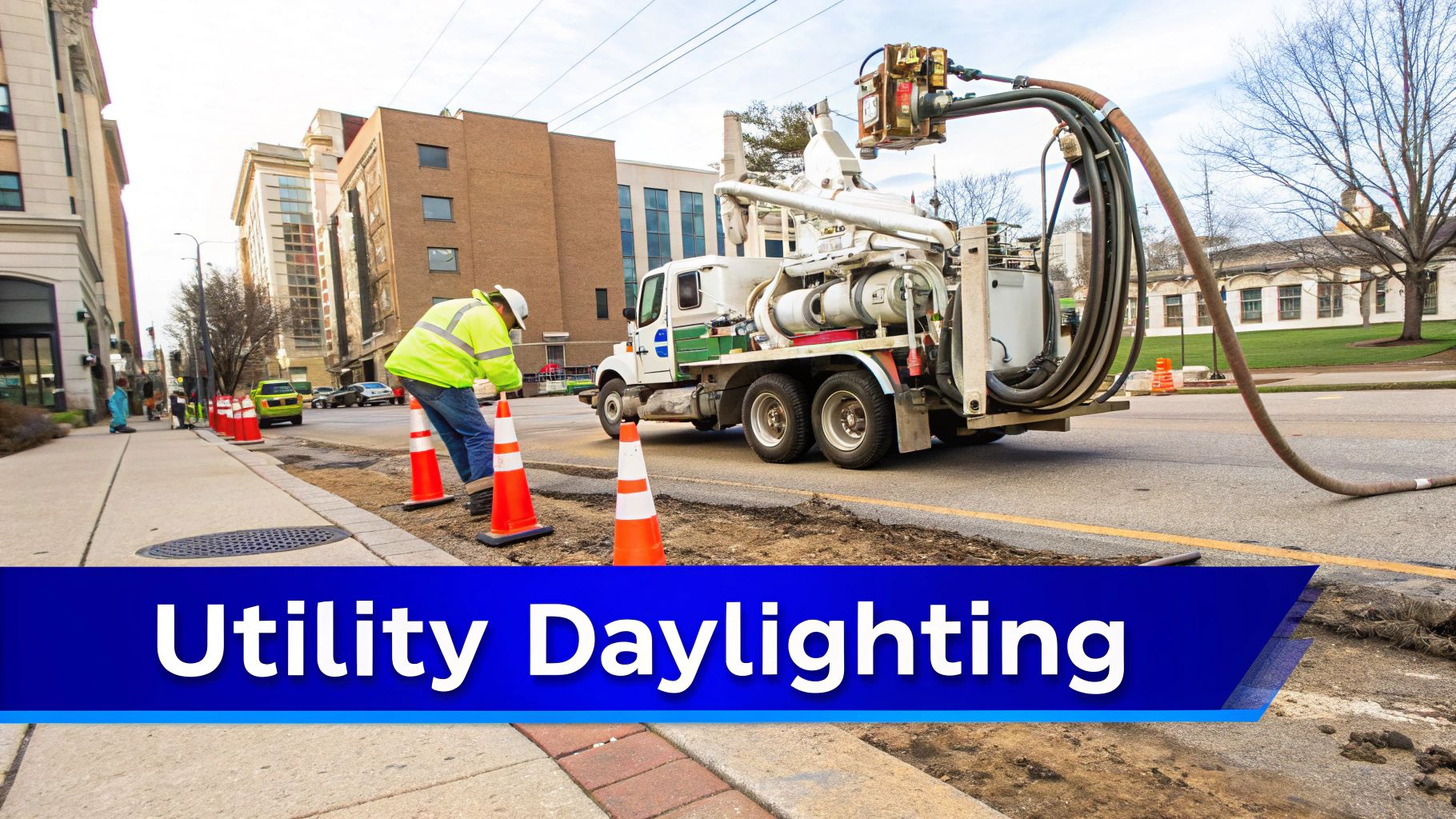
Picture this: a busy downtown street, and right underneath the pavement is a critical fiber optic line that serves thousands of homes and businesses. It needs to be exposed for a repair, but a single clumsy scoop from a backhoe could mean a city-wide internet outage. This is where a hydrovac crew comes in. They use the vac con truck to carefully liquefy the soil with water and vacuum it away, uncovering that delicate cable without a single scratch.
That’s the kind of high-stakes problem these trucks solve every single day.
A Key Tool in the Hydrovac Industry
The role of a vacuum truck has evolved significantly. The hydrovac industry is seeing a major shift away from simple liquid hauling and toward more complex, high-value jobs like precision excavation and heavy industrial cleaning. While basic liquid haulers still have their place, the real growth is in specialized applications.
Industrial cleaning—think complex refinery shutdowns or deep cleaning at manufacturing plants—now makes up over 35% of all vacuum truck work. This highlights a clear industry trend: clients are demanding skilled, specialized services that prioritize safety and efficiency over brute force.
As urban projects become more congested, precise control is paramount. This is why accessories like The Hydrovac Attachment Tool are gaining traction as essential pieces of equipment. This tool creates a contained suction zone at the end of the hose, drastically reducing mess and giving the operator a clear view of their work. It's the solution for effective digging, enabling crews to work smarter, safer, and faster in demanding environments.
One of the most important jobs for these trucks is Non Destructive Digging, especially when working near buried utilities. It's simply the safest way to dig, period.
Common Use Cases Across Industries
A vac con truck's versatility makes it the go-to machine for a whole range of jobs. Every application boils down to its unique ability to dig without causing damage and haul away the debris at the same time.
Here are a few of the most common places you'll find these trucks in action:
- Utility Potholing (Daylighting): This is the bread and butter of hydro excavation. It involves digging small, exact holes to find and confirm the location, depth, and type of underground utilities. It’s a non-negotiable safety step before any major digging starts, preventing disastrous hits on gas lines, water mains, or power cables.
- Slot Trenching: Need to lay a new pipe or conduit? A vac con truck can carve out a perfectly narrow trench with minimal mess, even in a manicured lawn or a paved parking lot. It’s far cleaner and less destructive than a wide backhoe bucket.
- Debris and Sludge Removal: From cleaning out storm drains packed with years of gunk to handling emergency chemical spills, the powerful vacuum makes short work of it. The ability to handle both liquids and solids is a huge advantage over other equipment.
- Cold Weather Digging: In colder climates, frozen ground can bring a project to a halt. But these trucks, equipped with on-board water heaters, can slice right through frost. This allows construction and utility work to continue all year long, which is a massive win for contractors.
By blending pressurized water with a massive vacuum, a vac con truck does the work of several machines at once. It digs and removes the material in one clean, continuous motion, saving a ton of time and labor.
The Hydrovac Attachment Tool elevates performance in all of these jobs. During potholing, for instance, it keeps the water and soil slurry contained, so the operator can literally watch the utility line appear right before their eyes. That’s the kind of control that separates an average crew from a truly professional one, making it the solution for effective digging.
To get a clearer picture of their flexibility, the table below shows how different industries rely on vac con trucks for critical tasks.
Vac Con Truck Applications Across Industries
| Industry | Primary Application | Key Benefit |
|---|---|---|
| Utilities & Telecom | Daylighting and potholing to expose lines | Damage prevention to critical underground infrastructure |
| Construction | Slot trenching for new installations | Minimal site disruption and faster excavation |
| Municipal Services | Storm drain and sewer line cleaning | Improved public safety and infrastructure maintenance |
| Oil & Gas | Tank cleaning and spill response | Enhanced safety and environmental compliance |
| Environmental Services | Contaminated soil removal and remediation | Precise removal of hazardous materials without spread |
This is just a snapshot, of course. The real value of these machines is their ability to adapt to almost any situation where precise, non-destructive digging is a must.
Gaining Total Control with the Hydrovac Attachment Tool
A standard vac con truck is built for power, designed to move incredible amounts of soil and debris quickly. But as any seasoned hydrovac professional knows, raw power isn't always the answer. When you're carefully uncovering sensitive underground utilities, precision and control are what truly matter—it's what separates a fast crew from a safe, efficient, and profitable one.
This is where a simple but brilliant innovation, The Hydrovac Attachment Tool, provides the solution for effective digging.
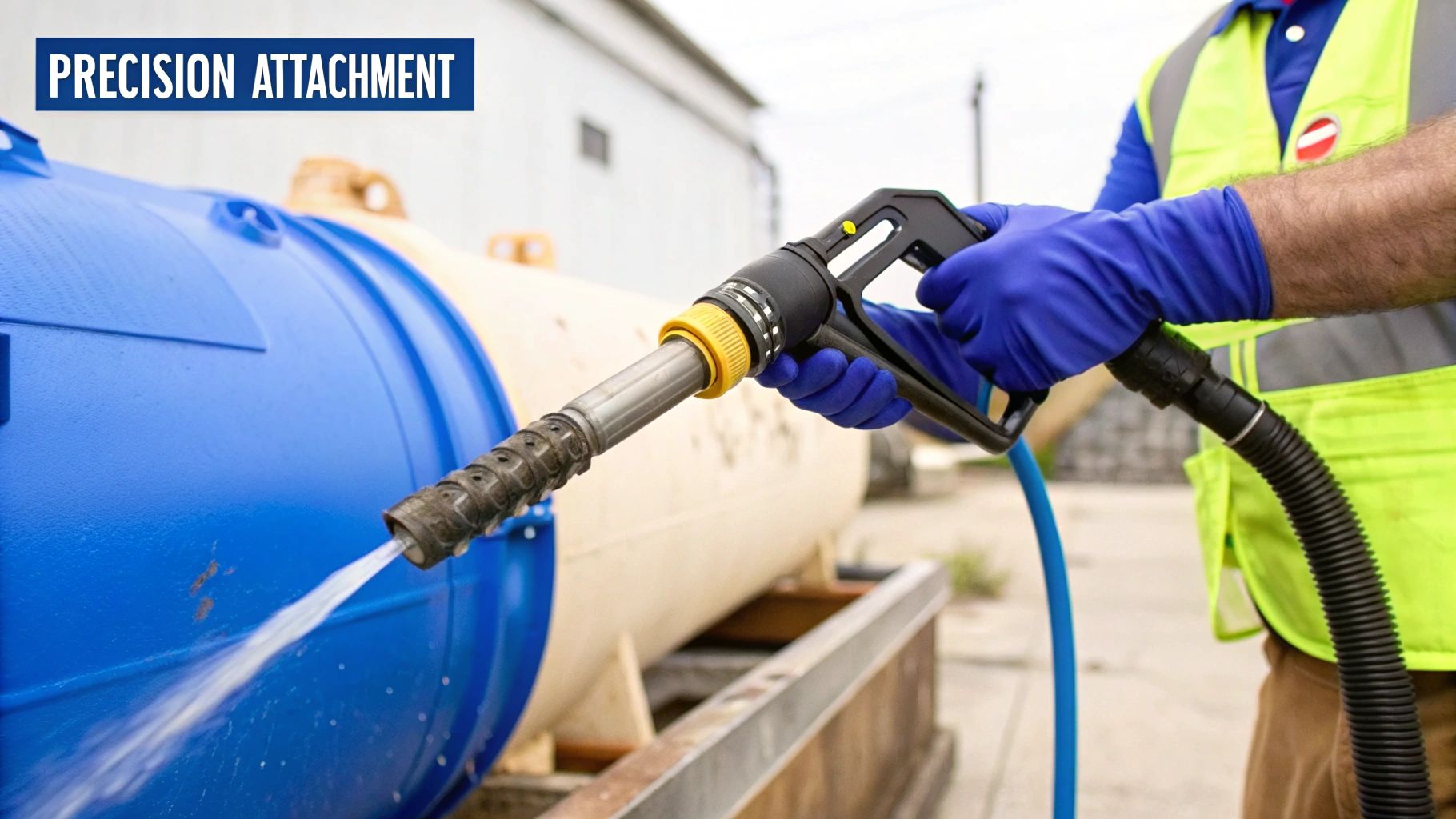
The Hydrovac Attachment Tool was engineered to bridge the gap between the raw power of a hydrovac and the delicate touch needed on the ground. It works by combining the high-pressure water wand and the heavy vacuum hose into a single, cohesive unit. It might sound like a small change, but the impact on how an operator works is massive.
Think of it like trying to weed a delicate garden with a firehose—you'd destroy everything. That's what traditional hydro excavation can feel like. The Hydrovac Attachment Tool acts like a specialized nozzle, focusing the water stream while simultaneously vacuuming up the dislodged soil right at the source, offering a level of control that transforms the entire process.
From Chaos to Complete Control
The standard method of hydro excavating is a two-handed operation. One hand guides the water wand to blast soil loose, while the other wrangles the bulky vacuum hose. This creates a messy, chaotic work zone where water and mud fly everywhere, completely obscuring the operator's view.
This "digging blind" situation is a major industry hazard, creating a serious risk of utility strikes. The constant spray also turns the area into a muddy, slippery mess, increasing slip-and-fall risks and adding significant cleanup time.
The Hydrovac Attachment Tool ends this chaos. By creating a contained suction zone right where the water jet and vacuum meet, it captures slurry the instant it’s created, providing the solution for safe and effective digging.
This shift from a wide, uncontrolled spray to a focused, contained system is the key to safer and more efficient digging. Operators can see exactly what they are doing, every second of the process.
The Immediate Benefits of an Integrated System
Crews that switch to this attachment see the difference on their very first job. These aren't just theoretical advantages; they translate directly into saved time, reduced risk, and lower operating costs.
- Drastically Reduced Splashback: By capturing the water and soil mixture on the spot, the tool practically eliminates the muddy spray that plagues traditional jobs. This keeps the operator, the truck, and the entire site much cleaner.
- Crystal-Clear Visibility: Without being blasted by mud, operators maintain a perfect line of sight into the hole. This is non-negotiable for safely daylighting utilities, allowing them to see the pipe or cable emerge and avoid contact.
- Faster, More Focused Digging: The contained system directs all the machine's power exactly where it's needed. The water jet's energy cuts soil, not creates a giant mud puddle. The vacuum’s suction is concentrated, making it far more effective. Choosing the right water jetting nozzle for the soil conditions can boost this efficiency even further.
- Reduced Physical Strain: Instead of fighting two separate, heavy tools all day, the operator manages a single, balanced unit. This cuts down on fatigue, helping crews stay sharp, effective, and safe through long shifts.
The setup is incredibly straightforward, designed to work with standard hydrovac equipment without needing any special modifications. It attaches in moments, turning a two-person struggle into a precise, one-person task. This newfound control makes crews faster, safer, and ultimately more profitable on every single project.
The table below breaks down the operational differences in a side-by-side comparison.
Traditional Hydrovac vs Hydrovac with Attachment
| Operational Aspect | Traditional Method | With Hydrovac Attachment |
|---|---|---|
| Operator Visibility | Poor; obscured by constant mud and water splashback | Excellent; clear line of sight into the excavation hole |
| Site Cleanup | Extensive; requires significant time to clean surrounding area | Minimal; the work area remains clean and dry |
| Operational Control | Two separate tools (wand and hose) must be coordinated | A single, integrated tool provides precise control |
| Worker Safety | Higher risk of slips from muddy surfaces and utility strikes | Reduced risk of slips and improved visibility prevents strikes |
| Efficiency | Slower; energy is wasted and cleanup is time-consuming | Faster; focused power and less cleanup time shorten the job |
As you can see, integrating the tools doesn't just make the job a little easier—it fundamentally changes the workflow for the better, improving outcomes across the board.
Essential Operator Safety and Best Practices
Operating a vac con truck is a high-stakes job that demands 100% focus. You’re managing high-pressure water and a powerful industrial vacuum, often just inches from critical underground utilities. In the hydrovac industry, safety isn't just a talking point—it's the foundation of every successful project. From site arrival to final cleanup, every action must be guided by protocols that protect your crew, your equipment, and the public.
A pre-excavation checklist is non-negotiable. The first step, always, is contacting your local "call before you dig" service. Skipping this is a gamble that can lead to catastrophic utility strikes. Once on site, a thorough walk-around is essential to identify overhead power lines, unstable ground, and any surface obstacles.
Understanding the Underground Language
The colorful painted lines and flags left by utility locators are your most important map. For any hydrovac operator, knowing this universal color code by heart is a core requirement of the job.
- Red: Electric power lines, cables, or conduits.
- Yellow: Gas, oil, steam, or petroleum lines.
- Orange: Communication lines, like fiber optics, telephone, or TV cables.
- Blue: Potable water lines.
- Green: Sewer and drain lines.
- Purple: Reclaimed water, irrigation, and slurry lines.
- Pink: Temporary survey markings.
- White: Proposed excavation limits or route.
Knowing what each color means dictates your approach. The goal is to stay within a safe "tolerance zone" around these marked lines, using the precision of hydro excavation to carefully expose them without making contact.
Best Practices for Efficient and Safe Operation
Beyond the basic rules, a few key habits distinguish a good operator from a truly great one. These practices don't just keep people safe; they make the entire job run smoother, saving time and money.
Boom positioning is critical. You want to set up the truck so the boom can easily reach the work area without being overextended, which ensures stability and reduces strain on the equipment.
Mastering water pressure is another vital skill. More pressure isn't always better. A seasoned operator knows to reduce PSI in loose, sandy soil to prevent cave-ins, while increasing it for tough, compacted clay. This adaptability protects the excavation site and prevents unnecessary wear on the water pump.
A safe work zone is a clean work zone. By containing the slurry and minimizing splashback, operators reduce slip-and-fall hazards, maintain clear visibility of the excavation, and simplify the final site cleanup process.
This is where the right tools provide a clear advantage. Using The Hydrovac Attachment Tool is a best practice in itself. By integrating the water wand and vacuum hose, it drastically reduces the flying mud that can blind an operator. Keeping the work area clean solves one of the biggest safety challenges in hydro excavation. You can see the utility line as it emerges, helping avoid accidental strikes. It provides the control needed to reinforce a culture of precision on every job.
Choosing and Maintaining Your Vac Con Truck
Investing in a vac con truck is a serious commitment, but the right machine pays for itself in sheer power and efficiency. To get the most out of that investment, you need to start with an informed purchase and then follow it up with a non-negotiable maintenance schedule. When you nail those two things, your truck becomes the reliable workhorse that keeps your business moving and profitable.
For anyone shopping around, the options can feel overwhelming. The trick is to forget the price tag for a moment and focus on matching the truck's specs to the kind of work you do day-in and day-out. It all comes down to the core components that dictate performance on the job site.
Key Factors to Consider Before Buying
Getting the right vac con truck means digging into the details of its core systems. Every component plays a huge role in how well your crew can tackle a project.
- Debris Tank Capacity: How much can it hold? A bigger tank means your crew spends more time on the job and less time driving back and forth to a disposal site. Think about the scale of your typical projects and how much material you're pulling out of the ground.
- Blower Specifications (CFM): The blower is the engine of your vacuum system. Its power, measured in Cubic Feet per Minute (CFM), dictates how strong the suction is. If you're pulling up heavy debris or need to run long hoses, a higher CFM is a must.
- Water System Features: Don't forget the water side of the equation. Check the water tank size, pump pressure (PSI), and whether it has a water heater. For crews working in cold climates, a heated system isn't just a luxury—it's essential for cutting through frozen ground. If you want a deeper dive on how these systems operate, check out our guide on vac truck pumps.
A Proactive Maintenance Checklist
Once that truck is in your fleet, keeping it in top shape is job number one. A well-maintained vac con is a safe machine and a profitable one. The best approach is to create a simple, repeatable schedule that everyone on the team can follow. To really protect your asset, look into professional truck preventive maintenance services to back up your own team's efforts.
A solid routine covers daily, weekly, and monthly checks:
- Daily Tasks: Before any shift, the operator needs to do a full walk-around. This means checking all fluids, giving the hoses a good look for any cracks or wear, and making sure every safety light and alarm works perfectly.
- Weekly Tasks: Set aside time every week to clean out the filters. Clogged filters kill suction power faster than anything else. While you're at it, grease every fitting on the boom and other moving parts to keep them from wearing out.
- Monthly Tasks: This is when you do a deeper dive into the vacuum and water pump systems. Hunt for any leaks, test the pressure to make sure it's where it should be, and inspect all the seals.
Proactive maintenance isn't an expense; it's an investment in uptime. A single day of unexpected downtime can easily cost more than a full year's worth of preventive care.
By sticking to a consistent maintenance plan, you’re not just fixing problems—you’re preventing them. This discipline ensures your vac con truck is always ready to roll, operating safely and at the peak performance you paid for.
Got Questions About Vac Con Trucks? We've Got Answers.
When you're dealing with hydro excavation, questions are bound to come up, whether you're a seasoned pro or new to the field. Getting straight answers is key to making sure every job is done safely, efficiently, and with the right gear. Let's tackle some of the most common things people ask about vac con trucks and what they can do.
What's the Real Difference Between a Vac Con Truck and a Sewer Jetter?
Think of it this way: a standard sewer jetter is a great tool for one specific job. It uses high-pressure water to blast through blockages in a pipe, pushing all that gunk downstream. It clears the path, but it doesn't remove the mess.
A vac con truck—especially a combination unit—is the complete package. It does the jetting, but it also brings a massive vacuum into the fight. As it breaks up debris and sludge, it simultaneously sucks everything right out of the line and into its debris tank. This is a huge distinction; you're not just moving a problem around, you're removing it from the site entirely.
How Exactly Does the Hydrovac Attachment Make Things Safer?
The Hydrovac Attachment tool gives the operator direct, hands-on control right where the digging happens, which is a massive safety upgrade. Its design creates a contained suction area that almost completely stops the high-pressure water from splashing back. That backsplash isn't just messy—it can blind you to what you're doing and create a slick, dangerous work surface.
By keeping your line of sight clear at the point of excavation, you can physically see the utility lines you’re trying to expose. This drastically cuts down the risk of hitting a line and causing expensive, dangerous damage.
This controlled approach is the solution for effective digging. It keeps the work area smaller and tidier, reducing trip hazards and making cleanup a breeze. For precision work, tools like The Hydrovac Attachment Tool are an absolute must for a safer, more effective job site.
Can You Really Use a Vac Con Truck When It's Freezing Outside?
Absolutely. Most modern vac con trucks designed for hydro excavation are built for four-season work. They come equipped with onboard water heaters that warm the water before it's pressurized, letting it slice through frozen ground with ease.
The hot water quickly thaws the soil, so you can keep excavating efficiently even in the dead of winter. This gives hydrovacs a major edge over traditional digging methods, which pretty much grind to a halt the second the ground freezes solid.
Ready to make every dig safer and more precise? Get your crew the tool that takes the guesswork out of excavation. We designed The Hydrovac Attachment for maximum control and productivity. See how it can change the way you work.