


The heart and soul of any hydrovac truck is its pump. This isn't just a component; it's the engine that generates the incredible suction needed for safe, non-destructive hydro excavation. For any operator in the hydrovac industry, gaining a deep understanding of how these pumps perform is the most critical step to maximizing efficiency and profitability on any job site.
The Powerhouse Behind Precision Digging
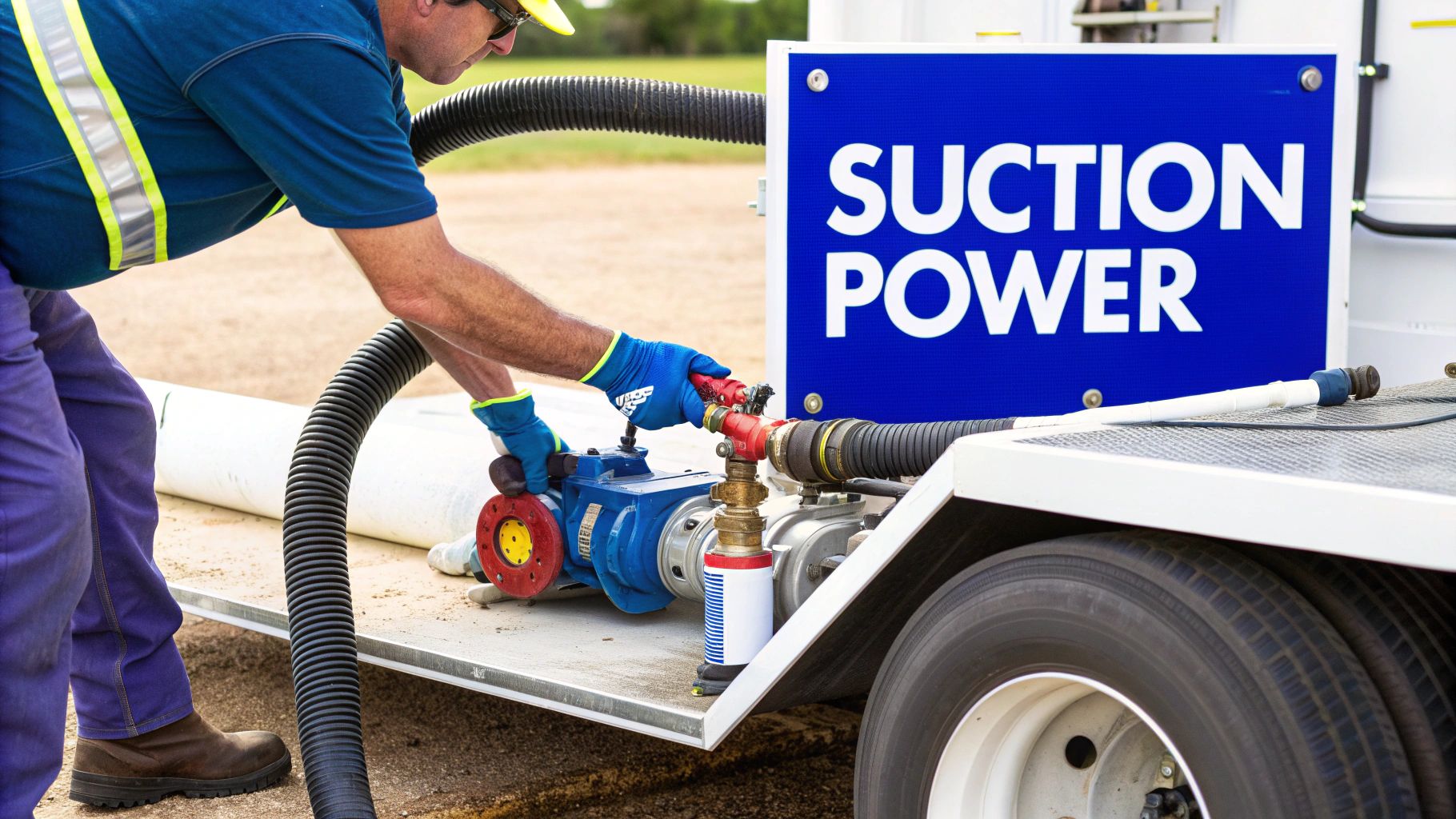
When we talk about a pump's performance, it really boils down to two key numbers: CFM (Cubic Feet per Minute) and Mercury (Hg). It’s easy to get them mixed up, but they do completely different jobs in hydro excavation.
Think of CFM as the speed of the air rushing through the hose—it's the wind that carries debris away. You need high CFM to keep lighter materials moving smoothly, especially over long hose runs. On the other hand, Mercury (Hg) is all about raw lifting power. This is the brute strength that breaks heavy, water-logged soil or dense clay free from the ground in the first place.
Here’s the catch: a pump with sky-high CFM but low Hg might move air like a hurricane but will struggle to even budge heavy spoils. Flip that, and a high-Hg, low-CFM pump can lift a bowling ball but doesn't have the airflow to get it down the hose. The secret to a productive hydrovac operation is striking the perfect balance between the two.
Below is a quick breakdown to help you visualize how these metrics play out in the real world.
Understanding Your Pump's Key Performance Metrics
This table breaks down the essential performance metrics of vac truck pumps, helping you understand how each specification translates to real-world job site capability.
| Metric | What It Measures | How It Affects Your Hydrovac Job |
|---|---|---|
| CFM (Cubic Feet per Minute) | Airflow volume. It's the amount of air the pump can move in one minute. | Moves material. Higher CFM is crucial for carrying lighter debris (slurry, loose soil) over long distances through the hose. It keeps things from settling and clogging. |
| Hg (Inches of Mercury) | Vacuum level. This is the pure suction force, or the "pulling power" of the pump. | Lifts material. Higher Hg provides the muscle needed to break heavy, dense materials (like clay, rocks, or saturated soil) loose from the ground and into the hose. |
Getting a feel for these numbers helps you match your truck's capabilities to the job at hand, ensuring you're not trying to move mountains with a machine built for molehills.
From Brute Force To Surgical Precision
Here's an industry truth: just having a powerful pump doesn't guarantee a productive day. The real challenge is making sure all that raw power actually makes it to the end of the hose and does useful work. Inefficient tools, air leaks, and pressure loss can bleed away your pump's power before it ever touches the ground.
This is where innovative solutions for effective digging come into play. The goal is to channel every ounce of that suction directly to the spot you're digging.
By creating a sealed suction zone right at the excavation point, operators can stop power loss in its tracks. This simple change transforms a pump's raw potential into true surgical digging precision, boosting performance without needing a bigger truck.
This is exactly what the Hydrovac Attachment Tool is designed for. It creates a contained, focused environment at the nozzle, ensuring that all the pump's airflow (CFM) and lifting power (Hg) are concentrated on breaking up and vacuuming material. This approach is the solution for effective digging, cutting down on waste and making your existing equipment dramatically more effective. For a deeper dive into what different trucks can do, check out our guide to Vac-Con trucks.
The demand for this kind of efficiency is only growing. The global vacuum truck market is expanding rapidly, jumping from USD 2.043 billion and is expected to reach USD 4.526 billion by 2035. This boom, fueled by industrial growth and tougher waste regulations, shows just how critical effective vacuum excavation has become. Discover more insights about the vacuum truck market growth.
What Are the Main Types of Vac Truck Pumps?
Choosing the right vac truck pump is a lot like picking the right tool for a job. They all create suction, sure, but how they get there—and what they're best at—is a different story. Getting a handle on the technology powering these industry workhorses is the first step toward making smarter decisions on the job site.
The world of vac truck pumps really boils down to three main designs: the Positive Displacement (PD) Lobe, the Rotary Vane, and the Liquid Ring. Instead of getting lost in complicated engineering diagrams, let's use some simple analogies to see how they really move air and muck.
Positive Displacement (PD) Lobe Blowers
Think of a PD Lobe Blower as a massive, industrial-strength fan. Inside the pump casing, two cleverly shaped lobes spin in opposite directions. As they turn, they trap huge "pockets" of air between themselves and the casing, pushing that air through the system.
This design is all about moving incredible volumes of air, which is why PD pumps are the undisputed champions of high CFM. They’re fantastic for dry vacuuming and pulling material through incredibly long hose runs. The trade-off? Their design makes them more sensitive to heat and grit, so you absolutely need top-notch filtration to keep the lobes from getting chewed up.
- Core Strength: Unmatched airflow (CFM), perfect for dry material and long-distance work.
- Critical Weakness: Prone to overheating and needs excellent filtration to protect its internal parts from abrasive materials.
Rotary Vane Vacuum Pumps
Imagine a revolving door, but for air. That's a pretty good picture of a Rotary Vane pump. It has a rotor that's mounted off-center inside a round housing, and this rotor has slots with sliding vanes. As it spins, centrifugal force slings the vanes outward, creating sealed chambers that trap air, squeeze it down, and then push it out, generating a powerful vacuum.
Rotary Vane pumps are the all-stars of the hydrovac world because they offer a fantastic balance of both CFM (airflow) and Hg (lifting power). This versatility makes them the go-to choice for crews who need to handle everything from dry, dusty soil to thick, heavy slurry. They really are the jack-of-all-trades of vacuum pumps.
The real magic of the Rotary Vane design is its knack for pulling a deep vacuum (high Hg). This gives it serious lifting power, which is exactly what you need for hydro excavation jobs where you have to break stubborn, water-logged soil free from the ground.
This balanced performance is precisely why you see them on so many multi-purpose hydrovac trucks.
Liquid Ring Vacuum Pumps
For this one, picture an old-fashioned water wheel. But instead of the water turning the wheel, the wheel uses water to move air. A Liquid Ring pump spins an impeller inside a housing that’s partially filled with a liquid, usually water. As the impeller spins, it flings the water against the outer wall, forming a solid "ring of liquid." This creates sealed chambers between the impeller's blades and the water ring.
As these chambers rotate, they get bigger and then smaller, drawing in air and then compressing it to create a seriously powerful and stable vacuum. Since all the moving parts are constantly bathed in cool water, these pumps are built like tanks. They can run all day long sucking up wet, sticky slurry without breaking a sweat. Their only real downside is that they aren't as efficient, especially with dry stuff, because some energy is always spent just moving the water around.
This incredible durability makes them a favorite for the toughest, continuous-duty jobs where you just can't afford downtime.
Knowing these differences helps you match your truck’s pump to the challenge of the day. And no matter which pump you're running, the Hydrovac Attachment Tool is the ideal solution to ensure every bit of that hard-earned suction is put to work, turning raw power into focused, efficient digging.
Selecting the Right Pump for Your Digging Needs
Picking the right pump for your hydrovac work isn’t about chasing the biggest numbers on a spec sheet. It's a strategic move, one that lines up the pump’s power with the specific demands of the job. Getting it wrong means wasted fuel, slow progress, and a lot of frustration on site. The real goal is to create a perfect harmony between what your pump can do and the ground you’re trying to move.
Think of it like choosing the right gear on a truck. When you’re dealing with loose, sandy soil or a watery slurry, you need high CFM (cubic feet per minute). This acts like a strong, steady river, carrying the material smoothly all the way down the hose. But when you hit dense, stubborn clay or heavily compacted ground, you need raw lifting power. That's where high Hg (inches of mercury) comes in, acting like a powerful crane to break heavy material free and yank it into the vacuum stream.
Aligning Power with Purpose
The material you’re digging should always be your number one guide. An operator who gets this can easily outperform a crew with a more powerful truck but the wrong approach. It’s all about working smarter, not just harder.
- For Loose Soils and Slurry: Make high CFM your priority. You need that sheer volume of airflow to keep lighter materials suspended and moving, preventing clogs, especially over long hose runs.
- For Dense Clay and Compacted Earth: High Hg is non-negotiable. This is the brute force required to overcome the suction of saturated, heavy materials and lift them straight up.
Don't forget to factor in the job site environment. A long hose run creates a ton of friction, demanding more power just to keep the air moving. Likewise, working at a higher elevation means the air is thinner, which can sap your pump's performance and lifting capability. You have to account for these variables when you're planning a dig.
This simple decision tree shows how the job type points you directly to the best pump for hydrovac and other vacuum work.
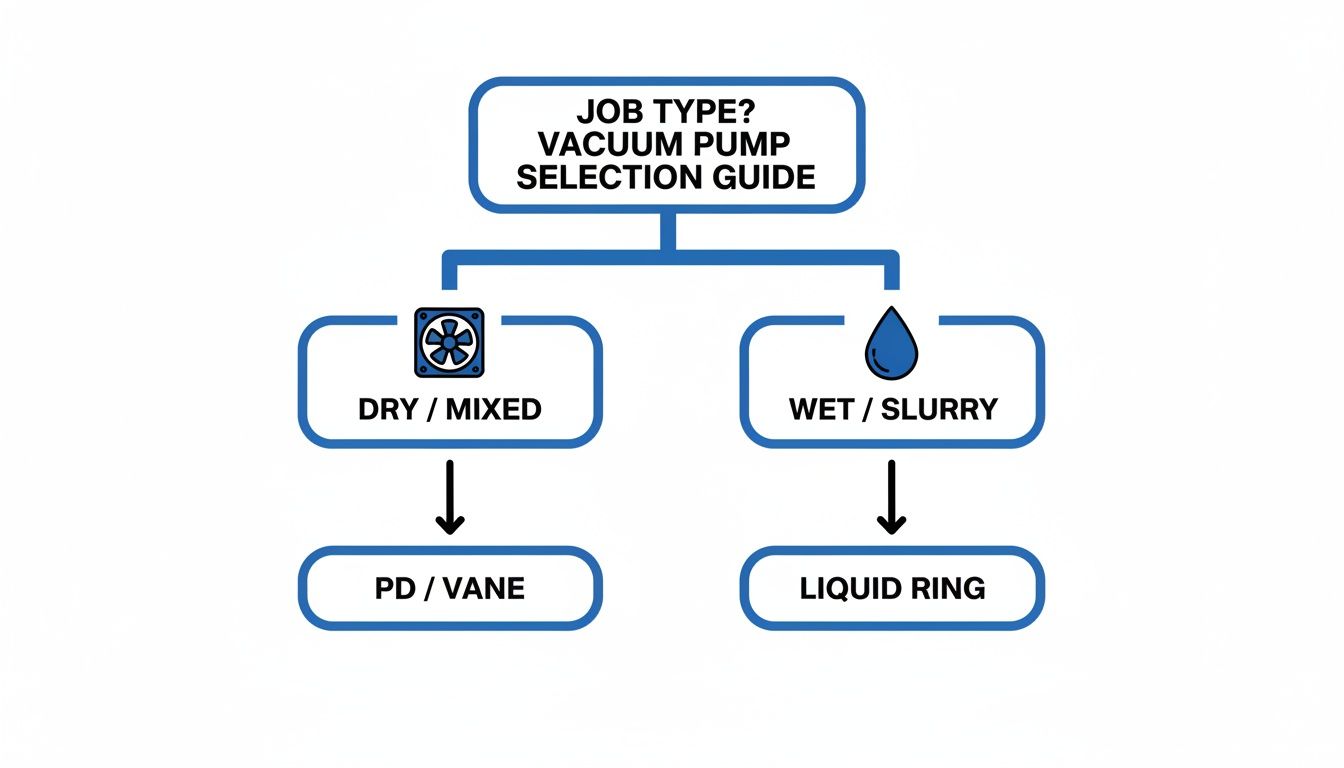
As you can see, the flowchart makes it clear: dry or mixed materials are best handled by PD or Vane pumps, while the tough, wet slurry jobs are a perfect match for durable Liquid Ring pumps.
To help you visualize this, here's a quick breakdown of which pump excels where.
Matching the Pump Type to the Hydrovac Job
Use this quick comparison table to see which pump type is the best fit for common hydro excavation tasks, helping you make smarter decisions on the job site.
| Pump Type | Ideal For | Core Strengths | Key Limitations |
|---|---|---|---|
| Liquid Ring | Wet, slurry-based excavation; potholing; sewer cleaning | Can handle liquids continuously; very durable | Lower vacuum levels (Hg); requires water |
| Rotary Vane | Dry excavation; industrial cleaning; mixed wet/dry materials | High vacuum levels (Hg); good for dry materials | Vanes can wear; sensitive to ingested liquids |
| Rotary Lobe (PD) | Moving large volumes of air; dry material transfer | Extremely high CFM; efficient for dry bulk | Lower vacuum; intolerant of solids/liquids |
| Centrifugal | Primarily for moving liquids; dewatering | Excellent for high-volume liquid transfer | Does not create a vacuum on its own |
This table serves as a great starting point for matching your equipment to the specific challenges of your next hydro excavation project.
The Critical Role of the Nozzle
Here’s a crucial insight from the hydrovac industry: even the most powerful vac truck pumps are useless if their power is squandered at the point of contact. The end of the hose is where efficiency is either won or lost. An open, unsealed hose lets ambient air rush in, which massively weakens the focused suction you need to actually dig.
You could have 5,000 CFM at the truck, but if you're losing half of that to air leaks around the nozzle, you're only digging with 2,500 CFM of effective power. It's like trying to drink through a straw with a giant hole in the side.
This is exactly where the Hydrovac Attachment Tool offers a game-changing solution. By creating a sealed suction zone right on the ground, it stops that outside air from leaking in. This simple step ensures that every bit of CFM and Hg your pump generates is concentrated into a focused, high-velocity column of air. This prevents power loss and turns your standard equipment into a precision digging tool, dramatically boosting your efficiency without needing a bigger pump. You can learn more about the science of vacuum suction power in our article.
This focus on efficiency lines up with what's happening in the wider industry. Liquid suction trucks already make up over 60% of the vacuum truck market, and industrial cleaning is driving over 35% of the demand. This shows a strong preference for gear that can handle both liquids and solids with precision—especially portable solutions that integrate with common setups like 2.5-inch wet vac tubes. By optimizing the tools you use at the end of the hose, you can meet this demand far more effectively.
Keeping Your Pump in Fighting Shape
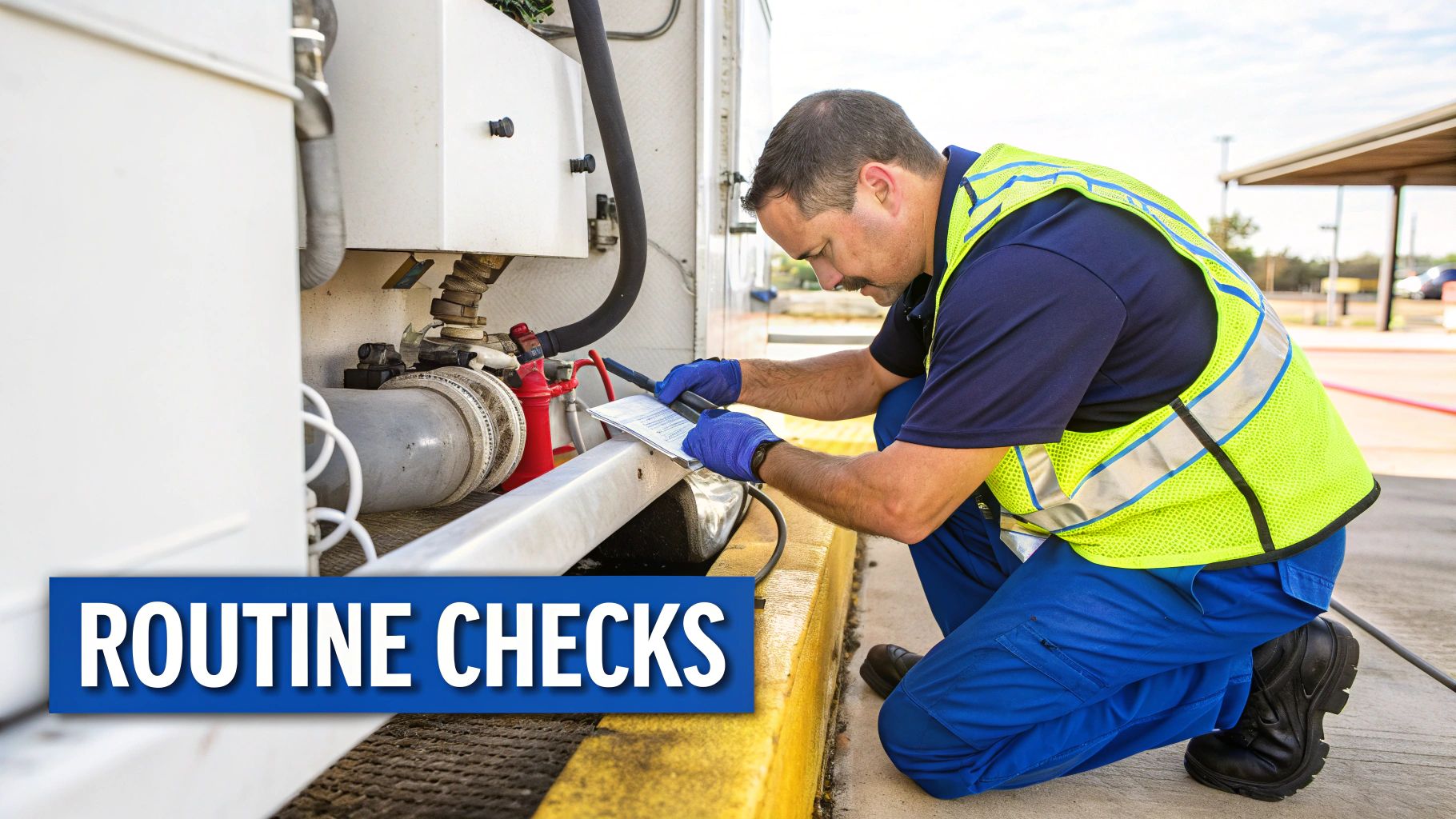
Even the most powerful vac truck pumps are worthless if they're not maintained. In the hydrovac industry, downtime isn't just an inconvenience; it's money straight out of your pocket. That's why a smart maintenance schedule isn't just "good practice"—it's the foundation of a successful operation. Think of the pump as the heart of your rig. If it's not healthy, the whole system suffers.
Preventative maintenance is all about spotting the small stuff before it becomes a big, expensive, job-stopping disaster. Taking a few minutes to inspect your gear at the start of each day can literally save you thousands of dollars and days of lost work. It’s a simple routine that protects your most critical asset.
This discipline pays off on the job site. A pump pulling its rated CFM and Hg means you can dig efficiently and predictably. When you combine that reliable power with a tool like the Hydrovac Attachment Tool, which provides a solution to keep you from losing suction right at the nozzle, you’ve got a recipe for serious productivity. Your crew can trust the gear to do its job, letting them focus on digging safely and getting the work done right.
The Daily Pump Health Check
Before you even think about starting the engine, do a quick walk-around. It’s not optional. These checks take less than five minutes and are your best defense against a bad day.
- Fluid Levels: Your pump needs oil just like your truck's engine. Check the levels to make sure they're in the sweet spot. Low oil leads to overheating and will absolutely destroy internal components.
- Filter Inspection: Think of the primary and secondary filters as the pump's lungs. Make sure they're clean. Clogged filters kill your airflow and, worse, can let damaging dirt and debris get sucked into the pump.
- Leak Search: Get your eyes on every hose, fitting, and seal. You're looking for any drip or wet spot. A tiny leak is a clear warning sign that a seal is about to fail completely.
Weekly and Monthly Maintenance Deep Dives
Setting aside a little more time each week and month will dramatically extend the life of your vac truck pumps and keep them running at full strength. These checks go deeper than a quick daily glance.
A well-maintained pump doesn't just prevent breakdowns; it ensures consistent suction power. This reliability is the foundation of efficient hydro excavation, protecting your investment, your timelines, and your reputation on every single project.
On your weekly check, use your ears. Listen for any weird noises when the pump is running—grinding, knocking, or whining can all point to internal wear. Also, feel for excessive vibration, which might mean a bearing is on its way out.
Monthly checks get a bit more hands-on. This is when you'll grease the fittings, check the tension on your drive belts, and clean off the pump’s cooling fins so it can shed heat properly. If you're curious about different power sources, you can learn about gasoline-powered vacuum units in our detailed guide. Sticking to this schedule ensures your equipment is always ready to go, delivering every bit of power to the Hydrovac Attachment for maximum digging force.
How to Troubleshoot Common Pump Problems
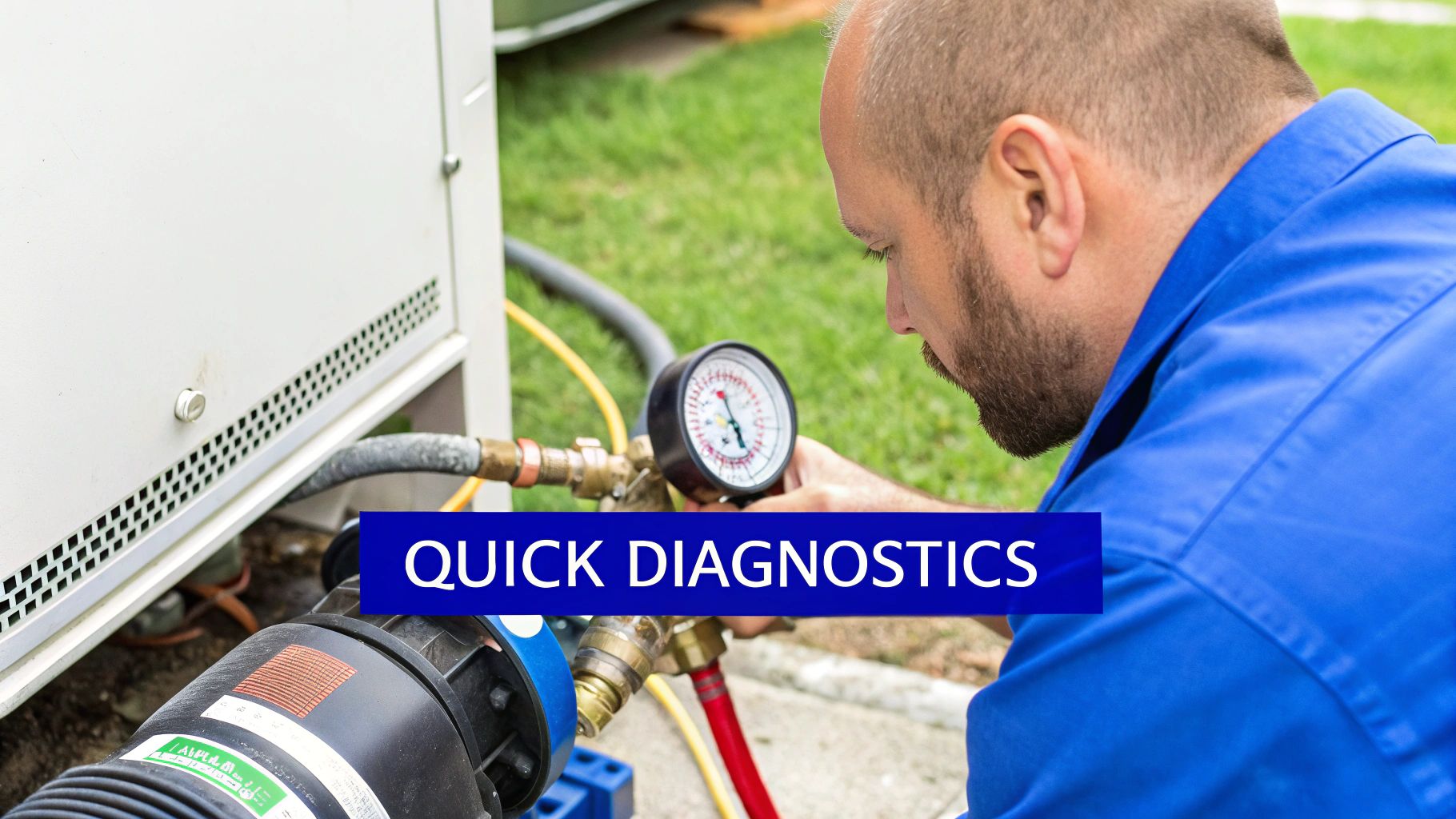
When the suction disappears or a new, ugly noise starts coming from your pump, every minute of downtime costs you money. On a busy hydrovac site, you can't afford to play guessing games. The key is having a methodical troubleshooting process to find the real problem fast and get back to work.
An important industry insight is that most performance issues that seem like a catastrophic pump failure are actually happening somewhere else entirely. Before you start pricing out a new pump, always start your diagnosis at the one place most people overlook: the very end of the hose.
Start With the Basics: Sudden Loss of Suction
A sudden drop in vacuum is the most common call for help, but the root cause is often surprisingly simple. Before you start tearing into the pump itself, run through this quick diagnostic checklist. This simple process of elimination will save you a world of frustration.
- Check for Clogs: The number one offender is almost always a blockage in the hose or right at the debris tank inlet. Even a small obstruction can stop airflow dead in its tracks, making it feel like the pump gave up.
- Inspect Your Filters: Think of the primary and secondary filters as the lungs of your system. If they get clogged with fine dust or saturated with moisture, they'll suffocate the airflow and kill your suction.
- Hunt for Air Leaks: A cracked hose, a fitting that’s worked itself loose, or a bad seal on the debris tank door will let outside air rush in, bleeding off your vacuum power. A distinct hissing sound is the tell-tale sign of a leak.
One of the sneakiest culprits for suction loss happens right at the point of excavation. If the nozzle isn't sealed against the ground, you're just sucking in ambient air, which massively dilutes the pump’s power exactly where you need it.
An air leak at the nozzle is like trying to drink through a straw with a hole in it. The pump is still pulling just as hard, but all its effort is wasted on pulling in useless air instead of the material you’re trying to move.
This is the exact problem the Hydrovac Attachment Tool was engineered to fix. Its secure clamp creates a sealed suction zone on the ground, providing a direct solution to air leaks at the source. By ruling out this common performance-killer first, you can get a much clearer picture of whether the problem is actually with your vac truck pumps.
Diagnosing More Serious Symptoms
If you've checked all the basics and your performance is still lagging, it's time to turn your attention to the pump itself. Specific symptoms are your best clues for figuring out what's wrong. For example, a pump running unusually hot often points to a lack of lubrication or restricted airflow that's making it work way too hard.
Strange noises are another major red flag. A loud grinding or knocking sound is a serious warning that debris has somehow gotten past the filters and into the pump. This could mean you have worn-out vanes or damaged lobes. If you hear anything like that, shut the system down immediately to prevent catastrophic failure. By working your way methodically from the nozzle back to the pump, you can diagnose problems quickly, safely, and get back on track.
Essential Safety Protocols for Vac Pump Operations
The sheer power you're dealing with in a vac truck pump demands a healthy dose of respect. On any hydrovac job, safety trumps performance every single time. A good day isn't just about getting the work done; it's about making sure every crew member heads home in one piece.
Following strict safety protocols isn't just about ticking boxes for compliance. It’s about building a professional culture where protecting your team, your equipment, and the public is second nature. The immense forces inside these systems can turn a small mistake into a major accident in the blink of an eye, which is why a disciplined approach is non-negotiable for everyone, from the rookie to the 20-year veteran.
Lockout/Tagout: The Unskippable First Step
Before anyone lays a hand on that pump for maintenance, the very first thing you do is Lockout/Tagout (LOTO). This is the absolute, must-do procedure to guarantee the machine is off and stays off until the work is finished.
- Kill the Power: Completely disconnect the main energy source. No shortcuts.
- Lock and Tag It: Slap a physical lock on the power source. Attach a tag that clearly states the equipment is being serviced and who is working on it.
- Double-Check: The final, crucial step is to try and start the machine. This confirms it’s well and truly de-energized.
This simple routine is what stands between you and an accidental start-up, a primary cause of serious injuries in this line of work.
Personal Protective Equipment and Being Aware of the Dangers
Your Personal Protective Equipment (PPE) is your first line of defense out there. The noise from these high-powered vac truck pumps can be deafening, so hearing protection isn't optional—it's essential. Of course, safety glasses, steel-toed boots, and high-visibility gear should be standard issue for every job.
Safety isn't a checklist you rush through at the start of the day. It’s a mindset you carry from the moment you step on-site to the final cleanup. You have to stay alert to what could go wrong.
A huge risk is component failure under pressure. Hoses, clamps, and fittings take a beating, so they need to be inspected constantly for wear and tear. A hose that blows under pressure is like a small explosion, and it’s an incredibly dangerous situation.
This focus on safety is more important than ever. The demand for powerful vacuum solutions is booming, with the North American market projected to hit USD 1,179.88 million by 2032, thanks to new infrastructure projects and tighter regulations. Discover more insights about the global vacuum truck market. For hydrovac crews who want to capitalize on this growth, pairing effective digging solutions like the Hydrovac Attachment Tool with an uncompromising commitment to safety is the only way to work.
Your Top Questions About Vac Truck Pumps Answered
Even the most seasoned operators run into questions about the heart of their rig: the vacuum pump. Getting straight answers is the key to making the right calls on the job and keeping your operation humming. Let’s dig into some of the most common questions we hear from the hydrovac industry.
The idea here is to connect the dots between the technical specs on paper and how your truck actually performs in the dirt. A solid grasp of these concepts makes a real difference in your day-to-day productivity.
What’s the Difference Between CFM and Mercury?
This is, without a doubt, the number one point of confusion. The easiest way to think about it is "reach" versus "strength."
CFM (Cubic Feet per Minute) is all about airflow. Think of it like a powerful river current carrying debris downstream. A high CFM rating means your pump can move a large volume of air, which is what keeps slurry, rocks, and soil moving smoothly down the hose without getting stuck. It’s the reach that pulls material from a distance.
Mercury (Hg), on the other hand, is pure, brute-force lifting power. This is the strength that breaks heavy, compacted clay or a stubborn rock free from the ground to begin with. For serious hydro excavation, you need a healthy balance of both—one is useless without the other.
How Can I Get More Digging Power Without Buying a New Pump?
Believe it or not, the fastest and cheapest way to get more power is to stop wasting the power you’re already making. A shocking amount of suction is lost to air leaks right where the work happens—at the end of the hose. This is the biggest thief of performance on any job site.
The solution is using a specialized tool like the Hydrovac Attachment, which creates a solid seal against the ground.
This simple change forces 100% of your pump's airflow and suction directly into the soil. The result is an instant boost in digging speed and efficiency, all without a single tweak to your truck. You’re simply turning wasted power back into productive work.
It’s the quickest path to making your current equipment perform like a much stronger machine and the ideal solution for effective digging.
Which Pump Is Better for Wet Versus Dry Material?
The right pump really comes down to how it’s built. Positive Displacement (PD) pumps, including Rotary Vane models, are essentially high-powered air movers. This makes them champs at both dry vacuuming and handling the wet slurry found in hydrovac work, provided you have a good filtration system protecting their insides.
Liquid Ring pumps are a different beast. They use a spinning ring of water to create the vacuum. This design makes them incredibly rugged and fantastic for moving wet, heavy materials like sludge and slurry. However, because they rely on water, they aren't quite as efficient for purely dry applications.
What Are the First Warning Signs of Pump Failure?
The earliest clues that your pump is in trouble are almost always small changes in how it sounds or performs. Your ears are often the best first line of defense against a major breakdown that could sideline your truck for weeks.
Keep an eye (and ear) out for these red flags:
- A Drop in Suction: If you’ve cleaned the filters and checked for clogs but the power still feels weak, the problem is likely inside the pump.
- Running Hot: A pump that's suddenly hotter than normal is often screaming for help. It could be a lubrication issue or internal friction from worn-out parts.
- Strange Noises: Any new metallic grinding, clunking, or high-pitched whining is a bad sign. These are urgent warnings that internal components are failing.
- Visible Leaks: An oil drip from the pump housing means a seal has failed. That’s a problem you need to address immediately.
Catching these issues early can mean the difference between a simple repair and a full, costly replacement.
At Hydrovac Attachment, our focus is on providing solutions for more effective digging by helping you maximize the power you already own. Our patented tool ensures every ounce of your pump's performance goes into the ground, helping you work faster, safer, and more profitably.
Explore the Hydrovac Attachment and transform your digging power today.