


Think about using a stream of water to dig with the precision of a surgeon. It's not science fiction—it's a game-changer for landscapers, yard care professionals, and even ambitious DIYers. The secret lies in specialized sewer jetting nozzles, which can turn a regular pressure washer into a powerful, pinpoint digging tool.
The Power of Water for Precision Digging
We’ve all been there. Traditional digging is messy and full of risks. A misplaced shovel or a mechanical auger can easily hit a buried utility line, turning a simple project like digging a fence post hole into a costly and dangerous nightmare. On top of that, you're left with a scarred landscape and a mountain of displaced soil to clean up. It's back-breaking work that's often inefficient and risky.
There’s a much smarter way to work. By using the focused power of hydro excavation, you can liquefy soil and break it apart without the brute force of a metal blade. This technique is a cleaner, more precise, and far safer alternative for all kinds of outdoor jobs, from setting fence posts to digging up pipes without damage.
Working Smarter, Not Harder
The concept is beautifully simple. Combine the right nozzle with a system that can suck away the debris, and you have a portable digging powerhouse. This is exactly what tools like the Hydrovac Attachment Tool are designed for. It brings together a pressure washer's high-pressure water jet and the suction of a wet vac hose, creating a clean system that blasts away soil and removes it in one go. This tool is a mobile solution designed for wet vacs to clear small amounts of debris, not for large hydrovac trucks.
This approach is perfect for jobs that demand a delicate touch:
- Setting Fence Posts: Create perfectly sized holes without tearing up your lawn.
- Exposing Irrigation Pipes: Gently uncover sprinkler lines for repairs or adjustments without causing damage.
- Locating Utilities: Safely "daylight" buried pipes and cables to verify their position before you bring in the heavy equipment.
This kind of focused water-jet technology is already trusted by professionals everywhere. For instance, many plumbing companies use similar principles for non-destructive drain cleaning, proving just how versatile and reliable this method is.
A Growing Industry Standard
Sewer jetting nozzles have become essential tools in the plumbing and municipal maintenance worlds, where high-pressure water jets clear out the toughest blockages. It’s no surprise that the global market for this equipment is booming.
A recent market analysis valued the worldwide sewer jetter equipment market at $1.5 billion in 2025, with a forecast to hit an impressive $2.6 billion by 2033. This incredible growth shows just how much the industry relies on water-based solutions. By adapting this same technology for your own digging projects with the Hydrovac Attachment Tool, you’re essentially bringing industrial-grade precision right into your backyard. You can dive deeper into the sewer jetter equipment trends to see where the industry is heading.
Understanding Nozzle Types and Spray Patterns
Not all nozzles are created equal. Far from it. Choosing the right one is the real secret behind turning a tough digging job into a quick, clean operation.
Think of your hydrovac nozzles like the different bits for a power drill. You wouldn't use a tiny precision bit to drill a massive hole, and you certainly wouldn't use a clunky spade bit for a delicate task. It's the same exact logic here—the nozzle has to match the job.
The secret is in the spray pattern, which is just a term for the angle and direction of the water jets. Each pattern is engineered to do something very specific, whether that's blasting through compacted clay for a fence post or gently clearing loose dirt away from a sensitive utility line. Getting a handle on these patterns is your first step toward true hydrovac mastery.
Penetrating vs. Flushing Nozzles
The two main players you'll work with are penetrating nozzles and flushing nozzles.
A penetrating nozzle, often called a "chisel point" or "digger" nozzle, is your powerhouse. It’s built with one or more forward-facing jets that shoot an incredibly focused, powerful stream of water straight ahead. This design is your go-to for breaking up tough, dense soil or boring a pilot hole for something like a fence post. It's all about raw, concentrated power to get the job started.
On the flip side, a flushing nozzle (you'll often see "spinner" or "rotating" types) is all about finesse. Instead of forward jets, these nozzles have jets angled out to the side and even to the rear, often spinning rapidly. Their job isn't to drill deeper but to widen the hole and scour the sides, clearing away all the loosened soil and debris.
This is the nozzle you'll grab after a penetrator has done the heavy lifting, or when you need to gently expose a fragile pipe without risking a direct hit. When you pair this action with the vacuum suction from a tool like the Hydrovac Attachment Tool, the flushing spray pushes all that liquefied mud and debris right into the wet vac hose. Cleanup becomes practically an afterthought.
The difference between this controlled method and old-school digging couldn't be more stark. Mechanical digging constantly risks damaging pipes, but hydro excavation is a whole different ballgame.
As you can see, hydro excavation completely sidesteps the common, costly mistakes that plague traditional methods, keeping those essential underground utilities safe and sound.
The Role of Jet Angles
Digging a little deeper, the specific angle of the water jets makes a huge difference in how a nozzle performs. These angles are measured in degrees from the nozzle's center line.
- 0-Degree Jets: These are the forward-blasting jets you'll find on penetrating nozzles. They deliver maximum impact force for breaking up hardpan or stubborn soil.
- 15 to 25-Degree Jets: This is the sweet spot for a good balance of thrust and cleaning power. These angled jets help propel the nozzle forward while simultaneously scouring the sides of the hole.
- 45-Degree and Wider Jets: Common on flushers and spinners, these wide-angle jets create a broad cleaning path perfect for clearing out large volumes of loose material quickly.
The numbers don't lie. High-pressure systems running above 4000 PSI can achieve cleaning rates 3x faster than other methods. For operators potholing utilities, nozzles with 15-25 degree spray angles can cut down on messy overspray by a whopping 70%. This channels the slurry directly into the vacuum stream, making the whole process cleaner and more efficient.
To give you a better idea of which tool to grab for which job, here’s a quick reference chart.
Matching Nozzle Spray Patterns to Digging Tasks
| Nozzle Type | Primary Spray Pattern | Best Use Case | How It Works for Digging |
|---|---|---|---|
| Penetrating/Digger | Forward-facing (0°) jets | Breaking up hard, compacted soil; digging post holes | Focuses all the water pressure into a single, powerful point to act like a hydraulic chisel. |
| Flushing/Spinner | Side and rear-facing (>30°) | Widening holes; exposing pipes safely | The wide spray scours the sides of the excavation, pushing loose material toward the vacuum hose. |
| Cornering Nozzle | Forward and side jets | Cleaning inside corners or around obstacles | Provides a forward thrust to navigate bends while side jets clear material away from the walls. |
| General Purpose | Mix of forward & rear jets | All-around cleaning and moderate digging | A jack-of-all-trades nozzle that balances forward momentum with cleaning power for varied conditions. |
Think of this table as your field guide. It’s designed to help you quickly match the right nozzle to your specific task, saving you time and headaches on the job site.
A worn-out nozzle is like trying to dig with a dull shovel. When the orifices get eroded, the water jets start to "mist" instead of forming tight, coherent streams. This absolutely kills your digging power and efficiency. Regular inspection is non-negotiable.
Ultimately, the most effective strategy is often to combine different nozzles. Start with a penetrating nozzle to punch through the tough stuff and create your initial hole. Then, swap it out for a flusher or spinner to widen the hole to the exact dimensions you need.
This simple two-step process turns what could be a complex digging task into a controlled, manageable, and incredibly precise operation. For a deeper dive into the physics behind these tools, our guide on how water jetting nozzles work is a great resource.
How to Choose the Right Nozzle for Your Project
Picking the right sewer jetting nozzle isn't a game of chance. It’s a calculated decision that can make or break your project, dictating how fast, clean, and safe the job gets done. The right nozzle lets you dig with surgical precision, sidestepping potential damage and saving a ton of time.
Getting this choice right boils down to a simple, three-step framework: what’s the goal, what’s the ground like, and what gear are you running? This becomes even more critical when you're using a controlled system like the Hydrovac Attachment Tool, where finesse often beats brute force. You're not just blasting dirt; you're performing a careful excavation.
Assess Your Digging Goal
First things first, what does a successful job look like? Your main objective will point you directly to the right nozzle and spray pattern. Are you trying to punch a deep, narrow hole, or are you gently clearing away soil over a wider area?
Let's look at a couple of common residential jobs:
- Digging a Fence Post Hole: Here, the name of the game is depth and creating a clean, uniform cylinder. A penetrating nozzle with a 0-degree forward jet is your best bet. Think of it like a hydraulic drill—it bores straight down to create an efficient pilot hole.
- Exposing a Buried Pipe: This is all about precision and safety. You need to get the soil out of the way without nicking the utility line. A flushing or spinner nozzle with wide-angle jets is perfect for this. It scours soil from the sides instead of blasting it directly at the pipe you’re trying to protect.
Starting with the end goal in mind keeps you from grabbing a tool that’s either way too aggressive or not nearly powerful enough for the task at hand.
Analyze the Ground Conditions
Next, get a feel for what you’re digging into. Soil type is a huge variable, as different materials react completely differently to pressurized water.
Soft, loamy soil breaks apart easily and doesn't require a lot of focused power. On the flip side, dense, compacted clay or rocky soil demands a much more aggressive approach. A nozzle that cuts through sandy soil like butter might barely scratch the surface of hardpan clay.
With a controlled tool like the Hydrovac Attachment Tool, precision is more important than raw power. The idea is to methodically liquefy and vacuum the soil, not blast a huge, messy crater.
For tough ground, you'll want a nozzle that concentrates your pressure washer's PSI into a fine, powerful stream. For looser stuff, a nozzle with a wider spray pattern can clear a larger area much faster by maximizing your GPM to move more debris.
Match the Nozzle to Your Machine
Finally, and this part is non-negotiable, you have to match the nozzle to your equipment's specs. The nozzle you pick absolutely must be calibrated for your pressure washer’s gallons per minute (GPM) and pounds per square inch (PSI) ratings. This is probably the most crucial technical step.
A nozzle is just a carefully engineered restriction. If its orifice—the tiny hole where the water shoots out—is too big for your machine's flow rate, your pressure will plummet, leaving you with a weak, useless spray. If it's too small, you can over-pressurize the whole system and risk damaging your pressure washer's pump.
- High PSI, Low GPM: This combination is fantastic for delicate jobs. The high pressure gives you the cutting power you need, while the lower flow rate makes the water and resulting slurry much easier to manage with a wet vac.
- Higher GPM: When you need to move a lot of soil quickly for bigger jobs like trenching, a higher GPM rating will speed things up. It simply liquefies and carries away more material with every gallon.
Choosing the right nozzle is just one piece of the puzzle. For a bigger picture of the essential equipment for your business, check out these Top Tools Every Plumbing Service Owner Should Have. Always, always, always consult the manufacturer’s nozzle sizing chart to find the perfect match for your pressure washer. It’s the only way to guarantee you get peak performance safely and efficiently.
Using Nozzles with a Hydrovac Attachment Tool
A powerful sewer jetting nozzle is only half the battle. Sure, it can liquefy and blast apart tough soil, but what do you do with the soupy mess it creates? That’s where the other half of the equation comes in, and it’s what turns a simple pressure washer and wet vac into a legitimate, portable hydro excavation system.
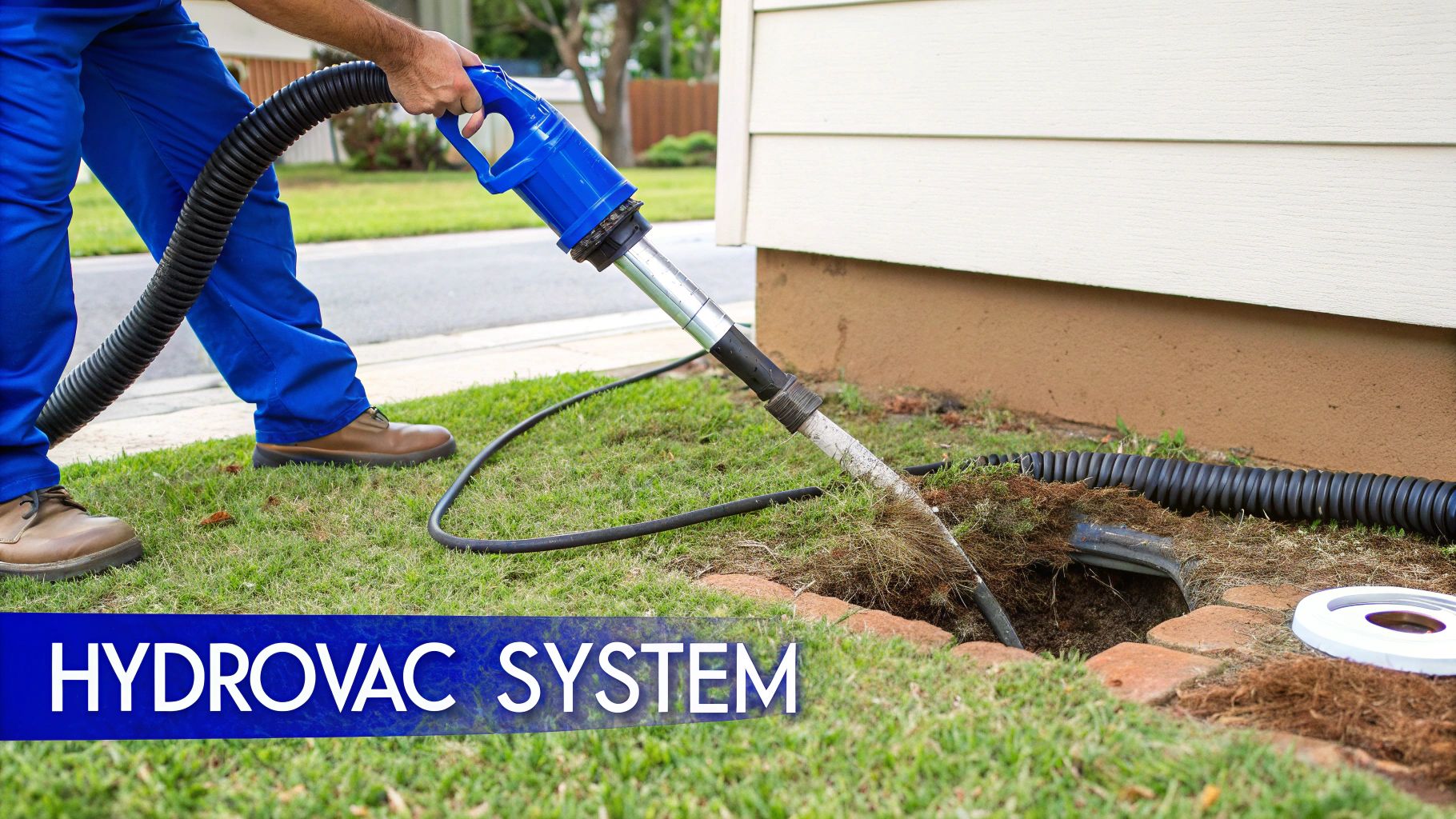
The magic is in the teamwork. The jetting nozzle does the heavy lifting, acting as the digging tool that turns compacted earth into a manageable slurry. At the exact same time, the Hydrovac Attachment Tool creates a powerful vacuum right at the tip, sucking that slurry away and into your wet vac instantly. This one-two punch gives you a clean, clear, and perfectly controlled workspace, so you can forget about the mud pits that come with traditional digging.
Practical Applications in Residential Digging
Let's be clear: we're not talking about the massive hydrovac trucks you see on city-wide projects. This setup is a nimble, go-anywhere solution made for the precision work common in yard care, residential repairs, and other small-scale jobs. The Hydrovac Attachment Tool was designed from the ground up to connect a standard pressure washer with a wet vac hose, letting one person tackle jobs that used to be a messy, back-breaking group effort.
Here are a few real-world examples of how it all comes together:
- Digging Fence Post Holes: Grab a penetrating nozzle and pair it with the attachment. You can bore a perfect hole with zero mess. As the nozzle cuts through the soil, the vacuum pulls the debris out immediately, leaving you with a clean hole and pristine turf around it.
- Exposing Irrigation Lines: Switch over to a fan-spray nozzle to gently wash away soil from around delicate PVC or poly pipes. The vacuum draws the mud away cleanly, meaning you never have to risk hitting the line with a shovel again.
- Setting Deck Footings: Need to create precise footings right up against a house foundation? This controlled method lets you remove only the soil you need to, keeping the job site tidy and professional.
The Clean, Damage-Free Advantage
The real beauty of pairing jetting nozzles with the Hydrovac Attachment Tool is how it takes risk and mess almost completely out of the picture. Digging with a shovel or an auger is always a gamble. You never quite know when you're about to hit a buried utility line, sprinkler pipe, or gas line. The consequences can be anything from a simple repair bill to a serious safety hazard.
Hydro excavation on this scale is just fundamentally safer. High-pressure water will slice through dirt, but it won’t instantly sever a buried cable or pipe, giving you a crucial moment to stop and see what you've found. Because the attachment provides immediate debris removal, your visibility stays crystal clear. You can actually see what you're exposing, as you expose it.
The Hydrovac Attachment Tool combines two distinct jobs—digging and cleaning—into a single, hyper-efficient action. It controls the water, captures the slurry, and stops your worksite from turning into a muddy swamp, saving a huge amount of time and labor.
This method also keeps your client's property looking sharp. There are no piles of dirt sitting on the lawn, and no mud splattered on the side of the house. All the excavated soil and water go straight into the wet vac for easy disposal. It’s a level of cleanliness that immediately sets a professional apart. To get a better look at how it all connects, you can check out the mechanics of a vacuum hose attachment and see how it streamlines the entire workflow.
Beyond Digging: Smart Debris Management
The usefulness of this combination tool doesn't stop at digging holes. It's a fantastic solution for any task where you need to move wet, messy debris without creating an even bigger problem. Think about cleaning out a clogged window well, clearing thick sediment from a sump pump pit, or removing a nasty clog of wet leaves from a storm drain.
The principle is identical. The pressure washer nozzle breaks up the compacted gunk, and the vacuum attachment whisks it away. This makes it an incredibly versatile piece of kit for landscapers, property maintenance crews, and anyone in the yard care business who wants to work smarter, not harder. It’s a modern approach that uses tools you probably already have—a pressure washer and a wet vac—to deliver faster, safer, and cleaner results on all your small-scale projects.
Best Practices for Safe and Efficient Digging
Using high-pressure water to dig is a game-changer, but all that power demands a serious focus on doing things the right way. Getting it right means every job, whether you're setting a simple fence post or carefully exposing a utility line, is done safely and efficiently. These best practices aren't just about following rules; they're about protecting yourself, the property, and making sure the job gets done properly.
This is exactly why controlled systems like the Hydrovac Attachment Tool are so valuable—they're designed to reduce job site risks while boosting how much you can get done in a day.
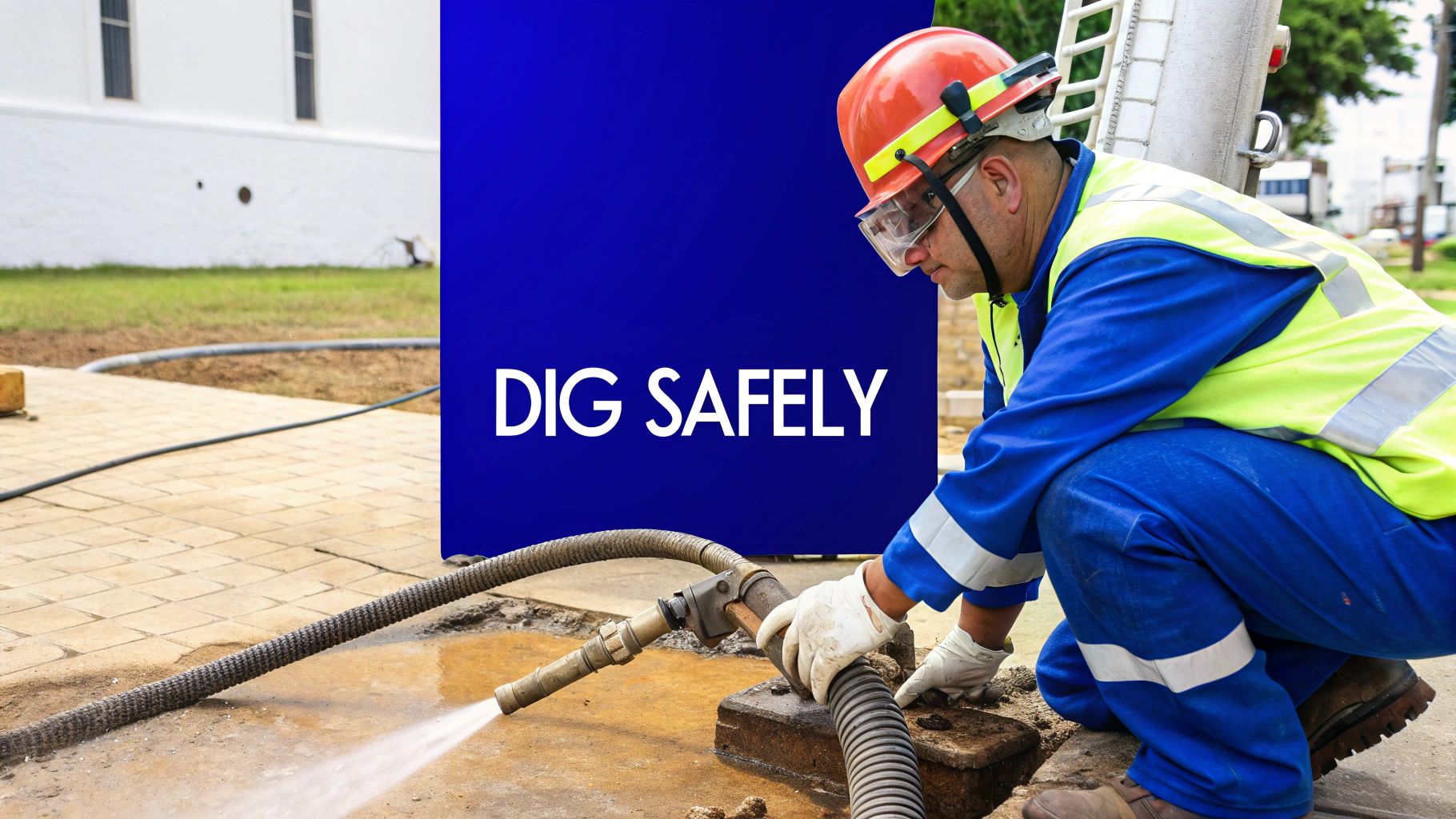
Before a single drop of water hits the ground, there's one step that is absolutely non-negotiable. Always, always call 811. This free service gets underground utility lines professionally located and marked, which is the single most important thing you can do to prevent a disaster. Hitting a buried gas, electric, or water line is a worst-case scenario you can easily avoid.
Gearing Up for a Clean Operation
With the utilities clearly marked, it's time to get your equipment and yourself ready. Pressurized water is no joke; it can turn tiny pebbles into high-speed projectiles and create a whole lot of splashback.
Your Must-Have Personal Protective Equipment (PPE):
- Safety Glasses or Goggles: This is non-negotiable for protecting your eyes from flying debris and spray.
- Waterproof Gloves: Keep your hands dry for a solid, safe grip on the wand.
- Steel-Toed, Waterproof Boots: Protect your feet from falling objects and the inevitable mud and water.
- Durable Work Pants: Your legs need a solid layer of protection from potential impacts and scrapes.
Next, give your wet vac a quick check. Make sure the filter is clean and the collection drum is empty. A vacuum that’s already full or clogged can't keep up with the slurry you're about to create, which defeats the whole purpose of a clean, controlled dig.
Mastering Your Digging Technique
Okay, safety checks are done. Now let's talk technique. The real skill is in methodical soil removal, not just blasting a hole and making a mess.
Always start with a lower pressure setting. This lets you get a feel for the soil's consistency and see how it reacts without immediately blowing it all over the place.
Think of it this way: a pro operator doesn't just squeeze the trigger and hope for the best. They work with intention, moving in a deliberate, circular pattern and only increasing the pressure as needed. This approach is what creates those clean, stable holes that are perfect for fence posts or footings.
When you're working to uncover a buried pipe, switch to a gentle sweeping motion, moving the nozzle from side to side. The key is to keep the wand moving and never point it directly at the utility line for more than a split second. Your goal is to wash soil away from the pipe, not blast at it. This technique, combined with the instant suction of the Hydrovac Attachment Tool, gives you the clear visibility you need to work without causing any damage.
Finally, remember that keeping your tools in good shape is just as important as your technique. To get a better handle on the hardware side of things, you can explore our other guides on choosing the right hydrovac excavation equipment for your specific jobs. By pairing solid prep work with smart digging practices, you can confidently take on any project—faster, smarter, and a whole lot safer.
Common Mistakes to Avoid When Hydro Digging
Hydro digging gives you incredible precision, but it's a game of inches where one wrong move can cause a real headache. We've all seen it: a simple dig turns into a muddy mess, or worse, a damaged utility line. Let's walk through the most common pitfalls so you can avoid them entirely.
Mistake Checklist
It usually comes down to a few key oversights that can snowball into bigger problems.
- Using the wrong nozzle for the soil you're cutting.
- Going in too hot with the pressure right next to fragile pipes.
- Ignoring where all that water is going and not having a containment plan.
A small oversight can turn a clean job into a muddy nightmare.
Knowing what these errors look like ahead of time is the best way to keep your jobs running smoothly and safely.
Avoiding Nozzle Mistakes
Think of it this way: trying to cut through hard-packed clay with a flusher nozzle is like trying to dig a trench with a push broom. You'll just make a mess on the surface.
A flusher is designed to spray sideways, clearing loose material, but it just doesn't have the focused power to break up dense ground. For that tough, compact soil, you need a penetrating nozzle to do the heavy lifting. Once the ground is broken up, then you can switch to a spinner to clean out the hole.
Managing Pressure and Runoff
Blasting away at maximum pressure right next to a PVC pipe or a fiber optic line is a recipe for disaster. It’s like pointing a fire hose at a stained-glass window—you're going to break something.
The smart approach is to start with a lower PSI and gradually increase it. This lets you see how the soil reacts without putting nearby utilities at risk.
- Always do a quick pressure test on a non-critical patch of ground first.
- Keep a close eye on your water flow to make sure you're not creating a swamp.
- Use a Hydrovac Attachment to suck up the slurry as you create it.
Controlling your runoff is just as important as controlling your pressure. The containment zone on the Hydrovac Attachment Tool is a game-changer here, funneling all that mud and debris straight into your wet vac before it can go anywhere else.
Underestimating how much slurry you're about to create is a classic rookie mistake. One minute you're digging, the next you're standing in a mud pit that's wrecking the customer's lawn.
| Mistake | Problem | Solution |
|---|---|---|
| Wrong nozzle type | Slow, messy progress in tough soils | Match the nozzle to the soil—use your nozzle guide! |
| Excessive pressure near pipes | High risk of pipe damage | Start with low PSI and increase it slowly and carefully. |
| Ignoring runoff | Giant mud pits and ruined landscaping | Use the Hydrovac Attachment Tool’s containment system. |
This little chart is a great cheat sheet for keeping things on track. The built-in vacuum zone on the attachment prevents that messy backwash, keeping the hole clean and your job site tidy.
Final Tips for Mess-Free Digging
Before you even pull the trigger, take a second to inspect your sewer jetting nozzles. A clogged or worn-out nozzle won't perform correctly and can be unsafe.
Make sure the clamps on your Hydrovac Attachment Tool are tight and the seals are in good shape to prevent leaks.
- Always double-check your 811 marks before breaking ground.
- Wear the right protective gear to guard against splashback and flying debris.
- Stick to the manufacturer's calibration guides for your nozzles—they exist for a reason.
Avoiding these common slip-ups is the key to faster, cleaner, and safer hydro excavation. When you have the Hydrovac Attachment Tool integrated into your workflow, you have total control over the entire process.
A little preparation and the right tool like the Hydrovac Attachment Tool turns every job into a clean success.
Steer clear of these traps, and you'll find your hydro digging jobs go from a potential hassle to a smooth, efficient process every single time.
Common Questions About Jetting Nozzles
Jumping into hydro digging for the first time? You've probably got a few questions. Let's walk through some of the most common ones to get you digging like a pro on your own projects.
Can I Use Any Pressure Washer?
While our Hydrovac Attachment Tool is built to snap right onto a standard pressure washer wand, not all machines are created equal. You need enough muscle to get the job done.
For effective digging, we recommend a pressure washer that can deliver at least 2000 PSI and 2.0 GPM. The real key, though, is matching the sewer jetting nozzle’s orifice size to your machine's specs. Get this wrong, and you'll either have weak pressure or risk burning out your pump. Always check the nozzle manufacturer's sizing chart—it's your roadmap to finding the perfect match.
How Does This Handle Hard or Rocky Soil?
Hydro excavation is a champ in most ground conditions, easily handling everything from loose sand to stubborn, dense clay. A high-PSI penetrating nozzle will make short work of compacted earth and even small gravel.
But let's be clear: this isn't a rock-cutting tool. You're not going to blast through solid bedrock. Where it truly shines in rocky soil is its precision. It washes away the dirt around the rocks, exposing them so you can pull them out by hand. Think about digging fence posts next to an old foundation—this is where that surgical control pays off.
The goal isn't to blast through rock but to work around it safely. This method allows for the careful removal of soil, preventing damage to both your equipment and any hidden utilities.
How Much Water Does This Actually Use?
Water consumption depends entirely on your pressure washer's GPM (gallons per minute) rating. Most residential units fall somewhere between 2-4 GPM.
That might sound like a lot, but context is everything. The incredible speed and efficiency of hydro digging mean you finish the job much faster. Plus, since the Hydrovac Attachment Tool captures all the slurry, you're not left with a massive, muddy cleanup job. When you factor it all in, you often use less water than you would with a shovel and hose. It’s simply a faster, cleaner process from start to finish.
What Kind of Maintenance Do These Nozzles Need?
Keeping your sewer jetting nozzles in top shape is straightforward but absolutely critical for performance.
After every job, give the nozzle a quick flush with clean water. This clears out any grit or debris that could clog the tiny orifices. Every so often, give them a good look-over for wear and tear. Damaged or eroded orifices will kill your pressure and turn a focused jet into a useless, misty spray. Using a worn-out nozzle is like trying to dig with a dull shovel—it just makes more work for you. Storing them in a dry spot prevents corrosion and keeps them ready for action.
When you need this kind of precision for your home and yard projects, the Hydrovac Attachment Tool is the answer. It combines the power of your pressure washer and wet vac into one clean, safe, and efficient digging system. See how it can completely change your workflow at the official Hydrovac Attachment website.