


At the business end of every high-pressure jetter hose is the tool that does all the real work: the sewer jetter nozzle. Think of it less as an accessory and more as the mission-critical tip of the spear. It's what takes the raw, untamed power from your pump and transforms it into a surgical instrument for blasting, cutting, and clearing out pipes. For the hydrovac industry, it's the component that enables precision digging.
The Power Behind Precision Hydro Excavation
In hydro excavation, success is often measured in inches. While the muscle comes from the truck's pump, the real precision and effectiveness come from a much smaller, often overlooked component—the sewer jetter nozzle. This guide isn't about treating nozzles as simple attachments. It's about understanding them as the instruments that make or break a job.
Think about a professional camera. The body has all the power and tech, but it’s the lens that focuses light to capture a brilliant, sharp photo. A sewer jetter nozzle works exactly the same way. It takes raw hydraulic force and concentrates it into a focused, powerful tool that gets the job done, whether that’s shredding a massive tree root or carefully digging around fragile utility lines.
Why Nozzle Selection Is Mission-Critical
Let’s be blunt: choosing the right nozzle is often the difference between a profitable day and a costly one. When you match the nozzle to the job, you work faster, you avoid damaging client infrastructure, and you keep your crew safer. In the hydrovac business, that choice hits your bottom line directly.
The need for this expertise is only growing. The global market for sewer jetter equipment hit $2.5 billion in 2024 and is on track to reach $3.8 billion by 2029. This boom is driven by expanding cities and the non-negotiable need to maintain aging sewer systems. For hydrovac operators, it means that mastering advanced nozzle technology isn't just an advantage—it's essential.
A nozzle is more than just a piece of metal; it’s a force multiplier. It dictates how efficiently you use water, fuel, and time on site. Getting it right means completing jobs faster, safer, and with greater precision.
For crews running hydrovacs, pairing the right nozzle with a tool like The Hydrovac Attachment Tool takes this precision to a whole new level. This combination turns a high-pressure job that could be messy and chaotic into a clean, controlled, surgical operation. The attachment makes non-destructive digging a truly refined process by containing both the water jet and the slurry it creates right at the vacuum hose. While specialized tools are key, it also helps to have a solid grasp of general pressure washing techniques to understand the fundamentals of high-pressure water.
At the end of the day, mastering nozzle selection isn’t just a technical skill. For any serious hydro excavation professional, it's a core business strategy.
Understanding how each characteristic of a nozzle translates to on-the-ground performance is crucial. The table below breaks down the direct connection between your nozzle choice and the results you get.
How Your Sewer Jetter Nozzle Choice Impacts Performance
| Nozzle Characteristic | Impact on Performance | Ideal Application |
|---|---|---|
| Spray Pattern | Determines where the force is directed—forward, backward, or sideways. | Thrust, cleaning, cutting, or a combination. |
| PSI/GPM Rating | Ensures the nozzle operates safely and effectively with your pump. | Matching nozzle to the pump's output for peak efficiency. |
| Material/Construction | Affects durability, wear resistance, and lifespan. | High-wear jobs like descaling or sand removal. |
| Orifice Size | Controls the pressure and flow, directly impacting cutting power. | Fine-tuning performance for specific blockages. |
Getting these details right isn't just about doing the job; it's about doing the job well, protecting your equipment, and building a reputation for reliable, expert work.
Understanding Nozzle Designs and Spray Patterns
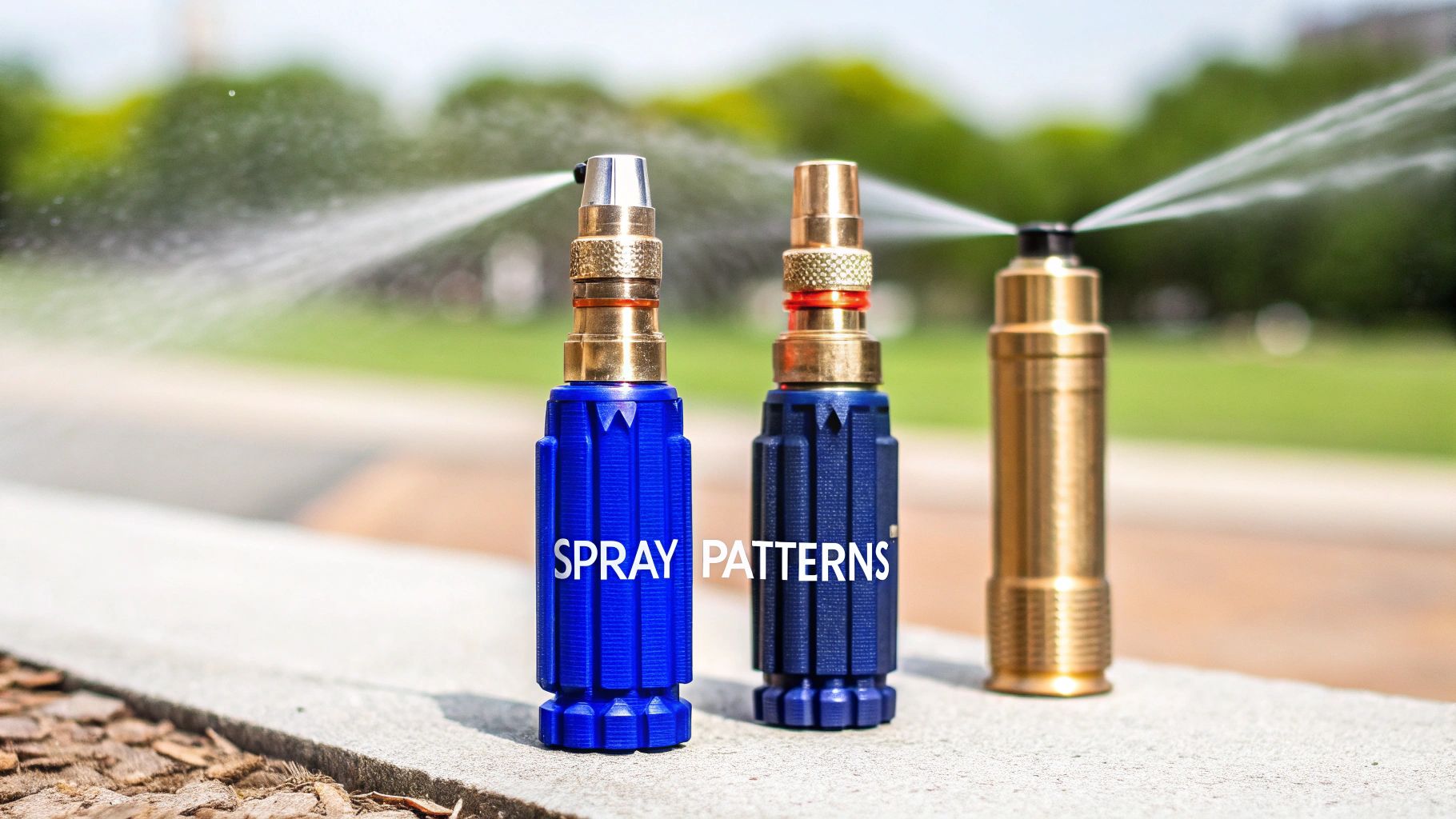
To really get the most out of your hydrovac, you have to look past the pump and focus on what's happening at the business end of the hose. The nozzle is where all that raw power gets focused into precise, effective action. Getting a handle on the engineering behind sewer jetter nozzles is a game-changer for any operator, because the nozzle’s design is what controls exactly how that water pressure hits a blockage or the soil itself.
Think of it this way: you wouldn't use a sledgehammer for a delicate carving job. The same idea applies underground. Each nozzle is designed for a specific mission, whether it's blasting through a solid clog or meticulously excavating soil.
The Purpose Behind Every Jet
The real magic of a sewer jetter nozzle is in the angle and placement of its jets, or orifices. Every single jet has a job to do. Once you understand their roles, you can almost see the work happening deep inside the pipe.
- Forward-Facing Jets: These are your spearhead. They shoot a focused, powerful stream of water straight ahead to punch through tough blockages like ice, impacted dirt, or other densely packed gunk. In hydro excavation, these jets are what break up compacted soil.
- Rear-Facing Jets: These are the engines. Angled backward, they generate a powerful thrust that literally pulls the nozzle and hose down the line. As a bonus, they also blast all the loosened debris back toward you for easy vacuuming.
- Side Jets: Think of these as scrub brushes. Set at or near a 90-degree angle, they scour the inside of the pipe, stripping away grease, mineral scale, and other buildup that the rear jets might just fly past.
It's this combination of forces that makes jetting work so well. A good nozzle creates a symphony of jets that cut, propel, and clean all at once, making every gallon of water count. For a deeper dive into how these principles work for different hydro excavation jobs, you can learn more about water jet nozzles in our detailed guide.
Tiers of Nozzles for Different Jobs
Not all nozzles are built the same. In the hydrovac world, we generally group them into three tiers based on their design and what they're meant to do. Thinking in these tiers helps you grab the right tool for the job without a lot of guesswork.
The right nozzle is the difference between a quick, profitable job and a long, frustrating one. It's about applying the right kind of force in the right direction—whether that's cutting, flushing, or scouring.
From basic clean-outs to the toughest blockages, there’s a tier for everything.
- Tier 1 Nozzles (Flushers): These are your everyday workhorses. They're simple, tough, and have mostly rear-facing jets for maximum thrust and flushing power. Perfect for moving sand, loose gravel, and general debris in lines that are in decent shape.
- Tier 2 Nozzles (Cleaners): This is where you get a bit more specialized. Tier 2 nozzles often mix rear and side jets to give you both forward momentum and serious wall-cleaning power. They’re your go-to for cutting through grease and light scale.
- Tier 3 Nozzles (Cutters): When you hit a major roadblock, these are the tools you need. This category includes rotating nozzles, chain flails, and other heavy-duty mechanical cutters. A rotary nozzle, for instance, spins like a top to create a 360-degree spray pattern—a mini-vortex that shreds heavy grease and can even slice through thick tree roots.
For a hydrovac operator, this is crucial knowledge. When you pair a powerful Tier 3 cutting nozzle with a tool like the The Hydrovac Attachment Tool, you’ve created a precision digging machine. The nozzle does the aggressive cutting, while the attachment instantly contains the slurry and vacuums it away, turning a messy, difficult job into a clean, controlled excavation.
Balancing GPM and PSI for Maximum Effect
Any experienced hydrovac operator will tell you that successful digging and cleaning isn’t just about raw power—it’s about smart power. This is where the delicate balance between Gallons Per Minute (GPM) and Pounds per Square Inch (PSI) comes into play. Nailing this balance is the secret to getting the most out of your sewer jetter nozzles and finishing the job efficiently.
Think of it this way: GPM is the volume of water, like a powerful river current pushing tons of debris downstream. PSI is the force behind that water, like a focused, high-pressure needle jet that can cut through a solid object. You need both, but the specific problem you're facing dictates which one you lean on more heavily.
GPM: The Power to Flush
When your main goal is to move a massive amount of material, high GPM is your best friend. It’s the sheer volume of water that scours a pipe clean, flushing sand, sludge, and loose debris back toward your vacuum hose. If you're cleaning out a large storm drain packed with sediment, maxing out your GPM is the way to go.
For hydrovac crews, this translates directly to how fast you can dig. When breaking up soil, a higher GPM creates slurry much quicker, letting the vacuum system pull material out faster. This is especially true when using tools like the The Hydrovac Attachment Tool, where that high water volume is key to suspending debris for immediate removal.
PSI: The Power to Cut
High PSI, on the other hand, is all about concentrated impact. This is the piercing force you need to slice through the toughest obstructions. When you’re up against a wall of dense tree roots, hardened grease, or solid mineral scale, cranking up the PSI is what gets it done. The focused energy acts like a liquid blade, chipping away and breaking the blockage apart.
The real art of jetting isn't just about cranking your machine to its limits. It's about diagnosing the problem underground and prescribing the perfect mix of GPM and PSI to solve it quickly and safely.
But be careful—high pressure demands respect. Blasting away with excessive PSI in old, fragile pipes can cause serious damage, turning a routine cleaning job into a nightmare repair. This is where an operator's experience is priceless. Knowing when to dial back the pressure is just as important as knowing when to pour it on.
Matching Pressure and Flow to the Job
The real skill is dialing in that perfect GPM-to-PSI ratio for the situation at hand. Your truck's pump generates the power, but it's the nozzle that puts it to work. That’s why ensuring your nozzle is correctly sized for your pump's output is so critical. A mismatch will kill your performance, wasting fuel, water, and time on the job. A solid understanding of your vac truck pumps and what they can do is the foundation for getting this right.
Here’s how this balance plays out in the real world:
- Clearing Heavy Sediment: Here, you'll want to prioritize high GPM over PSI. A wide-angle flushing nozzle pushing maximum water volume will move heavy sand and gravel far better than a sharp, high-pressure stream ever could.
- Cutting Thick Tree Roots: In this fight, high PSI is the hero. A dedicated root-cutter nozzle with forward-facing, high-pressure jets concentrates all its energy on slicing through the roots. GPM takes a backseat; the goal is to cut, not just flush.
- Removing Stubborn Grease: This calls for a balanced attack. You need enough PSI to blast the grease off the pipe walls, but you also need enough GPM to carry those sticky chunks away before they glob back together downstream. A rotating or spinner nozzle often hits that sweet spot.
Choosing the Right Nozzle for Common Obstructions
Picking the right sewer jetter nozzle isn't just a technical footnote—it's the core of your strategy out in the field. Every clog is a different battle. You wouldn't bring a sledgehammer to a knife fight, and you shouldn't bring a flushing nozzle to a root problem. Think of this as your field guide for matching the tool to the task, making sure you put the right kind of force exactly where it's needed most.
Let's get practical. We’re moving beyond theory and diving into the real-world messes that crews deal with every day. Whether it's a pipe choked with dense tree roots or a line completely sealed with grease, we'll break down which nozzle to grab and, more importantly, why it works.
Battling Thick Tree Roots
When tree roots get into a sewer line, they don't just block it; they create a thick, fibrous net that can bring everything to a dead stop. This is no job for a standard flusher. You need something designed for aggressive, surgical cutting.
This is exactly where a Tier 3 rotary or "Warthog-style" nozzle earns its keep. These are highly specialized tools. Their spinning head shoots out high-pressure jets angled for maximum cutting power. Instead of just blasting forward, that controlled rotation turns the nozzle into a liquid chainsaw, methodically shredding roots from the inside out without tearing up the pipe. The secret here is high PSI—you need that intense pressure to slice through tough, organic material.
Dissolving Stubborn Grease Blockages
Grease is a completely different animal. It doesn't just plug a pipe; it coats the entire inner surface, building up layer by sticky layer until flow is impossible. A simple forward-facing jet will just punch a tiny hole through the middle, a tunnel that will close up almost immediately.
For a grease job, you need a nozzle that delivers 360-degree wall cleaning. The perfect tool for this is a spinning or spinner nozzle. Its side-facing jets rotate at incredible speed, creating a powerful scouring action that literally peels grease off the pipe walls. The best approach is a balanced one: moderate PSI to strip the grease and a higher GPM to flush all that gunk downstream before it can clump back together. If you're tackling this kind of job, knowing how to unblock a sewer drain properly can make all the difference.
This decision-making process—choosing between GPM for flushing and PSI for cutting—can be tricky, but this chart helps simplify it.
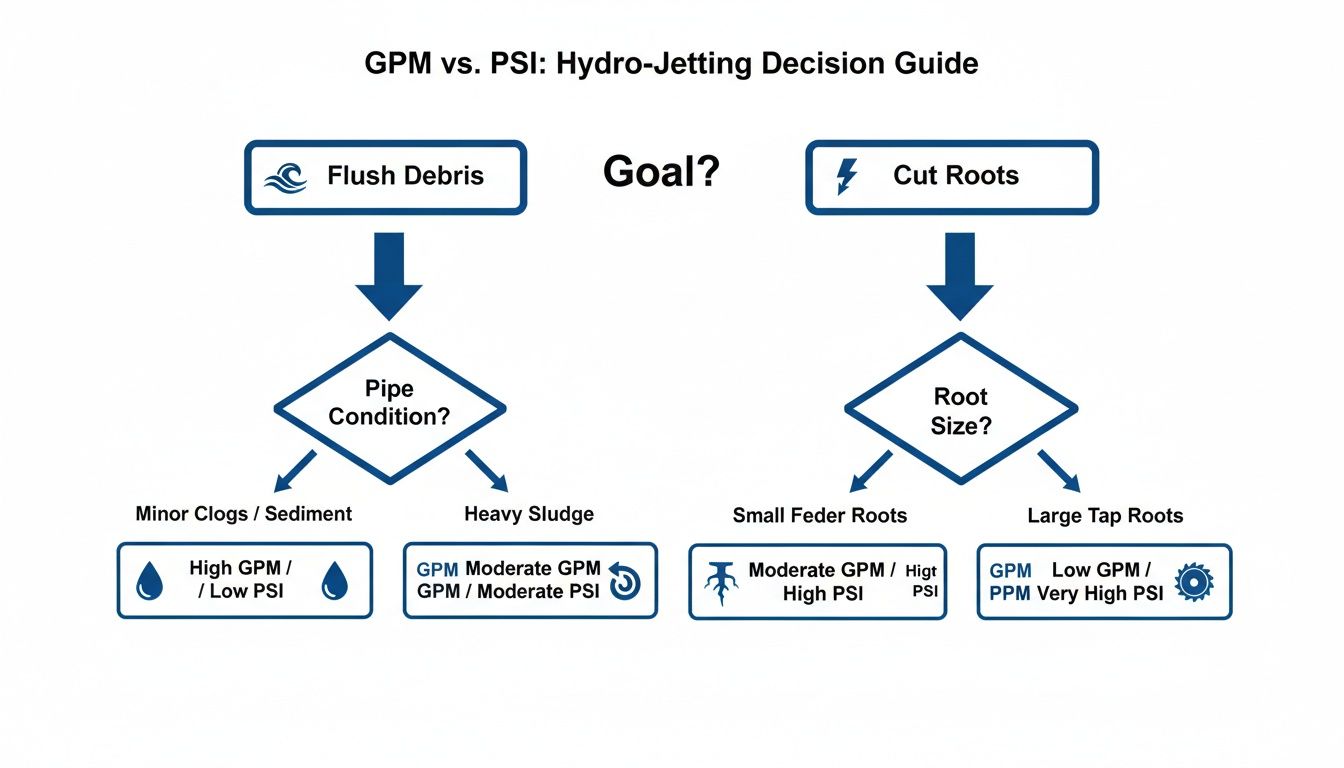
It’s a great visual reminder: prioritize high water volume (GPM) when you need to move loose material, and crank up the pressure (PSI) when you need to break through something solid.
Flushing Heavy Sediment and Debris
After a big storm or in areas with lots of soil runoff, pipes can get completely packed with sand, gravel, and other heavy gunk. The mission here isn't about cutting; it’s about moving a huge amount of material as quickly as possible.
Your go-to for this is a flusher nozzle. These Tier 1 workhorses are designed with one goal in mind: maximum thrust. Their rear-facing jets are angled to create a powerful current that lifts sediment off the pipe floor and propels it back toward the manhole for easy vacuuming. For this work, you want to prioritize high GPM over PSI. It’s the sheer volume of water, not the pressure, that gets heavy, loose debris moving.
This is where the The Hydrovac Attachment Tool becomes a game-changer. The nozzle’s high GPM turns the sediment into a slurry, and the attachment immediately contains and funnels it straight into the vacuum hose. It transforms a messy, back-breaking job into a clean, controlled excavation with minimal cleanup.
The most profitable operators don't rely on one "do-it-all" nozzle. They build a small, versatile arsenal—a cutter for roots, a spinner for grease, and a flusher for sediment—to save time, fuel, and water on every single job.
Nozzle Selection Field Guide for Common Jobs
To make things even simpler on the job site, here's a quick-reference guide. Think of it as a cheat sheet for matching the problem in front of you with the right tool and settings.
| Obstruction Type | Recommended Nozzle Type | Key Spray Pattern | Ideal GPM/PSI Balance |
|---|---|---|---|
| Thick Tree Roots | Tier 3 Rotary / Warthog-style | Forward/Side Rotating Jets (Cutting) | High PSI / Lower GPM |
| Hard Grease | Spinning / Spinner Nozzle | 360-Degree Side Jets (Scouring) | Moderate PSI / High GPM |
| Heavy Sediment | Tier 1 Flusher Nozzle | Rear-Facing Jets (Thrusting) | High GPM / Lower PSI |
| Scale / Concrete | Chain Scraper / Tier 3 | High-Speed Rotating (Milling/Grinding) | Very High PSI / Moderate GPM |
| General Flushing | Tier 1 General Purpose | Balanced Rear & Forward Jets | High GPM / Moderate PSI |
Keep this handy, and you'll find yourself clearing lines faster and more efficiently, saving wear and tear on both your equipment and your crew.
Integrating Nozzles With Hydrovac Systems for Precision Digging
This is where the raw power of jetting meets the surgical precision of modern hydro excavation. While sewer jetter nozzles were born to clear pipes, their world gets a whole lot bigger when you pair them with a powerful vacuum system. This combination is the very backbone of non-destructive digging, a technique quickly becoming the gold standard for working around sensitive underground infrastructure.
Think about it: a jetter nozzle on its own will blast soil and debris everywhere, creating a hazardous mess. A vacuum hose by itself can't break up compacted earth. But bringing them together in the right way? That’s the key to unlocking true hydro excavation.
To make it work, you need a tool that lets the water jet and vacuum work in perfect concert. This is where specialized attachments become absolutely essential for turning a potentially chaotic process into a controlled, efficient one.
The Bridge Between Jetting and Vacuuming
The secret to this powerful team-up is a tool designed specifically to merge these two forces. A product like the The Hydrovac Attachment Tool acts as that crucial bridge. It channels the focused water stream from your nozzle while simultaneously funneling the resulting slurry straight into the vacuum hose. This isn't just about convenience; it fundamentally changes how you get the job done.
Imagine trying to dig a precise hole with a fire hose. Water would spray everywhere, you’d be blind to what you’re doing, and the cleanup would be a nightmare. Now, picture containing that blast within a vacuum shroud. Suddenly, every drop of water has a purpose, and every piece of displaced material is instantly whisked away.
The Hydrovac Attachment Tool is the solution for effective digging. It eliminates dangerous splashback, drastically cuts down on cleanup time, and provides the clear visibility needed for safe, precise work around sensitive infrastructure.
It’s this controlled environment that gives hydrovac operators the confidence to work around buried utilities, knowing they’re minimizing risk while getting the job done right.
Gold-Standard Applications in the Field
The combination of a powerful sewer jetter nozzle and an integrated vacuum system isn't just for odd jobs; it's the go-to method for some of the most critical tasks in the hydrovac industry. This setup delivers a level of precision that traditional digging methods simply can't touch. It’s all about working smarter, not just harder.
The benefits are crystal clear in a few key applications:
- Potholing and Daylighting Utilities: Safely exposing underground gas lines, fiber optics, or electrical conduits demands absolute control. This system lets operators liquefy soil layer by layer and immediately vacuum it away, revealing the utility without the catastrophic risk of a bucket strike. One slip-up with an excavator can cost tens of thousands and create a serious public safety hazard.
- Trenching in Tight Urban Areas: Digging a clean trench between buildings or right next to a sidewalk is a major headache. The contained nature of this system means no flying debris, minimal ground disturbance, and a much smaller operational footprint, making it perfect for crowded city work.
- Creating Precise Excavations: Whether you're setting fence posts, pouring foundation footings, or installing an irrigation system, this method allows for clean, exact holes. The operator can see precisely what they are digging, ensuring the excavation is the perfect size and depth—no guesswork required.
By pairing the right sewer jetter nozzle with a tool like the The Hydrovac Attachment Tool, crews transform their equipment. It's no longer just a pipe cleaning system; it becomes a sophisticated, non-destructive digging solution that delivers safer, faster, and cleaner results on every single job site.
Nozzle Maintenance and Safety Essentials
An effective nozzle is a safe nozzle. That’s not just a nice saying; in the hydrovac world, where high pressure is the name of the game, it’s a non-negotiable rule. The performance of your entire system, from the pump right down to the vacuum hose, hinges on the condition of your sewer jetter nozzles. A worn or damaged nozzle isn't just less effective—it's a high-pressure hazard waiting to happen, putting both your crew and equipment on the line.
Think of a nozzle orifice like the barrel of a rifle. When it’s new, it’s perfectly machined to channel a focused, powerful jet of water. But over time, all the sand, gravel, and grit you're blasting away starts to erode that precise opening, causing it to lose its shape. A worn-out, egg-shaped orifice scatters the water jet, leading to a major pressure drop. Your powerful cutting tool suddenly turns into a wasteful sprinkler, costing you fuel, water, and—most importantly—time on the job.
Your Routine Nozzle Inspection Checklist
You have to inspect your nozzles regularly. It’s not optional. A quick once-over before each shift can be the difference between a smooth day and costly downtime or a dangerous failure. This isn’t about running complex diagnostics; it’s about building the simple habit of looking for the obvious signs of wear.
Here’s a straightforward checklist to get into the habit of using:
- Check for Orifice Wear: This is the #1 red flag. Look closely at each jet orifice. Are they perfectly round? If you see any that look elongated, oval, or uneven, that nozzle is shot. It's lost its efficiency and needs to be replaced.
- Inspect for Cracks or Damage: Give the nozzle body a good look. Check for any visible cracks, deep dings, or messed-up threads. A compromised nozzle body can fail spectacularly under thousands of pounds of pressure.
- Clear Any Blockages: Use a small, soft tool like a tip cleaner to gently poke out any debris from the orifices. Whatever you do, don't use a hard metal object that could scratch or change the orifice size.
A simple cleaning routine after each job—just a quick rinse and inspection—can make a huge difference in how long your nozzles last, ensuring you get the same reliable power every single time you fire up the pump.
A nozzle that looks worn out is worn out. Pushing your luck with it doesn't just cut your cleaning power; it puts a ton of unnecessary strain on your pump, burns extra fuel, and makes jobs take longer. That hits your bottom line, plain and simple.
High-Pressure Safety Protocols
Nothing is more important than safety. The insane pressures we work with in this industry demand constant awareness and sticking to the rules. Blowback—the violent, uncontrolled redirection of high-pressure water—is a massive risk, especially when a nozzle smacks into a solid blockage unexpectedly.
Keeping a safe distance is your first line of defense. Just as crucial is wearing the right Personal Protective Equipment (PPE) at all times. That means waterproof gear, steel-toed boots, safety glasses or a full face shield, and some heavy-duty gloves. For a closer look at other gear that can boost your safety and efficiency, check out our guide on essential vacuum hose accessories.
When you pair a nozzle with a tool like The Hydrovac Attachment Tool, you add another critical layer of safety. The attachment is designed to contain that high-pressure spray and the slurry it creates, channeling it all safely into the vacuum hose. This design drastically cuts down on the risk of dangerous splashback, protecting the operator and helping keep the worksite clean and controlled. This is a game-changer when you're doing precision digging around delicate utilities, where seeing what you're doing and controlling the excavation is everything.
Sewer Jetter Nozzles: Your Questions Answered
We get a lot of questions about sewer jetter nozzles, especially from hydrovac operators looking to get the most out of their equipment. Let's tackle some of the most common ones with practical, straightforward answers.
How Do I Choose the Correct Orifice Size for My Nozzle?
Picking the right orifice size is all about matching the nozzle to your jetter's flow (GPM) and pressure (PSI) specs. If you get it wrong, you'll either see a massive pressure drop at the hose end or, just as bad, you'll overwork your pump. Both scenarios burn extra fuel and waste time on the job.
The best practice is simple: grab the manufacturer’s chart that came with your jetter. Find your machine’s GPM and the PSI you want to run at, and the chart will point you to the exact nozzle size you need for peak performance.
What Are the Telltale Signs a Nozzle Needs Replacing?
You'll feel a worn-out nozzle before you see it. The most obvious sign is a drop in operating pressure right at the gauge. The spray pattern will also look weak and disorganized instead of sharp and focused.
For a closer look, inspect the orifices themselves. If they're starting to look oval or egg-shaped instead of perfectly round, it's time for a replacement. Pushing a worn nozzle just wastes water and fuel, extends your time on site, and ultimately costs you money.
Can I Really Use One Nozzle for Every Single Job?
Honestly, trying to use a single "do-it-all" nozzle is a recipe for frustration and inefficiency. While some general-purpose nozzles are handy, a penetrating nozzle built to shred roots just isn’t going to scour grease off pipe walls effectively.
Smart, profitable operators build a small, curated kit of nozzles for their most common jobs. Think a dedicated root cutter, a high-flow flusher for sand and sediment, and a spinner for greasy buildup. This approach saves time, water, and fuel on every single job.
And when you need to switch from cleaning to precision digging, pairing the right nozzle with The Hydrovac Attachment Tool is the perfect move. The nozzle breaks up the material, and the attachment immediately contains the slurry for the vacuum, giving you a clean, controlled excavation with virtually no mess.
For a tool that bridges the gap between powerful jetting and precise, non-destructive digging, trust Hydrovac Attachment. Learn how to make your operations cleaner and more efficient by visiting https://hydrovacattm.com.