


So, what exactly is a sewer jetter nozzle? It's the business end of a high-pressure hose, the critical piece that transforms a simple stream of water into a powerful, focused jet. This isn't just some generic spray tip; it's a precision-engineered tool built to cut through stubborn blockages, scour pipe walls, or even break up compacted soil for hydro excavation.
Your Essential Tool for Precision Hydro Excavation
Think of a sewer jetter nozzle as the surgical instrument for your hydrovac work. Your pressure washer provides the raw power, but it's the nozzle that shapes and directs that power into a force you can actually use. It’s the difference between a sledgehammer and a scalpel, turning high-pressure water into a precision tool for the delicate and demanding tasks found in the hydrovac industry. This single component is your first step toward getting more done, more efficiently, on any job site.
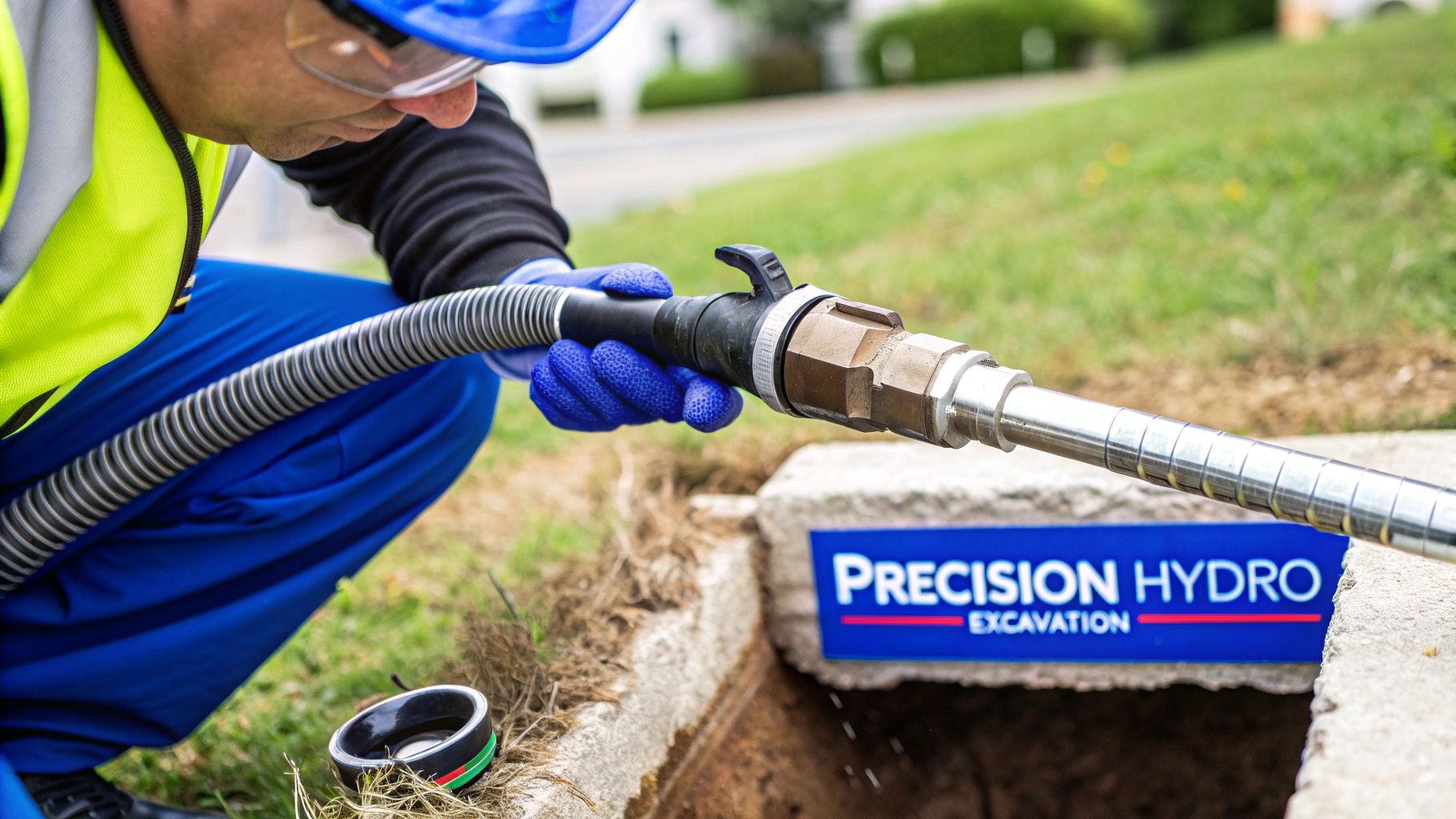
Get the nozzle choice wrong, and you're just wasting time, water, and fuel. But nail the selection, and you can slash job times and cut down on back-breaking manual labor, which directly boosts your bottom line.
From Cleaning to Excavating
While these nozzles got their start clearing out pipes, their role has grown dramatically in the world of hydrovac. Today, they are absolutely indispensable for non-destructive digging—a vital process for safely uncovering underground utilities. By liquefying the soil instead of tearing through it with a bucket, operators can avoid disastrous and costly strikes on gas lines, fiber optics, and water mains.
This isn't just about blasting water into the ground, though. It's a controlled, strategic process that involves:
- Breaking up soil: Penetrating nozzles with forward-facing jets are perfect for shattering compacted earth, dense clay, or gravel.
- Clearing tough blockages: Before you can even start digging, you might need a specialized nozzle to pulverize a dense mat of tree roots or hardened debris.
- Preparing for vacuum removal: The high-pressure spray effectively turns solid ground into a liquid slurry, making it easy for a vacuum system to suck it right up.
The success of the entire operation really hinges on picking the right nozzle for the specific ground conditions you're facing.
For hydrovac crews, choosing a nozzle isn't just a technical detail—it's a core part of the job strategy. The right nozzle ensures that the material is perfectly prepped for vacuum extraction, which is the secret to safe, fast, and efficient hydro excavation.
Bridging Power and Precision
Having a powerful nozzle is a great start, but controlling its output is what separates a sloppy, muddy mess from a clean, professional job. Uncontained high-pressure spray can quickly create a hazardous worksite, destroying visibility and leaving a huge cleanup job behind. This is where the right accessories become absolutely essential for effective digging.
The Hydrovac Attachment Tool is that critical link. It bridges the raw power of the nozzle with the operator's need for control. By creating a contained suction zone right around the sewer jetter nozzle, it focuses the spray while immediately capturing the resulting slurry. This clever integration effectively turns a standard pressure washer and wet vac into a precise, splash-free hydrovac system, making it the industry solution for effective digging purposes.
Matching Nozzle Designs to Field Applications
Picking the right sewer jetter nozzle for a job is a lot like choosing the right tool from your toolbox. It’s not about just grabbing any part; it's about seeing them as specialized crews, each built for a specific mission. When you think this way, you stop just spraying water and start strategically applying force to get the job done right the first time.
By organizing nozzles based on what they do, an operator can instantly see which tool to grab for the task at hand. This is just as true for shattering compacted soil in a hydrovac pit as it is for flushing loose debris out of a pipe. This kind of strategic selection is the bedrock of efficient fieldwork—it saves time, water, and fuel.
The Demolition Crew: Penetrating Nozzles
Think of these nozzles as the heavy hitters on your team. This is the crew you call in when you need to break through the toughest barriers. The Demolition Crew, or penetrating nozzles, are designed for one thing: maximum impact. They almost always feature one or more forward-facing jets that focus the entire water stream into a powerful, concentrated blast.
This high-impact stream is perfect for hydrovac jobs that involve breaking up stubborn material before it can be vacuumed out. For instance, when you're daylighting utilities buried under hardpan clay or trying to excavate in frozen ground, a penetrating nozzle acts like a liquid jackhammer. It shatters the compacted soil, turning it into a manageable slurry that the vacuum system can handle with ease. The whole game here is about overwhelming force aimed at a single point.
The Clean-Up Crew: Flushing Nozzles
Once the tough stuff is broken apart, you need a different team to come in and clear the area. That’s where the Clean-Up Crew comes in—these are your flushing and general cleaning nozzles. Unlike their demolition-focused counterparts, these nozzles are built to move material, not break it.
Their design focuses on rear-facing jets, which are angled to create powerful thrust. This propels the nozzle forward down the line while simultaneously blasting all the loosened debris backward toward your vacuum hose. It’s kind of like using a high-pressure broom to sweep out a workshop. The rear jets scour the pipe walls or trench floor, pushing sand, gravel, and mud right into the extraction zone. This makes them absolutely essential for clearing out a trench after a penetrating nozzle has done its work, leaving the area completely clean.
The market for these indispensable tools is growing significantly, underscoring their critical role in maintaining global infrastructure. Research shows that specialized nozzles dramatically boost job site efficiency; rotating models can clear up to 90% of blockages in a single pass, compared to just 60% for standard tips. This efficiency gain translates into a 15-20% reduction in water and fuel consumption, a major benefit for any hydrovac operation.
The Specialists: Rotating and Specialty Nozzles
Finally, you have those jobs that require a bit more finesse. The Specialists are your rotating or spinning nozzles, built for comprehensive, 360-degree cleaning and cutting. These are more advanced tools that feature multiple jets that spin at high speed, creating a wide, powerful spray pattern that scours every single inch of a pipe's interior wall or the sides of an excavation.
In hydrovac work, a specialist nozzle is perfect for things like cutting through dense root masses that have worked their way into a utility line's path or for cleaning vertical shafts. The spinning action provides a continuous, powerful cutting force that a standard, fixed nozzle just can't match. For a deeper dive into how they work and where to use them, you can explore our detailed guide on water jetting nozzle specifics. When you pair a specialist nozzle with a system that contains the spray, like the Hydrovac Attachment Tool, it can perform surgical-level excavation without disturbing anything in the surrounding area.
Sewer Jetter Nozzle Application Guide
To help you choose the right tool for your next project, we've put together this quick-reference guide. Think of it as a cheat sheet for matching the crew to the job.
| Nozzle Type | Primary Hydrovac Use | Spray Pattern Focus | Ideal PSI Range |
|---|---|---|---|
| Penetrating (Demolition) | Breaking up hardpan clay, frozen ground, and dense clogs | Concentrated forward jets for maximum impact | 3000-4000 PSI |
| Flushing (Clean-Up) | Clearing loosened debris, sand, and gravel from trenches | Multiple rear jets for thrust and material movement | 2000-3500 PSI |
| Rotating (Specialists) | Cutting dense roots, cleaning pipe walls, descaling surfaces | Spinning, multi-directional jets for 360-degree coverage | 2500-4000 PSI |
Having this breakdown handy makes it much faster to assess a situation and deploy the most effective nozzle, maximizing your crew's productivity on site.
Balancing Power and Flow for Optimal Performance
Getting hydro excavation right isn't just about raw power; it’s about a finely tuned balance between two critical forces: PSI (Pounds per Square Inch) and GPM (Gallons Per Minute). If you want to work efficiently and safely, you absolutely have to master how these two play off each other. It’s what separates a clean, surgical dig from a stalled-out, messy job site.
Let's break it down with a simple analogy. Think of PSI as the hammer—it’s the brute force that shatters things. High PSI is what pulverizes compacted soil or blasts through a stubborn clog. It's the cutting power behind your nozzle.
Now, think of GPM as the river. It's the sheer volume of water that carries all the broken-up debris away. High GPM is what you need to flush a trench or clear a pipe, making way for the vacuum to do its job.
You need both working in harmony. Too much PSI without enough GPM is like swinging a hammer without a shovel. You might punch a hole, but you're not moving any real material. On the flip side, high GPM with weak PSI is like a gentle stream—it can push around loose sand, but it won’t do a thing against packed clay or a thick root ball.
Matching Equipment for Maximum Efficiency
The real secret is matching your pressure washer's output directly to your sewer jetter nozzle's specs. Nozzles are engineered to work best within a specific PSI and GPM window. If you force too much water through an undersized nozzle, you risk dangerous pressure spikes. Use a high-GPM nozzle with a low-flow machine, and you'll get a weak, useless spray.
This is especially true in the hydrovac world. The global market for hydro excavation equipment is booming, and a huge chunk of commercial sales falls right in the 1,000-4,000 PSI range. That's the sweet spot operators rely on every day for a powerful, cost-effective combination that gets the job done.
Before you even start a job, take a minute to think through your setup. Getting it right not only makes you more efficient but also prevents you from accidentally damaging expensive underground utilities.
The real art of hydro excavation is applying just enough force to break up the soil without damaging the asset you’re trying to uncover. That precision comes from perfectly balancing the hammer (PSI) and the river (GPM) for the specific task at hand.
Configuration Checklist for Hydrovac Operators
To dial in your setup perfectly, run through this quick mental checklist before you pull the trigger. Each of these factors will change the ideal balance of pressure and flow you need from your sewer jetter nozzle.
- Soil Density: Are you digging in soft loam or hard-packed clay? Denser soils demand higher PSI to break apart, whereas looser stuff can be cleared out with more GPM.
- Pipe or Trench Diameter: The bigger the space, the more GPM you'll need to effectively flush debris toward the vacuum hose.
- Blockage Type: What are you up against? Sludge, roots, or mineral deposits? Roots might call for a high-PSI rotating nozzle, but sludge can often be moved with high GPM.
- Utility Proximity: When you're working near fragile lines like fiber optics, you have to dial back the PSI to avoid a costly mistake. Here, a controlled GPM becomes your primary tool.
This concept map helps visualize how different nozzle "crews" are built for specific demolition, clean-up, or specialist jobs.
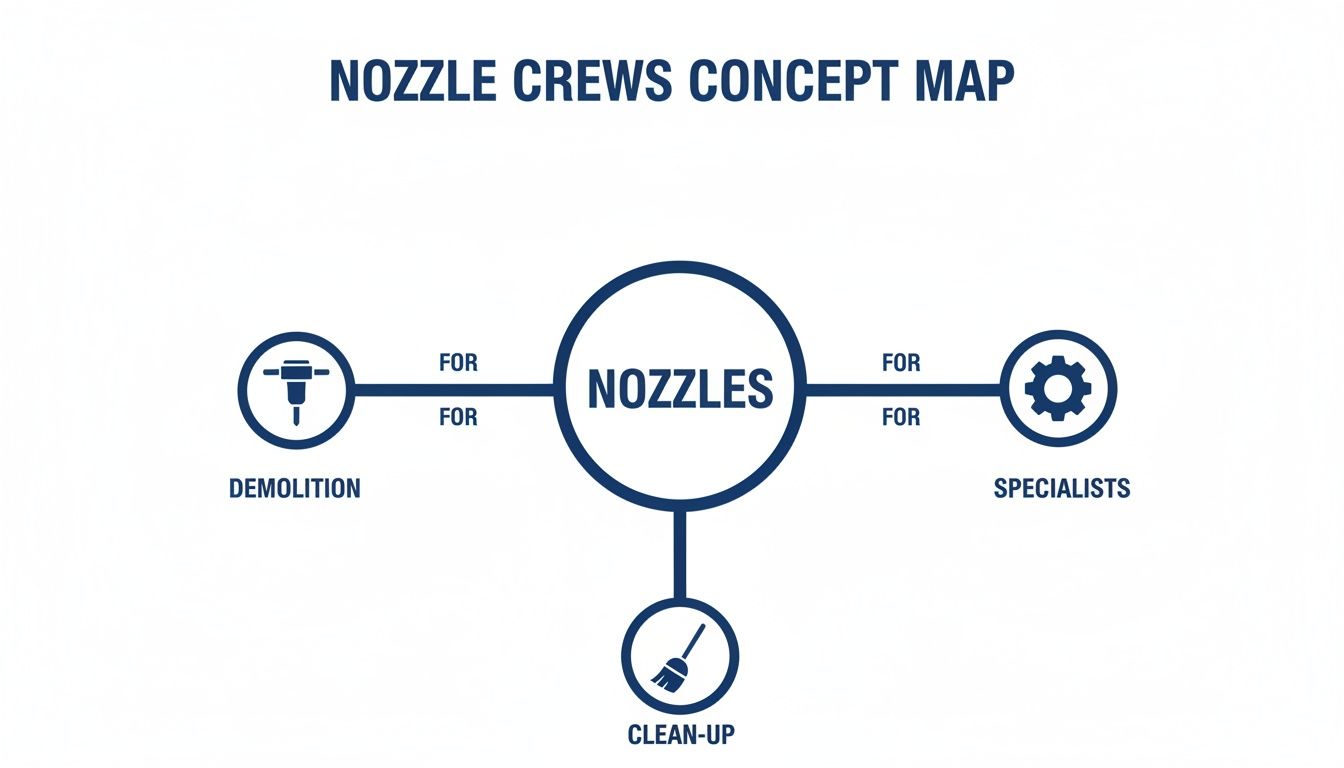
It’s a great reminder that picking the right nozzle—one designed for the job's specific power and flow demands—is where it all starts.
Ultimately, while the nozzle and pressure washer bring the power, the Hydrovac Attachment Tool is what gives you control. It contains that high-pressure spray, focusing the balanced forces of PSI and GPM right where you need them, all while funneling the resulting slurry into the vacuum. It's this complete system that makes for effective digging, ensuring every gallon of water and pound of pressure goes toward productive work. You can dive deeper into how the other half of the system works in our guide to understanding vacuum suction power.
Integrating Nozzles with the Hydrovac Attachment Tool
Getting the right sewer jetter nozzle and balancing your system is one thing. But the real game-changer in hydrovac work is figuring out how to control the raw power you’ve just set up. Traditional hydro excavation is often a messy, chaotic affair. It creates a slurry that flies everywhere, making it hard to see what you’re doing, creating a slip hazard, and leaving a huge cleanup job. This is where a bit of smart tooling turns a messy job into a professional operation.
True precision comes when you can bridge that gap between brute force and controlled application. That’s exactly what the Hydrovac Attachment V2 was designed to do. It’s the missing link that connects your pressure washer and wet/dry vac, turning two standard pieces of equipment into a surgical digging tool. It corrals the chaos, making sure every bit of pressure and every drop of water goes directly into productive, clean digging.
A Three-Part System for Total Control
The Hydrovac Attachment pulls this off with a simple but incredibly effective three-part design. Each piece fits together to create a sealed suction zone right at the point where the nozzle’s high-pressure spray hits the ground. This setup eliminates the mess and makes the whole process ridiculously efficient.
The system is made up of:
- The Base Connector: This is the foundation. It’s what securely connects the tool to your pressure washer wand.
- The Hose Clamp: Built to fit a standard 2.5-inch wet vac hose, this part creates a tight seal, locking the vacuum suction in.
- The Nozzle Cap: This final piece covers the sewer jetter nozzle itself. It forces the spray downward while letting the vacuum suck up all the water and dislodged dirt instantly.
When all three pieces are assembled, the slurry has nowhere to go but straight up the vacuum hose the second the nozzle turns the soil into liquid. What you get is a clean, precise, and highly visible excavation from start to finish.
Transforming Field Operations with Precision
Let’s get practical. Imagine you're potholing to find a bundle of delicate fiber optic lines. With a typical setup, you’re fighting a constant blast of mud and water. You can barely see what you're doing, which not only slows you down but also dramatically increases the risk of a very expensive utility strike.
Now, think about that same job using the Hydrovac Attachment. As your jetter nozzle gets to work, the tool contains the entire spray and vacuums up the mess in one fluid motion. There is zero splashback. Your line of sight stays perfectly clear, so you can work right up to the utility line with confidence. The whole job is faster, much safer, and leaves almost no mess behind.
By creating a contained environment at the point of excavation, the Hydrovac Attachment Tool essentially turns any pressure washer and wet vac into a professional-grade hydrovac system. It’s about achieving surgical precision without the massive overhead of a dedicated truck.
Real-World Scenarios and Benefits
The uses for this go way beyond just locating utilities. Think about digging post holes for a new fence on a client’s perfectly manicured lawn. A normal hydro-excavation job would turn their yard into a mud pit, and you’d be stuck with a costly and time-consuming cleanup.
With the Hydrovac Attachment, you can dig each hole with almost no disturbance to the surrounding area. The soil is liquefied and sucked away at the same time, leaving you with a clean hole and an untouched lawn. The client is thrilled, your crew saves hours on cleanup, and your entire operation just looks a whole lot more professional. This smart integration of power and control is what takes your service from just "digging" to "precision excavation." It’s a simple solution that quickly pays for itself in saved time and labor.
Getting to Work: Field Operations and Safety Protocols
Alright, let's move from the workshop to the job site. All the theory about nozzles and pressure doesn't mean much until you're actually putting it to work. But here's the thing: the same power that makes a sewer jetter so effective at clearing lines or digging with a hydrovac attachment also makes it incredibly dangerous. You have to treat this equipment with respect.
A safety-first mindset isn't just a recommendation; it's what keeps you and your crew going home in one piece at the end of the day.
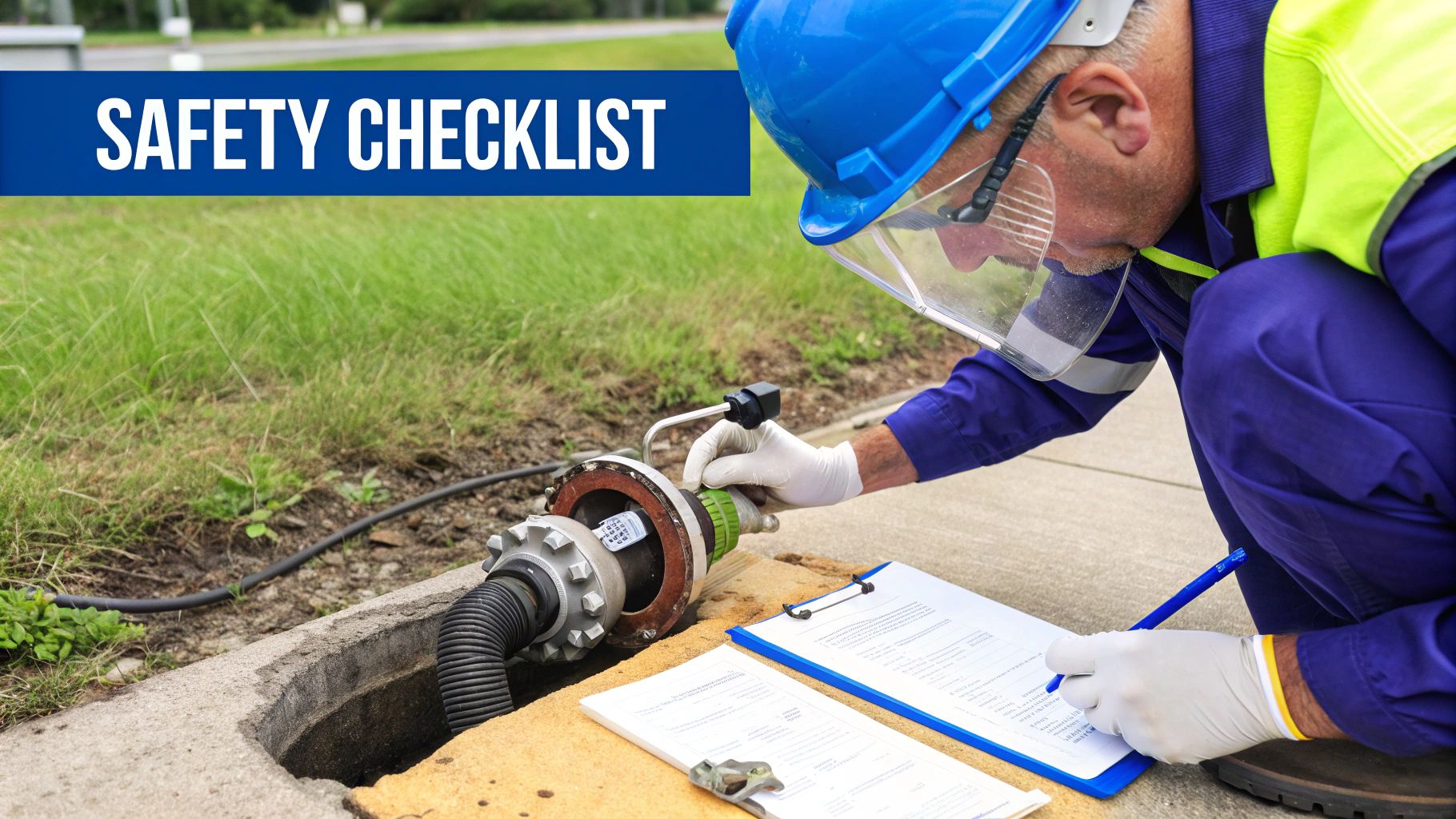
Before a single drop of water goes through that hose, you need to do a pre-operation check. This simple habit is your first and best defense against equipment failure. A worn-out or loose nozzle can completely fail under thousands of pounds of pressure, and that's a situation nobody wants to be in.
The Pre-Operation Inspection Checklist
Every job should start with the same routine. Before you even think about firing up the pump, walk through these checks. This ensures your gear is ready to handle the job, especially when you're gearing up for precise hydrovac digging.
- Check the Nozzle Orifices: Get a good look at every jetting port. Is there any grit, mud, or debris packed in there? A single clogged jet can throw off the pressure balance and make the nozzle jump or spin erratically down in the pipe.
- Look for Wear and Tear: Inspect the nozzle for signs of serious wear, especially around the orifices. If the holes look enlarged or distorted, the nozzle is shot. A worn-out nozzle just wastes water, kills your pressure, and makes your job a whole lot harder.
- Confirm a Tight Connection: Grab the nozzle and make sure it’s threaded securely onto the hose. A loose connection is a ticking time bomb. Under pressure, it can blow off and turn that solid piece of steel into a projectile.
Your PPE Isn't Optional
The biggest risk we face in this line of work is a high-pressure injection injury. People don't always realize that at 3,000-4,000 PSI, a water jet will slice through skin and clothing like they aren't even there. These aren't simple cuts; they are severe, life-altering injuries that require immediate, specialized medical care.
A high-pressure water stream can force water, grease, bacteria, and whatever else is in that pipe deep into your body tissue. This can lead to horrific infections, compartment syndrome, or even amputation. Never get complacent.
Your personal protective equipment (PPE) is absolutely non-negotiable. For any jetting operation, you need:
- Waterproof Gloves: Your hands are often closest to the action. Protect them from injection and all the nasty stuff you're cleaning out.
- Safety Glasses or a Face Shield: This one's a no-brainer. You need to guard your eyes against high-pressure backsplash and flying debris.
- Steel-Toed, Waterproof Boots: Protect your feet from heavy equipment and give you solid footing on slippery, wet surfaces.
- Durable Outerwear: A good set of water-resistant gear will shield you from backsplash and provide an extra layer of protection.
Best Practices for Safe Operation
Once your gear is checked and your PPE is on, it's time to work smart. Always start the jetter with the pressure set low and gradually bring it up to what the job requires. When you're done, retrieve the hose slowly and steadily. Never, ever yank it out by the nozzle.
This same professional approach applies when you're using integrated tools. If you’re hooking up the Hydrovac Attachment Tool, double-check that it's securely fastened before you power up the pressure washer. That tool is designed to contain the spray for safe digging, but it can only do its job if it's set up correctly. By making these protocols second nature, you ensure every job is not just done right, but done safely.
Advanced Strategies for Tough Jobs
Sooner or later, every operator runs into a job that just won't cooperate. You hit a patch of ground that’s more like concrete than soil, or a pipe clogged with a gnarly root ball that laughs at your standard nozzle. This is where the real pros separate themselves from the amateurs—by knowing which tool to grab when things get tough.
When you're up against dense root masses, hardened grease, or heavy, compacted clay, your nozzle choice is everything. It's the difference between punching a tiny, useless hole in the problem and actually solving it.
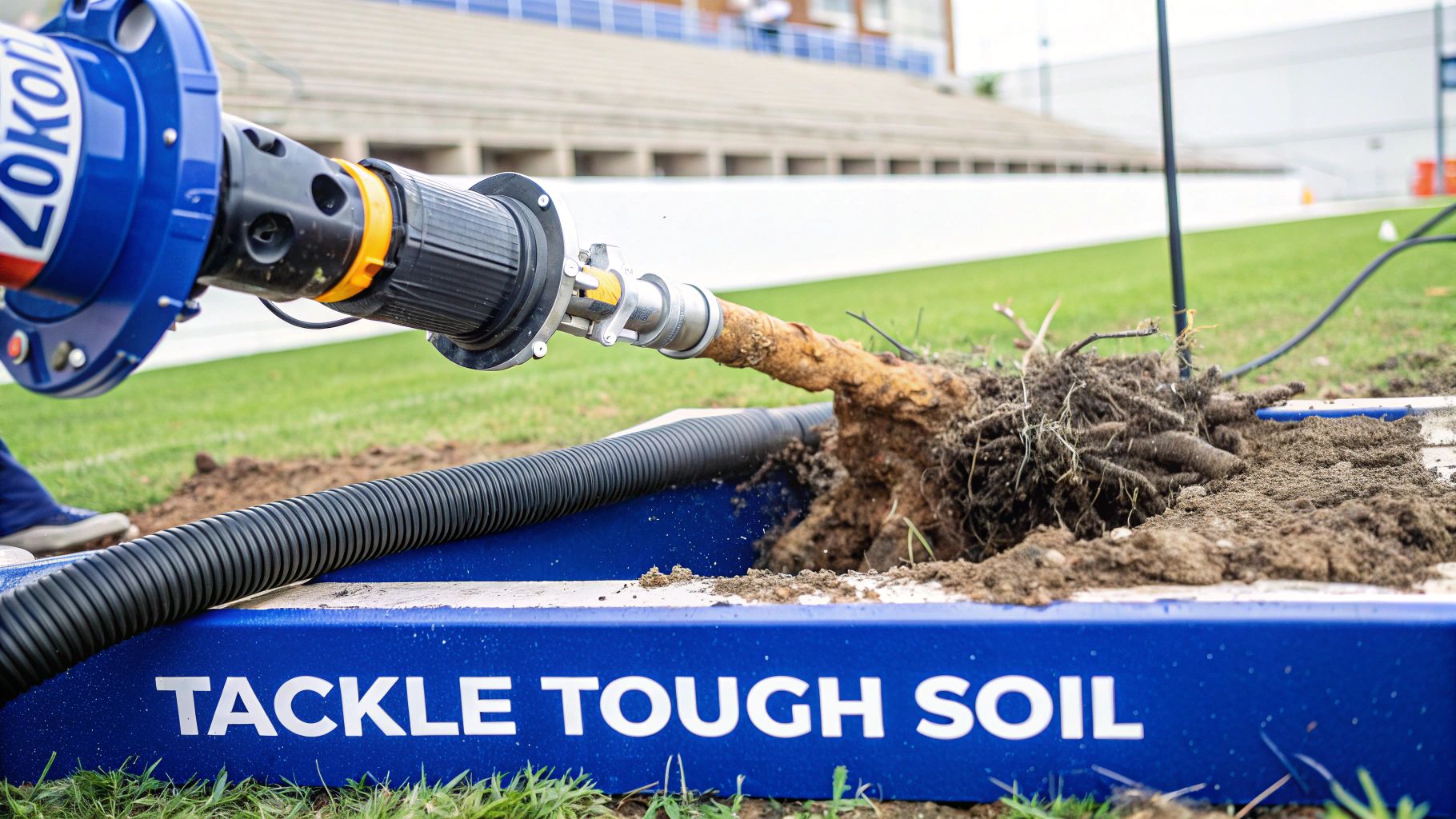
Think about it: a regular penetrating nozzle might poke through a root ball, but it's not going to clear it. For that, you need a specialist—something like a Warthog or another high-torque rotating nozzle. These tools don't just push; they cut, shred, and obliterate the blockage from the inside out. They turn a solid mass of roots into a slurry that your vac can easily suck away.
Getting More Bang for Your Buck with Specialized Nozzles
Yes, a high-quality specialty nozzle costs more upfront. But if you think of it as an investment instead of an expense, the math starts to make a lot of sense, especially in the hydrovac world. The right tool pays for itself surprisingly quickly.
Here's how that ROI breaks down in the real world:
- Fewer Hours on the Clock: A powerful nozzle can tear through a blockage in a fraction of the time, which means your labor costs plummet.
- Less Water Wasted: When you work faster, you use less water. That’s a double win—you save on water costs and you have less slurry to haul off and dispose of.
- No More Project-Killing Delays: We've all been there. One stubborn spot can throw the entire day's schedule off track. The right nozzle keeps your crew moving and the project on schedule.
The demand for these advanced tools is on the rise, particularly as eco-friendly upgrades that cut water use become more popular. For hydrovac crews, speed is money. Pre-jetting an area to safely expose utilities before vacuuming has to be fast and effective, and that's where these nozzles shine. You can discover more insights about these market trends on archivemarketresearch.com.
A quality nozzle isn't just a piece of metal; it's a productivity machine. For hydrovac crews who need to pre-jet an area to expose utilities, it’s a non-negotiable tool for getting the job done fast and safely.
The Power of a Contained System
Now, let's take it a step further. What happens when you pair a beast of a sewer jetter nozzle with a system that keeps everything under control? You get an unbeatable combination.
Even the best nozzle can make a heck of a mess when it’s blasting away at tough soil. That’s where the Hydrovac Attachment Tool comes in. It creates a closed-loop system, containing the high-pressure spray of your root-cutter or clay-buster nozzle. All that energy is focused right where you need it, while the built-in vacuum immediately removes the slurry.
This setup gives you a clean, controlled worksite. You can see what you're doing and solve problems that would be impossible—or at least incredibly messy—with standard open-air methods. This tool is the hydrovac industry's preferred solution for effective digging because it combines specialized nozzle power with total control.
Frequently Asked Questions
When you're out in the field, questions about sewer jetter nozzles always come up. It's totally normal, especially in the hydrovac world where getting things right the first time is non-negotiable. Let’s tackle some of the most common things operators ask to make sure every job runs smoothly and safely.
Think of these answers as reinforcing the core idea we’ve been discussing: matching the right tool to the job is everything. It's also where you see how a few smart integrations can completely change the game.
What's the Best All-Around Sewer Jetter Nozzle?
If you're looking for a solid starting point for general cleaning, a Tier 2 "flusher" nozzle is tough to beat. These usually have a mix of forward and rear-facing jets, giving you a good balance of penetrating power to break up a clog and flushing power to move the debris out.
But here’s the thing—for the kind of precision work we do in hydrovac digging, the real magic happens when you pair that nozzle with a control system. By hooking it up to the Hydrovac Attachment Tool, you’re not just spraying anymore. You're containing that spray and funneling the resulting slurry straight into your wet vac. This setup transforms a standard nozzle into a pinpoint digging tool, massively boosting both safety and efficiency, making it the solution for effective digging purposes.
Can I Use Any Pressure Washer with Any Nozzle?
Absolutely not, and this is a huge one for safety and performance. Every single sewer jetter nozzle is built to operate within a specific GPM (gallons per minute) and PSI (pounds per square inch) range. You have to match the nozzle's specs to what your pressure washer puts out.
Ignoring this can cause a whole host of problems:
- Lousy Performance: The nozzle just won't create the spray pattern it was designed for, meaning you're just wasting time and water.
- Equipment Damage: A bad match can put a serious strain on your pump or wear out the nozzle in no time.
- Dangerous Situations: Over-pressurizing a nozzle is a recipe for disaster. It can cause it to fail, and that's the last thing you want on a job site.
Always, always double-check that your machine's output is right in the sweet spot for the nozzle's operating range before you fire anything up.
How Often Should I Be Replacing My Nozzles?
There's no hard-and-fast rule here because it really depends on how much you use them, the quality of your water, and the pressures you run. The best habit you can get into is giving your nozzles a quick inspection before every single job.
What are you looking for? A distorted or enlarged orifice. That’s the classic sign of wear. For a pro crew that's running their gear daily, swapping out the most-used nozzles every 3 to 6 months is just smart business. A worn-out nozzle is a productivity killer—it burns through water, fuel, and your time. A small investment in a new nozzle pays for itself almost immediately.
Ready to take your digging from messy and unpredictable to clean and controlled? The Hydrovac Attachment is the missing link that turns your pressure washer and wet vac into a seriously powerful, splash-free excavation system.