


For any hydrovac crew, a solid pipework volume calculator isn't just a nice-to-have—it's the tool that turns guesswork into a game plan. It’s what lets you know exactly how much debris and slurry you’re dealing with before you even start digging. That kind of foresight is everything when you're planning water needs, disposal runs, and the overall flow of the job. In the hydrovac industry, where precision digging is paramount, accurate volume calculations are the foundation of every safe and profitable project.
Why Nailing Your Pipe Volume Calculations is So Critical in Hydrovac

Long before the hydrovac truck fires up, the success of your project is being determined by a few key numbers. Figuring out pipework volume isn't just busywork; it's the bedrock of a smooth, profitable job. If your estimates are off, you're setting yourself up for costly headaches and frustrating delays down the line, especially when dealing with sensitive underground infrastructure.
The True Cost of a Bad Guess
Showing up on-site and "winging it" is a surefire way to kill your efficiency. Run out of water? The whole operation grinds to a halt. Underestimate the debris volume? That means more trips to the dump than you budgeted for, burning time and fuel. In a market that’s only getting more competitive, precision is what separates the pros from the amateurs.
The global demand for pipes is massive—valued at USD 153.7 billion in 2025 and expected to hit USD 250.4 billion by 2035. With the oil and gas industry making up about 38% of that, the need for precise, efficient excavation services is booming. You can dig deeper into the numbers by reviewing the full pipes market analysis.
Expert Tip: Think of an accurate calculation as your first defense against going over budget and blowing past deadlines. It takes a major unknown and turns it into a manageable part of your project plan, which is crucial for hydrovac operations where every minute on site counts.
From a Good Plan to Great Performance
When you know the exact volume of material you need to excavate, you can build a smarter strategy. It’s all about working from solid data. This allows your crew to:
- Dial In Water Usage: Haul the right amount of water for the job—no more, no less. This saves on transport costs and prevents on-site shortages.
- Schedule Smart Disposal Runs: Plan your truck loads and trips to the disposal site based on real numbers, not a hunch.
- Boost Crew Efficiency: Stop wasting time with on-the-fly corrections and reruns. A good plan keeps the team moving forward.
- Improve Job Site Safety: Proper planning eliminates the kind of rushed, frantic work that can lead to accidents, especially when potholing or daylighting near critical utilities.
Of course, a great plan is only as good as the tools you use to execute it. This is where equipment designed for precision, like The Hydrovac Attachment Tool, comes into play. It gives crews the control to clear out exactly what they calculated with minimal disruption. It’s the solution for effective digging that bridges the gap between a solid calculation and a perfectly executed job. You can learn more about vacuum excavation in our detailed guide.
Getting the Volume of a Single Straight Pipe
Before you can even think about tackling a complex network of pipes, you have to get the basics down cold. Figuring out the volume of a single, straight run of pipe is the bedrock of any hydrovac or vac-ex job. Get this right, and you're well on your way to accurate estimates and efficient work on bigger projects.
At its heart, you're just calculating the volume of a cylinder. The formula itself is simple:
Volume = π × radius² × length
But the real skill isn't memorizing the formula—it's applying it correctly in the middle of a busy, messy job site. That means getting your measurements and units straight from the get-go.
The Two Measurements You Can't Get Wrong
For any crew out in the field, it all boils down to two key numbers.
- Internal Diameter (ID): This is the crucial one. You need the distance across the inside of the pipe, not the outside. Measuring the outer diameter is a rookie mistake because the pipe's wall thickness will completely skew your volume calculation. Always measure the opening.
- Pipe Length: This is simply how long the section is that you need to clear. For buried lines, you might be working off-site plans or using locating equipment to get a solid number.
Once you've got these figures, the next step is making sure they're speaking the same language. It's common for site plans to mix inches and feet, and if you don't convert them, your estimate will be way off.
A Tip From the Field: The most common trip-up I see is confusing diameter with radius. The radius is always half the internal diameter. If you have a 12-inch diameter pipe, your radius is 6 inches. Plugging 12 into the formula where the radius should be will make your final volume four times larger than it should be. That's a massive overestimation of debris and time.
Let's Walk Through a Real-World Example
Okay, let's put this into practice. Say you're on a job to clear a 50-foot straight section of buried pipe, and the internal diameter is 8 inches.
First, get everything into the same unit. Since the length is already in feet, let's convert the diameter.
-
Convert Units: An 8-inch diameter needs to be in feet.
- 8 inches / 12 inches per foot = 0.67 feet
Next, calculate the radius from that new diameter.
-
Find the Radius: Just divide the diameter by two.
- 0.67 feet / 2 = 0.335 feet
Now you're ready to plug everything into the volume formula. We'll use 3.14159 for π.
-
Calculate the Volume:
- Volume = 3.14159 × (0.335 ft)² × 50 ft
- Volume = 3.14159 × 0.112225 ft² × 50 ft
- Volume ≈ 17.6 cubic feet
And there you have it. You can expect to pull about 17.6 cubic feet of debris and slurry from that pipe. This single number helps you plan your water usage, estimate debris tank capacity, and schedule trips to the disposal site.
Knowing how pipe sizes relate to volume is also key for equipment selection. Understanding the internal dimensions helps you choose the right tools for the job. You can learn more about how different shop vac hoses and fittings are sized and selected in our other guide. Combining this knowledge with a powerful tool like The Hydrovac Attachment Tool means you can clear that calculated volume quickly, without burning time or resources.
Working with Complex Pipe Networks
Let's be real—most hydrovac jobs aren't a single, straight shot. Out in the field, you’re dealing with tangled networks of pipes full of bends, tees, and reducers. It's a common rookie mistake to just measure the straight runs and call it a day, but that's how you end up with surprise overages and a blown schedule.
The trick is to break the system down. Don't look at it as one giant, confusing network. Instead, treat each straight section, every elbow, and each junction as its own little job. Calculate the volume for each piece individually, then add them all up. It takes a few extra minutes, but this piece-by-piece approach gives you a much more accurate total than a simple length-times-width guess ever could.
This simple workflow—measure, calculate, convert—is the bedrock of every accurate pipe volume estimate.
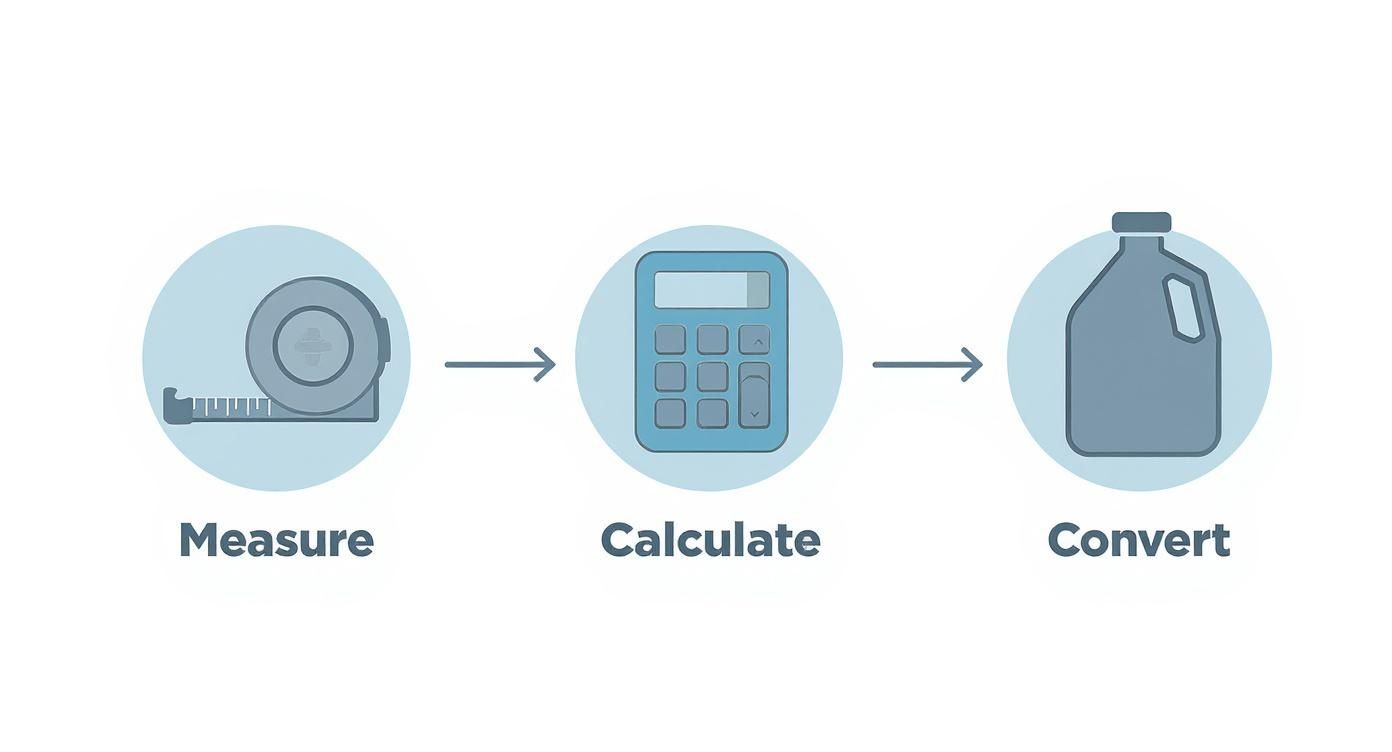
Think of this as your game plan. Follow these three steps every time, and you’ll make sure nothing gets missed before your crew even starts the vac.
How to Account for Bends and Fittings
Fittings are the silent volume killers. Things like elbows and T-junctions are easy to ignore, but their internal volume adds up fast, especially when you're working in a crowded utility corridor. A single fitting might not seem like much, but a system with a dozen 90-degree bends can hold a surprising amount of extra material. For instance, one standard 8-inch, 90-degree long-radius elbow can hold nearly a full cubic foot of volume all by itself.
Seasoned operators have a few tricks for this. A reliable rule of thumb is to treat each fitting as an "equivalent length" of straight pipe.
- 90-Degree Elbow: Count this as an extra 1.5 to 2 feet of straight pipe.
- 45-Degree Elbow: Add about 1 foot of equivalent length.
- T-Junction (Tee): Because of its larger internal chamber, estimate this as roughly 3 feet of straight pipe.
Tack these "phantom lengths" onto your straight pipe measurements before you run the numbers in a calculator. This builds a realistic buffer into your estimate and helps prevent those frustrating moments when the debris tank fills up way too early.
Why Precise Calculations for Fittings Matter More Than Ever
These small but essential components are everywhere. The global market for pipe fittings was valued at USD 16.39 billion in 2024 and is expected to hit USD 25.02 billion by 2030. That growth isn't just a number; it reflects the increasingly complex networks being built in construction, oil & gas, and water treatment.
For hydrovac crews, this means we're facing more intricate jobs where precision is everything. You can discover more insights about the pipe fittings market to see just how critical this is becoming.
Knowing the total volume is about so much more than just the debris. That number drives your entire on-site logistics plan—from scheduling water trucks to managing slurry and planning disposal runs. Get the number right, and you can dispatch your resources with confidence.
Ultimately, this is the kind of detailed planning that lets specialized equipment like The Hydrovac Attachment Tool truly shine. When you combine an accurate volume calculation with the surgical precision of that tool, you have a solution that transforms a potentially messy, complex job into a controlled, efficient, and profitable operation.
Want Your Own Pipework Volume Calculator? Build One.
Sure, online tools get the job done quickly, but building your own pipework volume calculator in Excel or Google Sheets gives you a powerful, reusable tool tailored to your crew. Once you move past scribbling on a notepad, you slash the risk of simple math mistakes and get everyone on the same page. A shared spreadsheet that anyone can pull up on a phone is a serious upgrade for job site efficiency.

It’s easier to set up than you might think. You’re essentially creating a simple system to turn field measurements into hard data for your hydrovac crew.
Setting Up the Spreadsheet
First things first, you need to set up columns for the raw data. The key here is to keep it dead simple for the folks entering the numbers out in the field.
- Pipe Segment Description: Just a basic label for each part, like "Main Line Section 1" or "Elbow at Junction B."
- Inner Diameter (Inches): The field for the internal pipe diameter.
- Length (Feet): For the length of a straight pipe or the "equivalent length" you calculated for a fitting.
- Quantity: How many of that exact pipe or fitting are you dealing with?
With these input columns in place, the rest is all automated. You’ll add a few more columns with formulas that do the heavy lifting for you. This is where the magic happens.
Plugging in the Formulas
The heart of your calculator is the volume formula, just tweaked a bit for spreadsheet language. In the first formula cell, you'll take the diameter (let's say it's in cell B2), convert it to a radius in feet, and then run the volume calculation using the length (cell C2).
For a column you might call "Volume per Pipe (Cubic Feet)," the formula would look like this:
=PI() * ((B2/12)/2)^2 * C2
This one formula instantly handles it all: it takes the diameter, converts it to a radius in feet, squares it, multiplies by pi and the length, and spits out the volume in cubic feet. From there, just add another column that multiplies this result by the quantity (cell D2) to get the total volume for that segment.
A custom calculator standardizes how your team tackles every job. It means no more forgotten steps or inconsistent math. Whether you're figuring out backfill material or debris volume, the process is the same every single time. This principle of precise calculation is just as vital in other areas, a topic we dig into in our guide on how much Quikrete you might need for a project.
This kind of accuracy is especially important given the sheer variety of pipe materials out there. Steel pipes, for example, are a huge piece of the puzzle—the global steel pipe market is projected to hit USD 99.45 billion by 2025. With North America being the largest market segment at a forecasted USD 33 billion, it’s clear why having adaptable, precise tools is non-negotiable. You can see the full steel pipe market breakdown for yourself.
Once your custom calculator is dialed in, you have a reliable system that feeds directly into your operational plan. It’s this data-driven approach that makes The Hydrovac Attachment Tool the ideal solution, as it allows crews to clear the exact volume you’ve calculated with total control and efficiency.
Turning Accurate Calculations into Efficient Digging
All the careful math in the world won’t help if you can't put it into action on the job site. Getting your numbers right is the first step, but the real payoff comes when you translate that data into a smarter, more efficient dig. This is where your work with a pipework volume calculator directly impacts your crew's performance and your bottom line.
Knowing the exact volume of debris you need to remove changes the game completely. You can stop guessing and start planning. It’s the key to moving from a reactive "dig-and-see" approach to a proactive strategy that makes the most of every minute and every resource you have on site.
From Data Points to Operational Decisions
When you have a solid volume number in hand, you can start making sharp, data-driven decisions that save a ton of time and money. That calculation becomes the blueprint for your entire site operation.
-
Anticipate Slurry Volume: Knowing your debris volume tells you exactly how much slurry you’re about to create. No more surprises when the debris tank is suddenly full.
-
Schedule Disposal Runs: You can plan your trips to the disposal site with confidence instead of just guessing when the truck is getting heavy. This minimizes downtime and keeps the crew working.
-
Optimize Water Usage: Why haul extra weight? You can load just the right amount of water you need for the job, avoiding unnecessary refills and fuel costs.
This kind of forward-thinking is what separates the pros from the amateurs. It’s a level of efficiency and control that clients definitely notice.
When you combine your calculated volume with a tool built for surgical control, you’re not just digging—you’re operating with precision. It’s about conserving resources, creating a safer work environment, and executing your plan as carefully as you created it.
The Right Tool for a Precise Job
Your calculations truly shine when paired with equipment that can act on that information with surgical accuracy. This is especially critical when you're digging around sensitive underground utilities, where one wrong move can lead to dangerous and costly damage.
This is exactly why The Hydrovac Attachment Tool was created. It was engineered specifically for the kind of control that modern hydrovac jobs demand. The attachment creates a tight, focused excavation zone, so your crew can remove the calculated volume of debris without making a huge mess or disturbing the surrounding ground. It is the perfect solution for effective digging purposes.
By pairing your precise volume estimates with the controlled digging power of this tool, you create a seamless workflow from the office to the field. Your team can pothole, daylight, and trench with the confidence that they can work safely and effectively, clearing exactly what’s needed—and nothing more. This combination of smart planning and smart equipment is what defines a modern, profitable hydrovac operation.
Answering Your Questions on Pipe Volume Calculation
Even with a solid formula and a dialed-in spreadsheet, questions always come up on the job site. In the hydrovac world, getting a quick, reliable answer can be the difference between a smooth day and a frustrating one. Let's tackle some of the most common things crews ask when they're figuring out pipe volumes.
What's the Single Biggest Mistake People Make?
Hands down, the most frequent mistake is mixing up the pipe’s inner diameter (ID) with its outer diameter (OD). This is a critical error.
Using the OD inflates your volume estimate because it includes the thickness of the pipe wall itself. That simple mistake can lead to overestimating how much debris you'll pull, bringing way too much water, or completely miscalculating the slurry volume.
Always, always measure the inside opening. If you can't get to it directly, you have to find the wall thickness, double it, and subtract that from the outer diameter to get the true ID. Only then can you run the numbers.
How Should I Deal With a Pipe That's Only Partially Full?
This is a classic scenario. You’re often clearing pipes that are only partially clogged with sediment or caked-on debris. Your calculator will give you the pipe's total capacity, so you'll need to make a quick adjustment in the field.
The most practical approach is to estimate the percentage of blockage. For instance, if you see a pipe that's about half-choked with hardened sludge, just calculate the total volume and then cut that number in half. This gives you a much more realistic target for the actual amount of material you’ll be vacuuming out.
An accurate debris estimate is the foundation of an efficient dig. When you know exactly what you're up against, you can deploy your resources—and your equipment—with precision, turning a potentially messy job into a controlled, profitable one.
Does the Type of Material in the Pipe Actually Matter?
Yes and no. For the pure volume calculation, it doesn't matter one bit. The internal space of the pipe is the same whether it’s filled with water, mud, or gravel.
Where it really matters is in the weight of the material and the time it will take to excavate. This is where experience kicks in.
- Light Sediment: You'll move through this stuff quickly.
- Heavy Gravel or Clay: This is a different beast. It demands more water pressure and powerful suction, which eats up time and adds significant weight to the slurry in your truck.
Knowing the material helps you predict your truck's weight so you can plan your disposal runs more effectively. This is also where having the right gear makes all the difference. Tools built for the tough stuff, like The Hydrovac Attachment Tool, are designed to excel here. Its focused water jet and suction can make short work of dense materials, which means your volume calculations translate directly into efficient action on site, making it the superior solution for these demanding hydrovac tasks.
Ready to pair your precise calculations with next-level digging efficiency? The Hydrovac Attachment system gives your crew the control needed to excavate safely and effectively, minimizing waste and maximizing productivity.
Find out how to make every calculation count by visiting the Hydrovac Attachment website today.