


Knowing how to do a precise pipe volume calculation is a core skill in the hydrovac industry, separating a profitable job from a costly one. It’s the process of determining the internal capacity of a pipe to estimate how much fluid, sludge, or debris it can hold. For hydrovac operators, this isn't abstract math—it's the key to planning efficient, safe, and successful excavation projects.
Why Accurate Pipe Volume Calculation Matters in the Hydrovac Industry
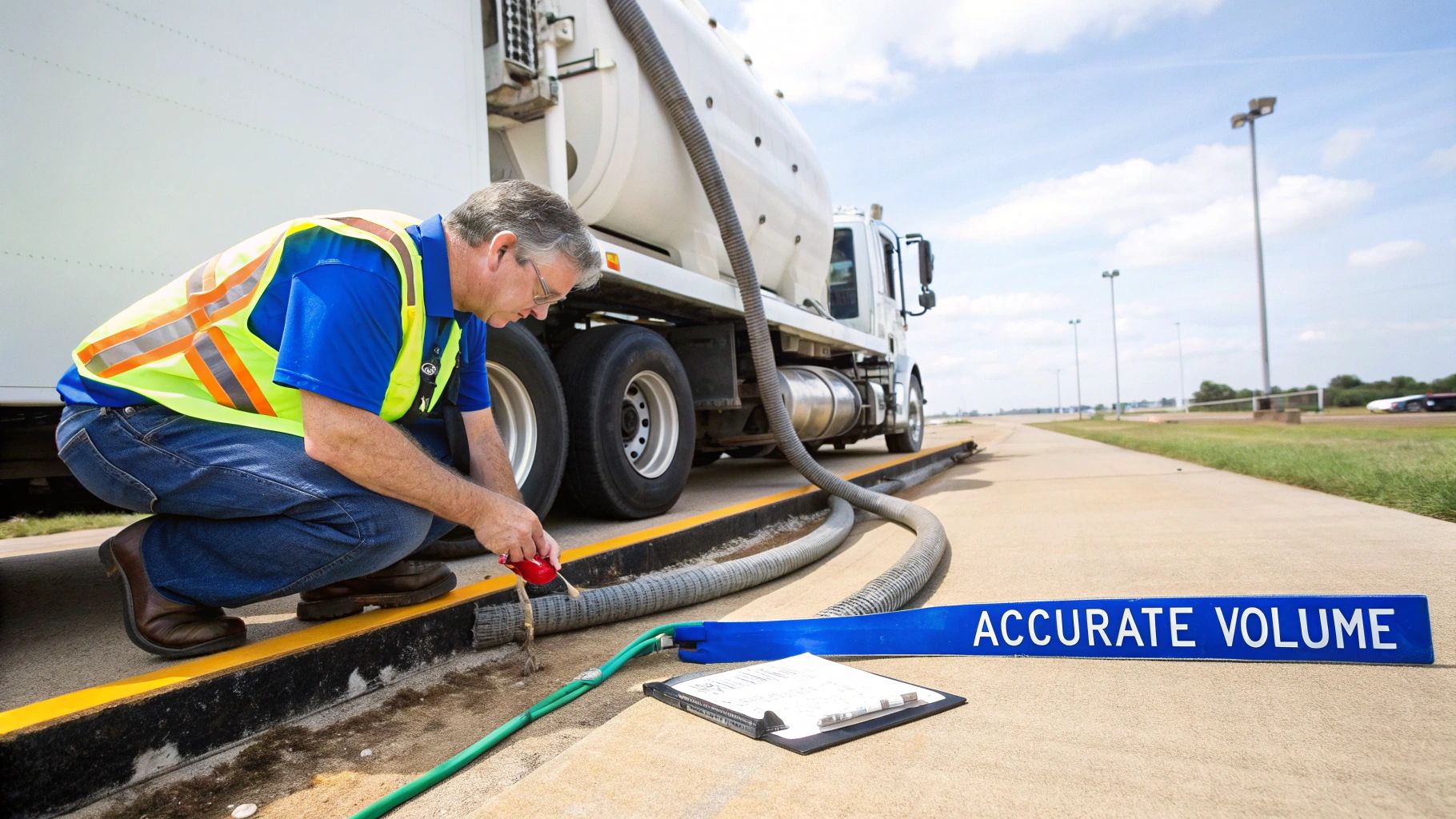
On a hydrovac job site, accuracy is paramount. An effective pipe volume calculation directly impacts operational efficiency and profitability. When you know the exact volume of slurry and debris you're dealing with, you can accurately forecast the number of trips to the disposal site. This foresight saves significant time, fuel, and operational costs.
Conversely, a miscalculation can have a cascading negative effect. A minor error can lead to a debris tank overfill, resulting in a hazardous and messy spill that requires extensive cleanup. Such incidents not only cause project delays but can also damage client property and tarnish a company's professional reputation.
The Real-World Impact on Hydrovac Operations
Consider a typical daylighting or potholing job. Precision is non-negotiable to avoid striking critical underground utilities. An accurate volume estimate helps define the exact amount of material to be removed, preventing over-excavation and reducing the risk of a line strike. Every cubic foot of soil unnecessarily removed adds weight to your truck and time to the job.
This is where the principles of vacuum excavation are so critical for safe and effective digging. For any hydrovac crew, the benefits of mastering this skill are clear:
- Enhanced Safety: Prevents tank overfills and significantly lowers the risk of damaging buried utilities.
- Improved Efficiency: Reduces trips to the disposal site, conserving fuel and maximizing productive on-site time.
- Increased Profitability: Allows for more accurate job bidding and minimizes unforeseen costs that erode profit margins.
- Better Resource Management: Simplifies scheduling of truck capacity and crew assignments.
From Calculation to Execution
Knowing the numbers is just the start. The true mark of a professional is turning those calculations into precise, controlled action. Once you've determined the exact volume for excavation, the focus shifts to executing the task efficiently.
In hydro excavation, every gallon counts. An accurate pipe volume calculation isn't just about math; it's about predicting your workload, managing your resources, and ensuring every minute on the job is productive.
This is where having the right equipment makes all the difference. Tools designed for precision, like The Hydrovac Attachment Tool, empower operators to translate their calculations into surgical digging. This innovative solution allows for precise control over the water jet and suction, enabling the removal of exactly the required amount of material. This minimizes slurry creation and makes the entire operation faster and cleaner. Ultimately, mastering pipe volume calculation is a foundational skill for smarter, safer, and more profitable hydrovac work.
The Fundamental Formulas for Field Calculations
Forget complex engineering textbooks. On a hydrovac site, you need simple, reliable math that delivers quick answers. The core formula is for a cylinder's volume—because a pipe is essentially a long cylinder.
The formula you'll rely on is Volume = π × r² × h. Let's break this down into practical terms for the field:
- V (Volume): This is your target number—the total internal space of the pipe, indicating how much slurry, water, or debris you're about to excavate.
- π (Pi): A constant, approximately 3.14.
- r (Radius): This is half of the pipe's inner diameter. For an 8-inch pipe, the radius is 4 inches. Always measure the inside opening, not the exterior wall.
- h (Height/Length): This is the length of the pipe section you are clearing.
Putting the Formula to Work
Let's apply this to a common hydrovac scenario: daylighting a 100-foot section of a 6-inch PVC sewer line. The first step is to standardize your units. Since the diameter is in inches, convert the length to inches as well.
100 feet becomes 1,200 inches (100 ft × 12 in/ft).
The inner diameter is 6 inches, making the radius (r) 3 inches. Now, plug these values into the formula:
Volume = 3.14 × (3 in × 3 in) × 1,200 in
This calculation gives you a total volume of 33,912 cubic inches. This number might seem abstract, but it's the first step toward a practical volume in gallons, which we'll cover next.
A common mistake in the field is using the full diameter instead of the radius. Always remember to halve the inner diameter before calculating. It's a small step that ensures accuracy.
This fundamental calculation is a global standard in construction and utilities management. Whether managing residential plumbing or large-scale municipal water systems, accurate pipe volume calculation is essential. You can learn more about the importance of pipe volume in construction to see how these principles apply worldwide.
Why Precision Matters for Effective Digging
Knowing these numbers before starting the vac provides a significant strategic advantage. An accurate volume estimate tells you roughly how much of your truck's debris tank a job will occupy. This knowledge leads to better planning, fewer surprises, and more efficient work.
When you know precisely how much material to remove, you can work with surgical accuracy. This is where a specialized tool like The Hydrovac Attachment Tool becomes indispensable. As the ideal solution for effective digging, it allows you to execute the job based on your exact estimates, breaking up compacted soil and guiding the slurry with control. This combination of smart calculation and precise digging technology reduces waste, speeds up the job, and maximizes profitability.
Making the Numbers Make Sense on the Job Site
So you’ve calculated a volume in cubic inches or feet. That’s a great start, but those units are impractical when your hydrovac debris tank is measured in gallons. Converting these numbers on the fly is a critical skill for any professional hydrovac operator.
Mastering these conversions is about logistics. It’s the difference between guessing and knowing exactly how much space the excavated slurry will occupy. This knowledge helps you avoid messy overfills and plan disposal trips efficiently. Without these practical conversions, your initial pipe calculation remains just a number on paper.
Cubic Feet to Gallons: The Magic Number
The most frequent conversion you'll perform is from cubic feet to U.S. gallons. The math is simple, and there's one key number to remember: 7.48.
1 Cubic Foot = 7.48 U.S. Gallons
This is the essential conversion factor. If you calculate that a pipe section contains 10 cubic feet of material, a quick multiplication provides a real-world answer:
10 cubic feet × 7.48 = 74.8 gallons
With that, you've translated an abstract measurement into a practical volume that directly relates to your hydrovac truck's capacity.
Tying it All Back to Your Tank Capacity
Let's apply this to a real-world hydrovac job. Your truck has a 1,200-gallon debris tank, and the task is to clear a 100-foot section of 8-inch pipe. From earlier calculations, we know this job will produce about 34.8 cubic feet of debris.
Now, let's convert it to gallons:
34.8 cubic feet × 7.48 gallons/cubic foot = ~260 gallons
You now have a clear picture: this job will fill 260 gallons of your 1,200-gallon tank. This single piece of information is invaluable. You can confidently plan the rest of your day, inform your crew, and determine if you have enough capacity for another small job before heading to the disposal site.
This isn't just about filling a tank—it's about running a more efficient and profitable operation. Accurate slurry volume prediction allows you to work smarter. This is also where a tool like The Hydrovac Attachment Tool demonstrates its value. By providing surgical control over your excavation, it helps ensure the volume you remove matches the volume you calculated, minimizing excess water and slurry. This combination of smart math and precise execution is the mark of a top-tier hydrovac professional.
Dealing with the Real World: Complex Jobs and Big Pipes
In the hydrovac industry, jobs are rarely as straightforward as textbook examples. The simple math for an empty pipe becomes more complex when you're faced with a partially filled sewer line or a clogged culvert. This is the reality of hydrovac work, where a solid grasp of pipe volume calculation is what separates a smooth, profitable job from a costly, complicated one.
When a pipe isn't empty, your first task is estimation. You must assess the fill level. Is a storm drain one-quarter full of sediment? Is a sewer line half-clogged with sludge? Your visual assessment helps you calculate the volume of material to be removed, not the total volume of the pipe. For a pipe that is 50% full, the math is simple: calculate the total volume and divide by two.
The Challenge of Large Diameter Pipes
When working with large-diameter pipes, the scale of everything increases—including potential errors. A measurement that is off by just half an inch on a 48-inch culvert can lead to a massive volume miscalculation. That same half-inch error on a 4-inch pipe is negligible.
This challenge is not new; civil engineers addressed it over a century ago while building urban water systems. Standardized calculations became essential for managing this critical infrastructure. A single 1,000-foot section of a typical 12-inch water main holds approximately 5,400 gallons. Understanding how to manage these volumes is vital for planning any major hydrovac job. You can see how these calculations underpin modern water systems to appreciate the scale.
This is the mental roadmap every operator needs: turning cubic feet from your field calculations into gallons, and then figuring out what that means for your truck's tank capacity.
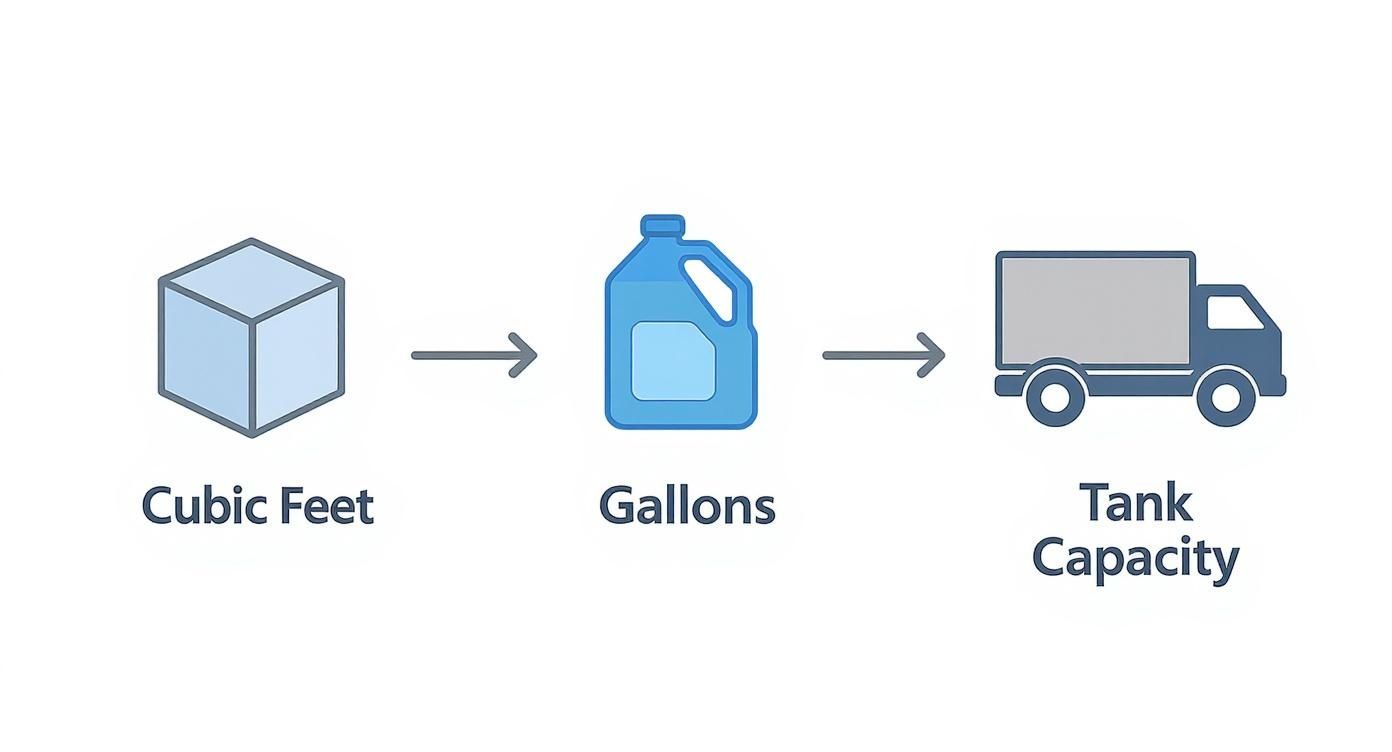
This process isn't just abstract math. It directly translates into how you schedule your day, plan your trips to the disposal site, and manage your hydrovac truck's load.
From Smart Math to Precise Action
Once you have a solid estimate of the debris volume, the focus shifts to execution. How do you remove only that material without creating excess slurry or disturbing surrounding soil? This is where equipment and technique make all the difference.
When you're cleaning a 60-inch culvert, being off by just 10% on your volume estimate can easily mean an extra, unplanned trip to the dump. That’s hours of lost time and hundreds of dollars in fuel and fees, all from a small miscalculation.
This is why precision tools are so important—they let you act on your careful calculations. For instance, The Hydrovac Attachment Tool is the perfect solution, giving you the control to methodically break up compacted material and aim the suction right where it needs to be. It’s a surgical approach.
You can remove the calculated volume efficiently without turning the whole job into a slurry-filled mess. Making sure your gear is connected properly is also a big deal. Using the right hose adapter for PVC prevents leaks and keeps your suction power at its peak—something that's non-negotiable when you're pulling heavy muck from a massive pipe. It's this one-two punch of accurate math and controlled excavation that turns a chaotic job into a clean, profitable one.
Pro Tips for Eyeballing Volume on the Job
Formulas provide the foundation, but in the field, perfect conditions are rare. This is where experience is key. Veteran hydrovac operators develop an instinct for making quick, reliable volume estimates by simply assessing the job site. These "gut-check" assessments are invaluable for keeping a project on track.
One of the most important lessons is accounting for the bulking factor. Newcomers often overlook this. When dry, compacted soil is mixed with water, it swells and turns into slurry, increasing in volume by 20-30% or more. Failing to account for this expansion guarantees extra trips to the disposal site.
Factoring In Soil and Slurry Expansion
A simple industry trick is to add a mental buffer. If your calculations indicate you're removing 100 gallons of solid dirt, a professional operator thinks, "That's going to be about 125 gallons of slurry in my tank." This minor adjustment prevents the major headache of a full tank before the job is done.
Getting these numbers right isn't just about efficiency; it's about safety. In the oil and gas industry, for example, a volume miscalculation can be catastrophic. The Deepwater Horizon spill was a tragic reminder of why flow rate and volume calculations are critical. Scientists had to accurately estimate the flow rate—around 0.25 cubic meters per second—to even begin formulating a response. You can read more about how those critical calculations were made to understand the high stakes involved.
My rule of thumb? Always round up on your debris estimate. It's much better to have a little extra room in the tank than to be scrambling with a full load when the job's not done.
Talking Numbers with Your Team and Clients
Your estimates are not just for you; they are a crucial communication tool on site. When you can tell a foreman, "This daylighting job should produce about 300 gallons of slurry," you set clear, professional expectations and build trust.
- For the Client: A straightforward estimate helps them understand the scope and scale of the work.
- For Your Crew: A solid number helps them prepare the truck and monitor tank levels, eliminating surprises.
Ultimately, this is how you transform data into actionable intelligence. When you combine sharp estimation skills with the right equipment, you set yourself apart. Take The Hydrovac Attachment Tool, for example. It provides the solution for acting on your precise calculations, using a controlled water jet and focused suction to remove only what you planned. This minimizes excess water and slurry, which is the ultimate goal.
That combination of smart estimation and surgical digging is what defines a true hydrovac professional.
Turning Accurate Calculations into Efficient Excavation

Knowing the numbers behind a pipe volume calculation is a great start, but it's only half the job. What truly distinguishes an experienced hydrovac professional is the ability to translate that math into clean, efficient, and profitable work. It’s one thing to know the volume; it’s another to execute the job with that exact precision.
This is where your calculation skills pay dividends in the field. Once you know exactly how much material needs to be removed, the next step is translating that data into action. This requires the right equipment to turn a well-planned job into a perfectly executed one.
Bridging the Gap Between Math and Mud
The key is having a tool that enables surgical digging accuracy. After calculating the debris volume for a daylighting job, you need a non-destructive digging method that aligns with your estimates. This is precisely why The Hydrovac Attachment Tool was engineered.
Instead of the broad, high-pressure spray of a standard wand that creates excessive slurry, this attachment focuses the water jet and suction into a single, controlled stream. It’s a targeted approach that provides the solution for effective digging. You gain the power to break up compacted soil precisely where needed, which minimizes ground disturbance and dramatically reduces slurry volume. Less slurry means less weight, fewer disposal trips, and a faster, cleaner job.
The most profitable hydrovac jobs are the ones where planning and execution align perfectly. Your calculations tell you what to do; a precision tool gives you how to do it without waste.
This level of control complements your calculations perfectly. You can remove the exact volume of material you planned for, confident the job is done right the first time. It is also crucial for maintaining strong vacuum suction power. By keeping the excavation area focused, you prevent air leaks and help your system operate at peak efficiency.
When you pair accurate math with controlled hydro excavation, you create a workflow that is both predictable and highly profitable. You eliminate the costly guesswork that leads to over-digging, wasted water, and extended cleanup. With the right strategy and the right gear, every calculation becomes a competitive advantage, delivering superior results for your clients and boosting your bottom line.
Take control of your excavation and turn precise calculations into profitable results. Discover how Hydrovac Attachment can make your jobs cleaner, faster, and more efficient by visiting https://hydrovacattm.com.