


If you've ever built a fence, installed a deck, or even just put up a mailbox, you know the feeling. The a-hole-digging part is pure, back-breaking work. That's where a one-man post hole digger comes in—it's a powered auger designed to take the grunt work out of the equation, letting one person do what used to take a team (and a lot of sweat).
These tools ditch the old shovel-and-clamshell routine for an engine that does the heavy lifting, drilling clean, perfect holes in a fraction of the time.
Digging Smarter, Not Harder
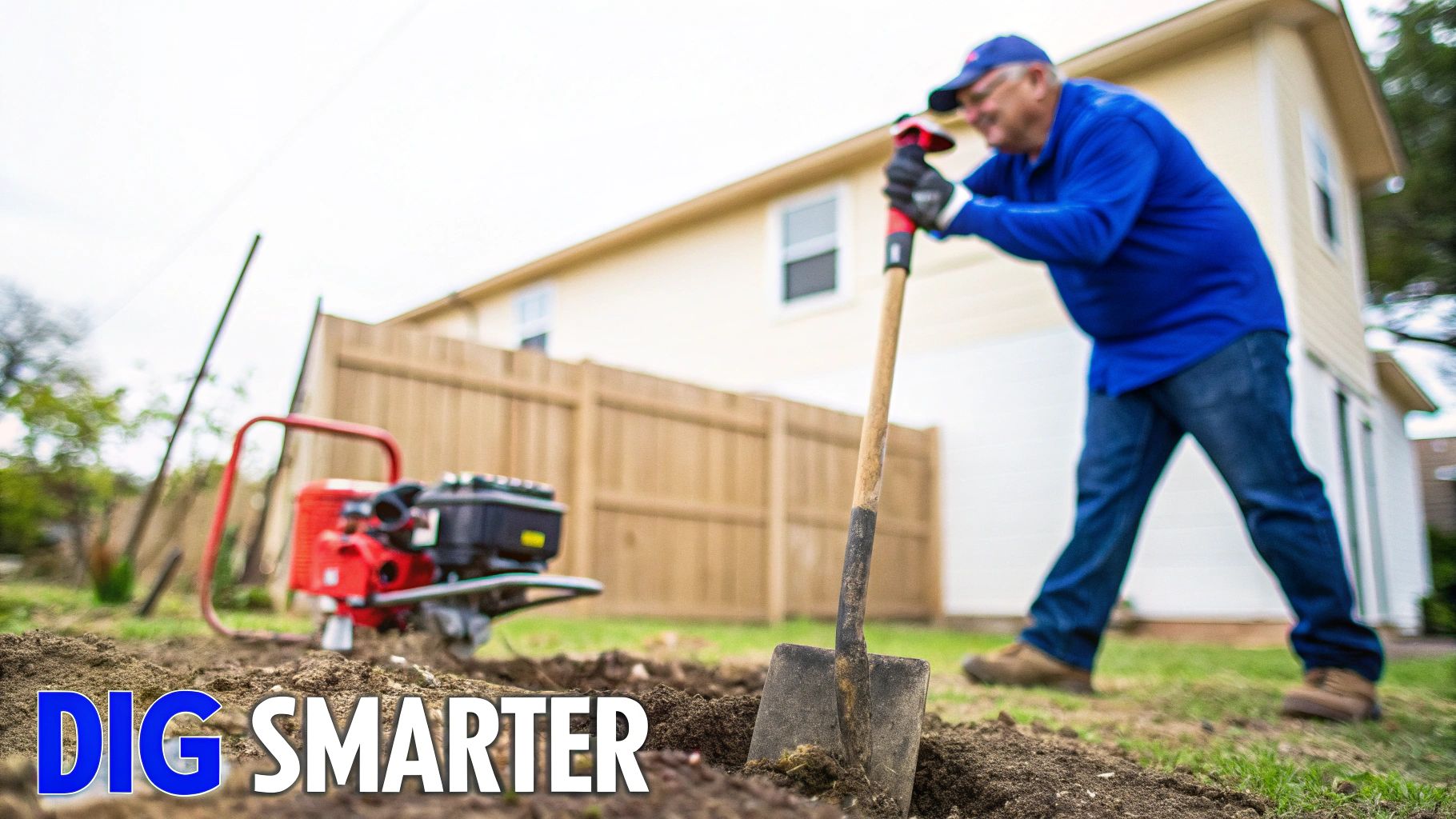
Let's be honest, manual digging is brutal. It’s slow, it’s tough on your back, and getting the holes perfectly uniform is a real challenge. Spending a whole weekend wrestling with a shovel just to end up with sore muscles and a wobbly fence line is no one's idea of a good time. This is exactly why powered augers are such a game-changer.
The Modern Approach to an Age-Old Task
Powered one-man post hole diggers bring mechanical muscle to your project, saving you a massive amount of time and energy. Instead of trying to chop through roots or pry out rocks by hand, the auger just powers its way through the soil.
This leap in efficiency means DIYers and professional contractors alike can get more done, faster, and with way better results. If you're tackling a new fence, figuring out how to dig a fence post hole with the right gear is step one for a solid, professional-looking installation.
But picking the right tool isn't just about grabbing the most powerful one off the shelf. It’s about matching the machine to the ground you're working with and the job you need to do.
For professional crews, especially in the hydrovac industry, the best tool isn't just the one that digs fastest. It's the one that works safest, creates the least mess, and protects underground infrastructure.
This guide will walk you through the standard options, but we're also going to look at what comes next. For jobs where precision and safety are non-negotiable, we'll introduce advanced hydrovac solutions. For pros in the field, tools like the Hydrovac Attachment are the future of smart digging—a non-destructive method that keeps sites clean, crews safe, and buried utilities intact.
It’s all about finding a better way to work. Smarter, not just harder.
Comparing Different Types of Post Hole Diggers
Picking the right one man post hole digger isn't about finding the "best" one—it's about finding the right one for your job. Think of it like a mechanic's toolbox; you wouldn’t grab a sledgehammer when you need a precision screwdriver. Each type of digger is designed for specific soil, a certain scale of work, and the person running it. Your choices really boil down to three camps: manual, gas-powered, and electric.
Let's start with the classic: the manual digger. Often called a "clamshell" digger, this is the original and, in some cases, still the champion. It shines when you’re working in tight spots or need to be surgical with your digging. You can feel exactly what you're hitting, letting you carefully work around rocks and roots without tearing up the surrounding area. This level of control makes them perfect for small jobs or tricky ground where a powered auger would be overkill.
You can't overstate the impact these simple tools had. In the early 20th century, they were a game-changer for small farms and homesteads. By 1920, clamshells and early manual augers were found on over 60% of U.S. farms under 100 acres. They let a single person dig up to 20 post holes a day, which was a massive leap from what you could do with a shovel. This efficiency boost cut labor costs by a staggering 40-50%, helping fuel the fencing boom across the country. Even today, the market is surprisingly strong, hitting $512 million in 2024, with North America accounting for 34% of that thanks to a healthy DIY culture. You can dig deeper into the manual post hole digger market trends on marketintelo.com.
To make sense of these options at a glance, here's a quick breakdown of how they stack up against each other.
One Man Post Hole Digger Comparison
| Digger Type | Best For Soil Type | Ideal Job Size | Power Source | Pros | Cons |
|---|---|---|---|---|---|
| Manual | Loamy, sandy, soft soils with minimal rocks. | Small jobs (1-10 holes), tight spaces, planting shrubs. | Human Power | Precise control, quiet, no fuel, inexpensive. | Slow, labor-intensive, struggles with hard or rocky soil. |
| Gas-Powered | Hard-packed clay, rocky soil, dense ground. | Large projects (fencing acres, decks, multiple structures). | Gasoline Engine | Maximum power and torque, fast, fully portable. | Loud, heavy, produces fumes, requires engine maintenance. |
| Electric/Cordless | Soft to medium-density soils. | Medium jobs (backyard fences, planting trees). | Electricity (Cord or Battery) | Quiet, no emissions, low maintenance, easy to start. | Less power than gas, limited by cord or battery life. |
This table gives you the bird's-eye view, but the real choice comes down to the trade-offs you're willing to make between power, convenience, and the type of ground you're breaking.
Gas-Powered Augers: The Powerhouses
When you’re facing tough ground and a lot of holes, there's no substitute for a gas-powered auger. Fired up with a two-stroke or four-stroke engine, these machines are built to tear through compacted soil, dense clay, and stubborn roots without breaking a sweat. They are the clear choice for big jobs, like fencing a large property or setting the footings for a massive deck.
Picture putting a fence around a few acres. A gas auger becomes your best friend, letting you drill dozens of perfect holes in an afternoon. Its main advantages are pretty clear:
- Unmatched Power: It chews through dense clay and soil with rocks that would stop other diggers cold.
- Portability: With no cords to trip over, you have total freedom to move across a large job site.
- Speed: It drills holes in a fraction of the time it would take to do it any other way.
Of course, all that muscle has its downsides. Gas engines are loud, pump out exhaust fumes, and need regular maintenance. They’re also heavy, and you’ll need some real physical strength to keep one under control, especially if the auger bites into a root.
Electric and Cordless Diggers: The Quiet Achievers
Electric post hole diggers represent the modern, quieter approach to digging. Corded models give you consistent, reliable power without fussing with fuel, making them a solid choice for projects around the house where you have access to an outlet. The battery-powered cordless models take convenience a step further, giving you portability with almost no noise and zero emissions.
If a gas auger is a rumbling muscle truck, an electric digger is like a silent, efficient EV. It’s ideal for backyard projects where you don’t want to annoy the neighbors or breathe in fumes.
Key Takeaway: Electric diggers are fantastic for small-to-medium jobs in softer ground. They excel in residential areas, offering a much more user-friendly experience with less noise, no exhaust, and virtually no maintenance.
While they are much easier to handle and store, they just don't pack the same punch as a gas model. They have less torque, which means they can get bogged down in heavily compacted or rocky soil. This makes them a poor fit for the toughest professional jobs but a perfect match for gardening, putting up a small fence, or digging in loamy soil where convenience trumps raw power.
How to Choose the Right Digger for Your Project
Picking the best one-man post hole digger isn't as simple as just choosing between gas and electric. The real art is in matching the machine's guts—its engine, auger, and overall design—to the specific dirt you'll be fighting and the job you need to get done. Get this right from the start, and you'll save yourself a world of frustration and end up with a professional result.
Think of the engine as the heart of the operation. With gas models, power is measured in cubic centimeters (cc), while electric diggers use voltage or watts. A bigger cc number doesn't just mean a faster spin; it means more torque. And torque is what really matters. It's the raw twisting force that chews through stubborn clay or rocky soil. High torque beats high RPMs every time when you're trying to bore a clean hole.
This chart lays out a simple decision-making process to help you land on the right type of digger for your specific needs.
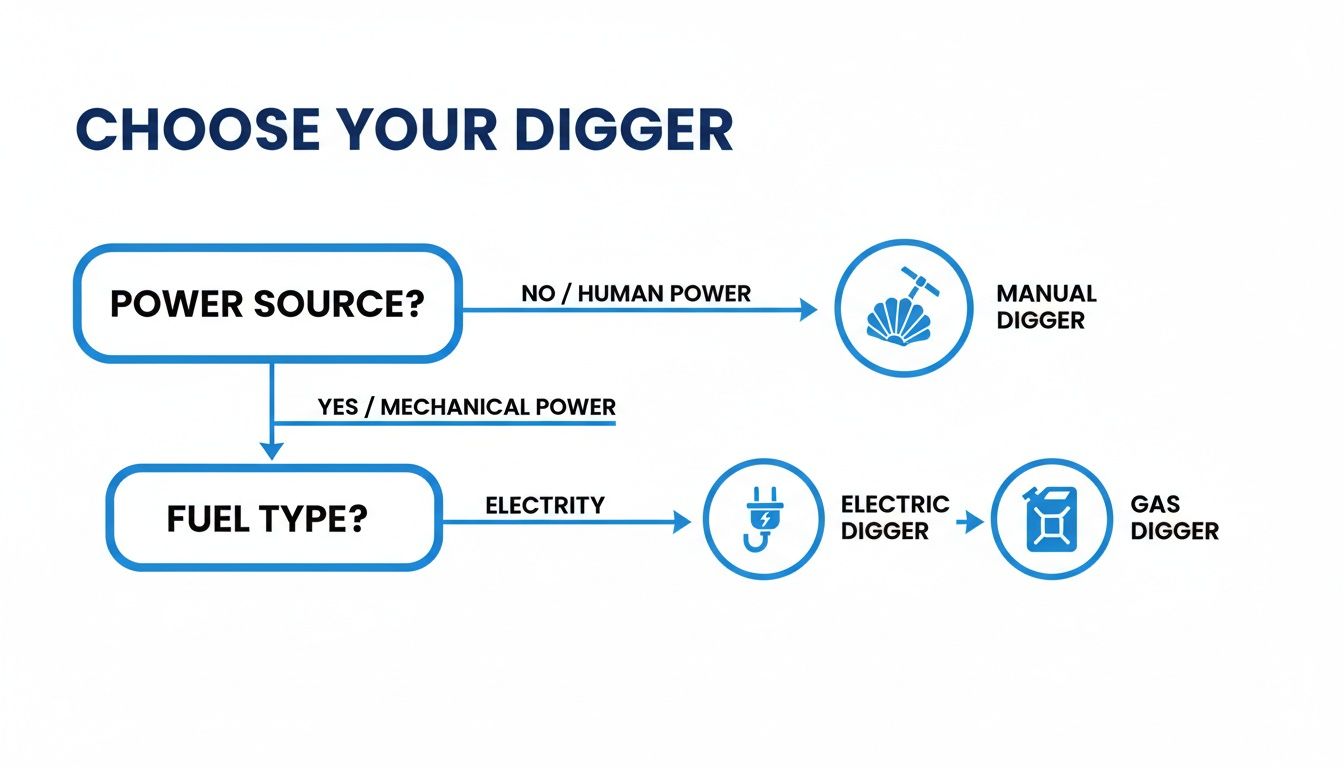
As you can see, a manual digger is perfect for small, precise jobs in softer ground. But if you're facing tough terrain or a large-scale project, you'll need the muscle of a gas-powered auger.
Matching the Auger to the Job
The auger bit itself is the business end of the tool, and getting the size right is crucial. A good rule of thumb is to pick an auger diameter that’s about two to three times the width of your post. This gives you plenty of space to pour concrete and set the post properly.
- For 4x4 Posts: A 6-inch or 8-inch auger is your best bet.
- For 6x6 Posts: Step up to a 10-inch or 12-inch auger.
If you go too small, you'll find yourself widening the hole by hand, which completely defeats the point of using a powered tool. Go too big, and you’re just wasting time, effort, and a lot of extra concrete.
The goal is a hole that’s snug enough for stability but wide enough to create a solid concrete footing. The right auger size is the first step to building a structure that lasts.
Don't Forget Ergonomics and Comfort
Lastly, pay attention to how the tool is built. The weight and handle setup of a one-man post hole digger can make or break your day. A well-balanced machine with anti-vibration handles is far easier to control and won't beat you up after a few hours of work.
This drive for efficiency is fueling massive growth in the industry. The market for these tools was valued at $440.1 million in 2023 and is expected to climb to $939.9 million by 2032. Why the boom? A single operator with a 62cc auger can drill about 15 holes per hour, while digging by hand might only yield five. That's a 66% reduction in project time, making these diggers an obvious investment for any serious contractor. You can learn more about the dirt hole auger market growth on coherentmarketinsights.com.
Essential Safety and Maintenance Practices
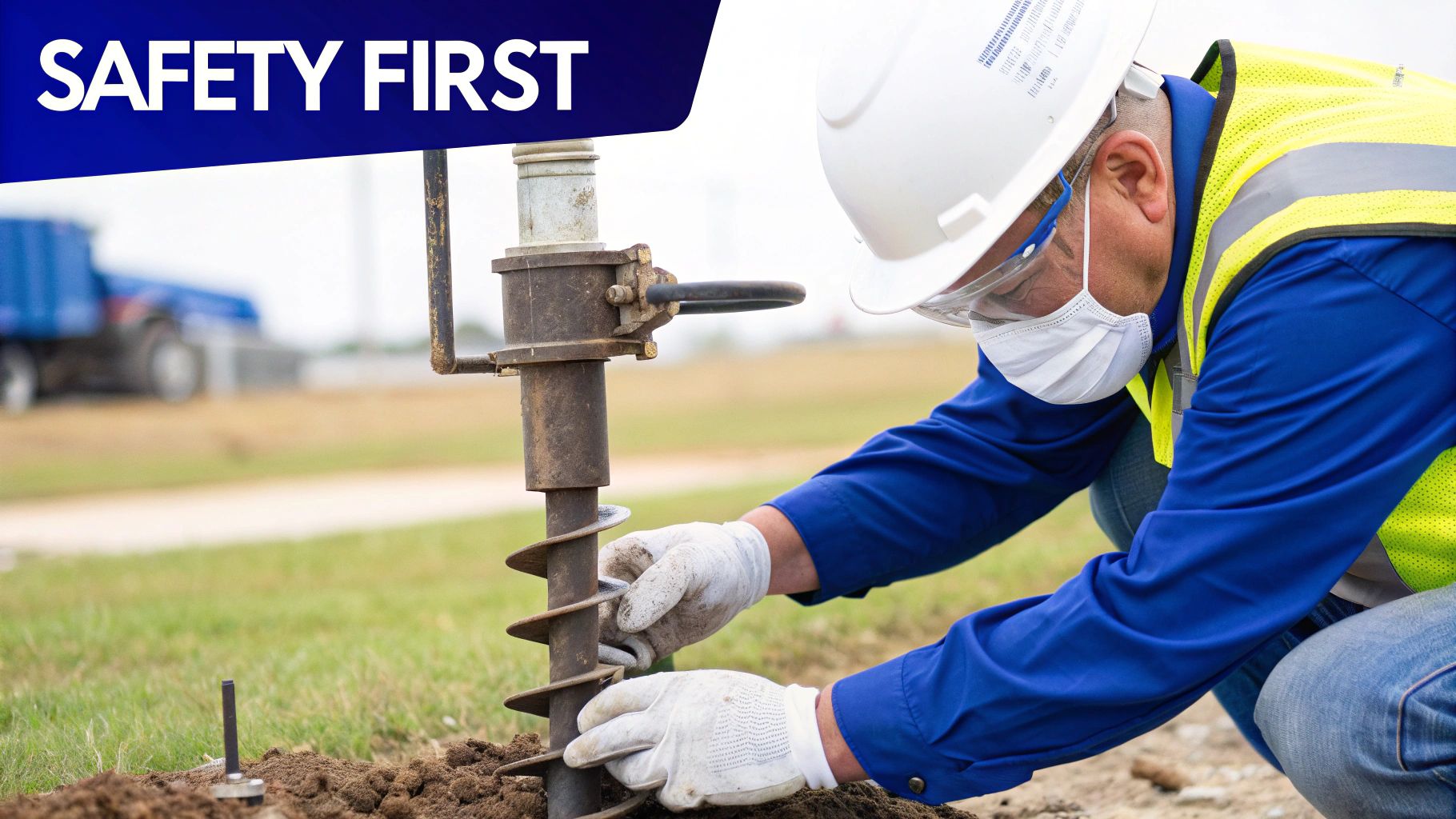
Any tool that combines a powerful engine with a spinning auger deserves a healthy dose of respect. A one man post hole digger is no exception. Before you even think about pulling that starter cord, a quick pre-operation check is an absolute must. It’s a simple habit that protects you and your machine.
First off, give the whole tool a once-over. Are there any loose bolts, signs of a fuel leak, or other visible damage? Make sure the auger bit is locked tightly onto the gearbox—the last thing you want is that thing flying off mid-spin. Finally, take a second to clear your workspace of any rocks, stray branches, or tools you could trip over.
Proper Operation and Personal Protective Equipment
The number one risk you'll face is kickback. This is what happens when the auger snags on something solid, like a big rock or a stubborn tree root. The auger stops, but the engine's torque doesn't. That force has to go somewhere, so it violently twists the entire powerhead back towards you. To counter this, plant your feet shoulder-width apart to create a solid, balanced stance. Always keep the machine close to your body and avoid overreaching.
Your Personal Protective Equipment (PPE) is non-negotiable. It's your first and best line of defense against injury.
- Eye Protection: Flying dirt, rocks, and debris are a given. Safety glasses or goggles are essential.
- Hearing Protection: Gas-powered augers are loud. Protect your hearing with earplugs or muffs.
- Sturdy Boots: Steel-toed boots will guard your feet against accidents and give you a much better grip on the ground.
- Gloves: A good pair of heavy-duty gloves helps you maintain a firm grip and dampens some of the vibrations.
If you want to dig deeper into workplace safety, you can find comprehensive guidelines on exposure controls and PPE that cover more than just the basics.
Routine Maintenance for Longevity
If you want your one man post hole digger to run safely and start when you need it to, you have to take care of it. A well-maintained tool is a reliable one. The best approach is to create a simple maintenance routine you can stick to.
A few minutes of care after each use can save you hours of headaches and a lot of money on repairs later. It’s all about making sure the machine is ready to go the next time you are.
After you're done for the day, wipe the machine down to get rid of caked-on dirt. Check the air filter and clean it if it looks clogged; a choked-up filter kills engine performance. For gas models, be meticulous about using the right fuel-to-oil mix, and if it's a 4-stroke, always check the oil level. Don't forget the business end—the auger blades. Sharp blades slice through soil efficiently and put less strain on the engine. If they're dull or chipped, either sharpen them or replace them. It makes digging easier and safer.
When Your Project Demands More Than Just a Hole
While a one man post hole digger is a fantastic tool for countless jobs, there are times when its brute force creates more problems than it solves. Professionals in the hydrovac industry know that certain projects demand a level of precision and care that a spinning auger just can't provide. These are often high-stakes situations where one mistake could lead to costly repairs or even dangerous accidents.
Think about the common headaches. A standard auger works by flinging displaced soil all over the site, leaving a mess that takes extra time and effort to clean up. In saturated or muddy ground, this turns into a splashy, uncontrollable disaster that can ruin surrounding lawns and property. Even more critical is the very real risk of striking unmarked utilities—a common and hazardous scenario in residential and urban areas.
When your digging needs go beyond what a standard post hole digger can safely handle, it's worth understanding professional excavation services.
The Shift to Non-Destructive Digging
This is where the hydrovac industry is getting smarter, leaning into non-destructive methods like hydro excavation. Instead of just ripping through the ground, this technique uses a highly controlled stream of pressurized water to liquefy the soil. A powerful vacuum then simultaneously removes the resulting slurry, leaving a clean, precise hole with zero mess and minimal ground disturbance. This is the core principle behind solutions like The Hydrovac Attachment Tool.
This method isn't about replacing every auger on every job. It’s a specialized upgrade for specific, high-risk applications:
- Utility Potholing: You can safely expose buried gas lines, fiber optic cables, or water mains without the slightest risk of a mechanical strike.
- Trenching Near Structures: It’s perfect for digging near building foundations or concrete slabs where an auger could easily cause structural damage.
- Working in Manicured Landscapes: This approach preserves established lawns, gardens, and hardscapes by completely avoiding messy soil displacement.
The earth auger market has exploded since the gas models of the 1950s, growing into a $1.68 billion industry in 2022. A solo operator with a 9-inch auger can punch a hole in just two minutes, but that speed comes with trade-offs. Safety logs show that using a one man post hole digger in wet soil can increase messy splashback by 25%. In contrast, a solution like the Hydrovac Attachment—which combines a power washer and wet vac—directs 95% of the debris neatly into the vacuum, making it ideal for clean, professional work.
Hydrovac excavation transforms digging from a brute-force task into a surgical procedure. It prioritizes what professionals value most: safety, precision, and a clean job site from start to finish.
This clean approach is crucial for modern contractors. Before you even think about setting posts, you need to know exactly how much concrete to use—our guide on how much Quikrete you need can help with that planning. But the planning only matters if the hole is excavated cleanly and safely. The Hydrovac Attachment gives you that clean-dig capability, ensuring your project starts on the right foot.
When You Need More Than an Auger: Introducing the Hydrovac Attachment
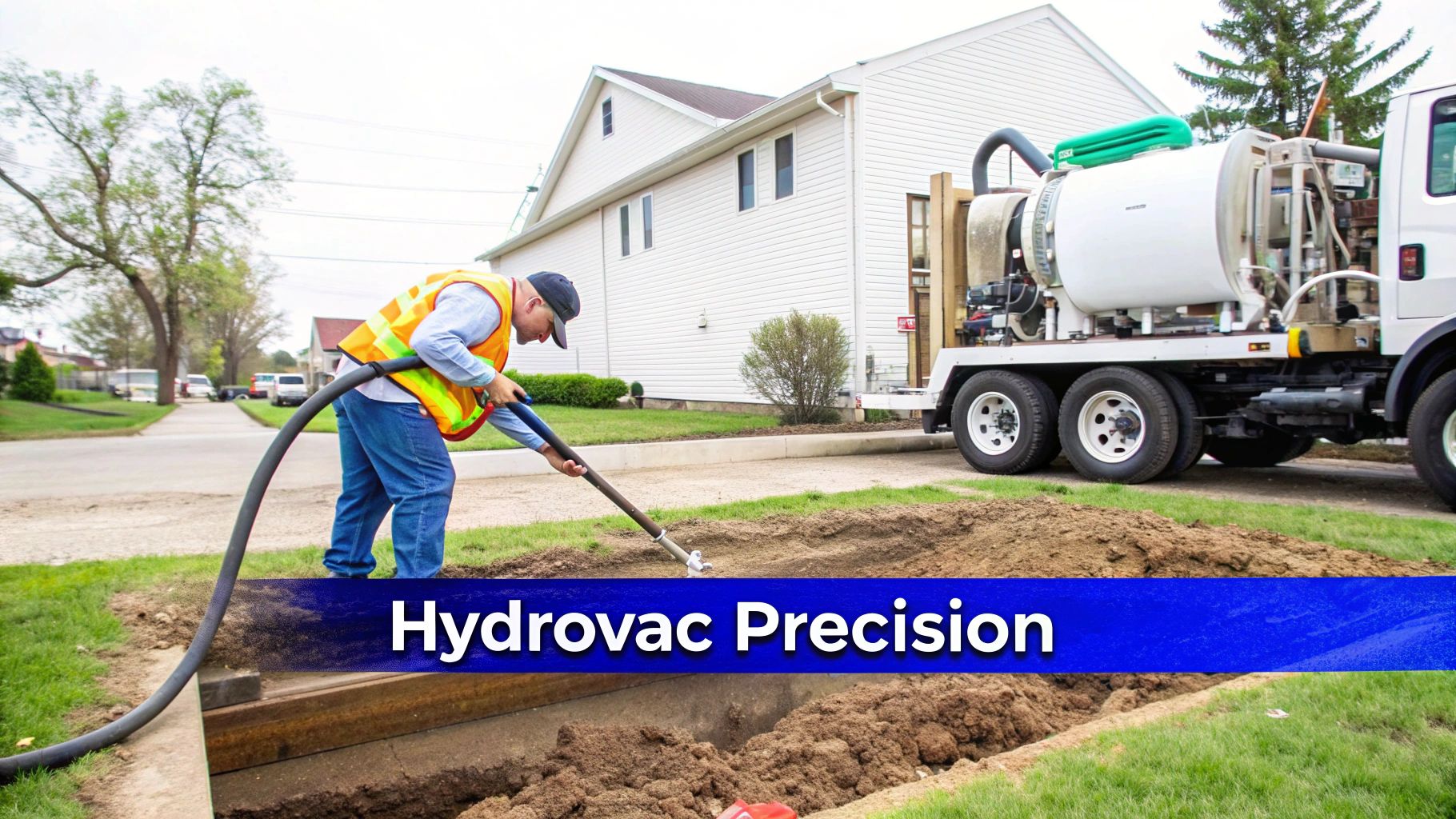
Let's be honest, there are times when even the best one man post hole digger just isn't the right tool for the job. When you're working in tight spaces or near buried utilities, a spinning auger can feel more like a liability than a solution. This is exactly where the Hydrovac Attachment Tool comes in.
Think of it as the smart, modern answer to the mess, risk, and brute force of old-school digging. It’s an ingenious system that connects two pieces of equipment most professional crews already have on the truck: a power washer and a wet/dry vac. By combining them, you get a powerful, non-destructive digging tool. The high-pressure water liquefies the soil, and the vacuum immediately sucks it away. Simple, clean, and incredibly precise.
A Game-Changer for Job Site Safety and Efficiency
For professional hydrovac contractors, the advantages are clear right out of the gate. That constant struggle with big, messy piles of displaced soil? Gone. Instead of shoveling dirt and spending ages on cleanup, the soil and water are contained and removed in one clean motion. That alone can slash your labor time and keep projects moving forward.
But the real win is safety. Hydro excavation is, by its very nature, non-destructive. That means you can work right next to buried utilities without the constant fear of hitting something critical.
With the Hydrovac Attachment Tool, you can carefully expose gas lines, fiber optic cables, or water mains. The risk of a costly, dangerous strike from a mechanical auger is completely off the table, keeping your crew—and the surrounding infrastructure—safe.
This kind of surgical precision opens up a whole new world of possibilities. Imagine these common scenarios:
- Potholing Utilities: You need to find and expose a utility line right up against a building's foundation. No problem.
- Trenching for Irrigation: You're cutting a narrow trench across a perfectly manicured lawn. The Hydrovac Attachment Tool does it without ripping up the turf.
- Fence Post Installation: You’re digging post holes in a tight backyard where messy piles of dirt would ruin a flowerbed or stain a patio. It’s the perfect tool for the job.
The Professional's Choice for a Clean Finish
At the end of the day, the Hydrovac Attachment Tool is for crews who care about the quality of their work from start to finish. It lets you work faster, much more safely, and with a level of precision a one man post hole digger could never match.
By minimizing the mess and disruption on-site, you’re showing clients a level of professionalism that truly stands out. If you'd like to see how all the pieces come together, you can learn more about the full range of hydrovac excavation equipment. It’s the smart choice for contractors who know that the best work is not just effective—it’s also clean, safe, and professional.
Got Questions? We've Got Answers.
Digging into a new project often unearths a few questions. Let's clear up some of the most common ones about choosing the right tool for the job, whether it's a trusty old auger or a more advanced hydrovac solution.
When Is a Traditional One Man Post Hole Digger Still the Right Tool?
A classic gas or electric auger is still your best friend for simple, wide-open jobs where you know the ground is clear of underground utilities. Think about setting a long fence line across an open field or planting a whole row of trees.
For those kinds of tasks, where speed is the name of the game and the risk of hitting a buried pipe or cable is practically zero, the raw power of a traditional digger is tough to beat.
What Gives Professional Crews an Edge with the Hydrovac Attachment Tool?
For the pros, it's all about precision, safety, and a clean job site. The Hydrovac Attachment Tool lets crews work smarter, not harder. It completely gets rid of the messy soil piles that come with auger digging, which means less time and money spent on cleanup.
The real game-changer is safety. It gives crews the ability to safely daylight utilities, exposing them without the risk of a dangerous and costly mechanical strike. When you're working in a tight backyard or on a sensitive commercial site, this tool minimizes damage to the landscape and demonstrates a level of care that really builds a professional reputation.
This ability to work cleanly and safely is what allows professional teams to take on jobs that are just too risky for a standard auger.
Is the Hydrovac Attachment Tool a Hassle to Set Up and Use?
Not at all—it was designed to be fast and easy. The patented three-part system clicks together in seconds, connecting a standard power washer wand to a common 2.5-inch wet vac hose.
There's no complex assembly required. It’s made from a lightweight polymer, so a single operator can handle it without the exhaustion that comes with wrestling heavy equipment. The whole point is for it to work seamlessly with the gear your crew already has on the truck, making it an incredibly practical tool for any professional team.
Ready to boost your crew's efficiency and raise your safety standards on the job? The Hydrovac Attachment Tool is the modern answer for precise, non-destructive digging that leaves your work site clean and your clients impressed.