


Digging a fence post hole the right way is about more than just brute force. For industry professionals, it comes down to planning your fence line, identifying underground utilities, and selecting the right excavation method for the soil type. Getting these steps right is what separates a long-lasting, professional installation from a costly callback. It prevents catastrophic utility strikes and ensures you're using the most efficient tools for the job, protecting both your crew and your bottom line.
Planning Your Fence Project for Success
A straight, sturdy fence is the hallmark of a professional job, and that begins long before breaking ground. Think of this initial planning as the foundation of your entire project—skip it, and you're setting yourself up for leaning posts, property line disputes, or worse, a dangerous and expensive run-in with a buried utility line. This is a critical phase for any hydrovac operator or fencing contractor.
This is your blueprinting phase. Your first move should be to physically map out the fence line. Use wooden stakes and a mason's string to establish a perfectly straight, visual guide for where every single post needs to go. This simple step ensures accuracy and efficiency once the digging begins.
Defining Boundaries and Local Rules
Once your string line is up, you need to verify two crucial things: your property lines and the local rules. Even if the client thinks they know where their property ends, always confirm with a property survey or plat. This professional due diligence prevents major disputes and liability issues.
Next, remember that almost every municipality has specific codes for fencing. These often dictate maximum height, material requirements, and setback distances from property lines. A quick check of the local building department's regulations is a non-negotiable step to avoid fines or teardown orders.
The Most Important Phone Call You'll Make
This part is non-negotiable for any excavation professional. Before any equipment touches the ground, you absolutely must identify all underground utilities. The critical first step is knowing how to locate underground utilities to avoid a disaster.
All you have to do is call 811 (the national "Call Before You Dig" hotline) a few days before you plan to start. It’s a completely free service. They'll dispatch crews from local utility companies to mark the approximate location of any buried lines on the property, including:
- Electric cables
- Gas pipes
- Water lines
- Communication and fiber optic cables
Hitting a utility line isn't just an "oops." It can cause serious injury, create a major service outage, and leave your company liable for thousands in repair costs. The colored flags and paint they use indicate exactly where non-destructive digging methods are essential.
Understanding Your Soil Conditions
Finally, assess the ground conditions. The soil composition dictates the right excavation method and equipment. Is it soft, loamy soil? Or are you dealing with dense, heavy clay that will fight you for every inch? Is the site full of rocks and thick tree roots?
This assessment determines whether manual tools are feasible or if you need to deploy mechanical equipment. For projects with challenging soil or in close proximity to marked utilities, non-destructive hydro excavation is often the safest and most efficient solution. Tools like The Hydrovac Attachment provide this capability without requiring a full-sized hydrovac truck.
Choosing the Right Tool for Digging Post Holes
When gearing up for a fencing project, selecting the right excavation method is a critical business decision. It's not just about getting the job done; it's about optimizing speed, cost, and most importantly, safety. The choice between a manual digger, a gas auger, or a hydrovac system depends entirely on the soil, the number of holes, and the presence of underground infrastructure.
Let's walk through these primary methods. Each has its place, but they represent vastly different approaches to performance and risk management, especially from a hydrovac industry perspective.
Comparing Fence Post Hole Digging Methods
Picking the right method is about matching the tool to the job's specific demands. The table below breaks down the pros and cons of each approach, providing an industry overview to guide your decision-making.
| Method | Best For | Speed | Safety (Utility Risk) | Mess & Cleanup | Initial Cost |
|---|---|---|---|---|---|
| Manual Digger | Small jobs (1-5 holes), soft soil, tight spaces | Very Slow | Low (you can feel obstructions) | Moderate (soil piles) | Very Low |
| Gas Auger | Medium to large jobs (10+ holes), open areas, tough soil | Fast | High (can easily damage lines) | High (flings dirt everywhere) | Moderate |
| Hydrovac | Any job near utilities, finished landscapes, tough soil | Moderate to Fast | Very Low (non-destructive) | Very Low (soil is vacuumed) | Low to High |
As you can see, the speed gained with an auger comes at the cost of safety and cleanup. Hydrovac systems, particularly portable solutions like The Hydrovac Attachment, offer an optimal balance, especially when buried utilities are a factor.
The Old Standbys: Manual Diggers and Augers
For minor repairs or a single post in soft soil, a manual post hole digger is adequate. However, for professional fencing contractors, relying on manual labor for multiple holes in hard-packed clay or rocky ground is inefficient and unprofitable.
This is why many turn to gas-powered augers. They bring mechanical power, turning a multi-day manual job into a few hours of work. For any project with a significant number of posts, an auger appears to be the logical step up.
But that power is a double-edged sword. An auger is a brute-force tool; it cannot distinguish between a rock, a root, or a buried gas line. A utility strike is a nightmare scenario that can cause serious injury and lead to catastrophic financial liability. Furthermore, augers create significant spoil piles and collateral damage to landscaping, increasing cleanup time and reducing customer satisfaction.
No matter which tool you're considering, safety has to come first.
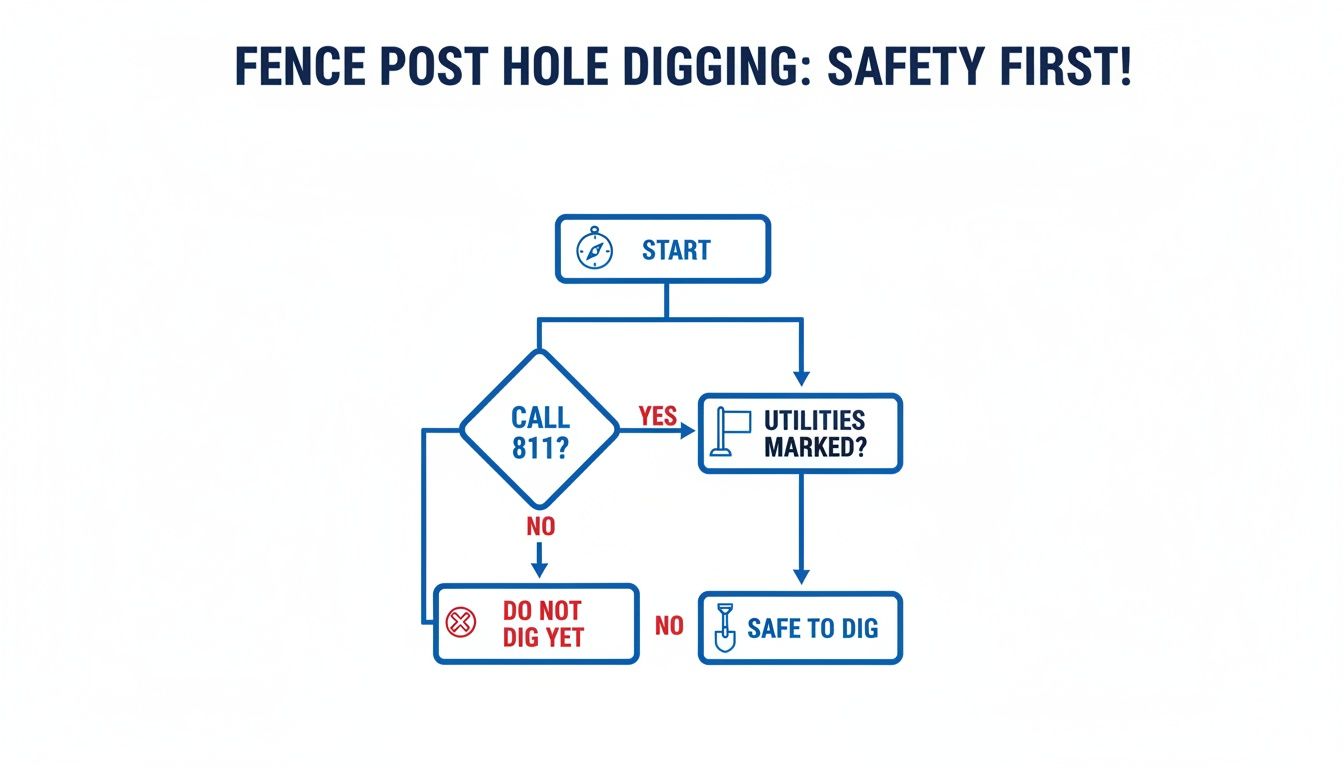
This can't be stressed enough: Calling 811 to get utilities marked is the absolute first thing you must do before breaking ground. It's a legal and professional requirement.
A Smarter Way to Dig: Precision and Safety
This is where hydrovac excavation completely changes the game. Instead of ripping and tearing at the ground, it uses pressurized water to liquefy the soil while a powerful vacuum sucks it all up. The process is clean, controlled, and incredibly precise, mitigating the risks associated with mechanical digging.
For any job with marked utilities or on a finished landscape, hydro excavation is the superior method. It delivers a perfect, clean hole without damaging the surrounding turf or risking a utility strike. In fact, many jurisdictions legally require non-destructive digging like hydrovac any time work is performed within the 18-inch tolerance zone of a marked utility line.
The bottom line is this: Manual diggers and augers have a place, but they introduce significant risks and inefficiencies. Hydrovac offers a safe, clean, and controlled method to execute the job professionally.
The Game-Changer: The Hydrovac Attachment
Historically, hydro excavation required a massive, expensive industrial truck—impractical and cost-prohibitive for most fencing or landscaping projects. But The Hydrovac Attachment has made this technology accessible to a wider range of contractors. This innovative device connects to a standard pressure washer and wet/dry vac, transforming common tools into a legitimate hydro-excavation system.
This is an ideal solution for fence installers, landscapers, and utility contractors. It provides the precision of a professional hydrovac system without the massive capital investment. If you want to see how this technology is evolving, you can check out some of the different types of hydrovac excavation equipment available today.
With a Hydrovac Attachment, you can easily:
- Safely "daylight" utilities: Dig down to visually confirm the exact location and depth of a pipe or cable.
- Dig in tight spots: Access corners and landscaped beds where an auger could never fit.
- Eliminate the mess: Spoil is vacuumed directly into a tank, leaving the job site spotless.
- Power through tough soil: The water jet cuts through compacted clay and hardpan that would stall an auger.
For any project where you can’t afford mistakes—whether it's protecting buried lines or a pristine lawn—this attachment is the modern, professional solution. It perfectly fills the gap between slow manual labor and high-risk mechanical digging.
The Hydrovac Advantage for Precision Digging
While traditional tools have their place, modern job sites demand a more sophisticated approach. This is where hydrovac excavation, especially with a tool like The Hydrovac Attachment, offers a decisive advantage for digging fence post holes. It shifts the process from brute force to surgical precision, a key selling point in the competitive hydrovac industry.
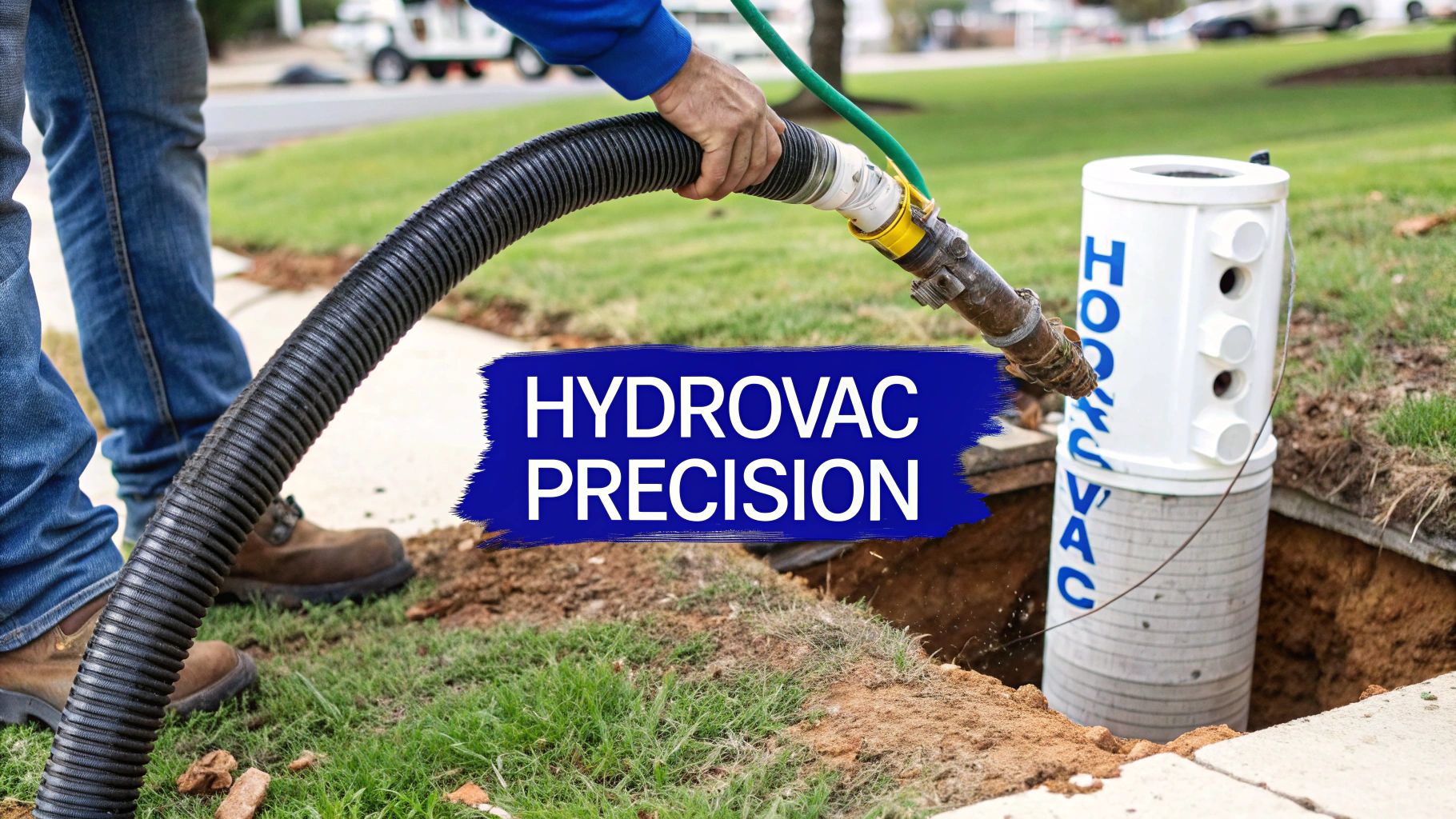
Consider a typical commercial installation: a new fence line must be installed through a landscaped area where 811 markings indicate irrigation, electrical, and fiber optic lines. Using a gas auger in this environment is not just risky—it's a liability that could lead to thousands in repair costs and project delays.
This is where hydro excavation proves its value. It employs a fundamentally different technique. A focused jet of high-pressure water liquefies the soil, and a powerful vacuum concurrently removes the slurry into a debris tank.
A Surgical Approach to Digging
The result is a perfectly clean, round hole with smooth sides, created without any mechanical blades ever touching a buried line. This allows contractors to safely "daylight" or expose a sensitive utility, clearing soil from all sides without causing damage. It’s the definition of non-destructive excavation.
This level of precision once required a full-sized hydrovac truck. But The Hydrovac Attachment now makes it accessible. By pairing a standard pressure washer with a wet/dry vac, it delivers professional-grade hydro excavation capabilities in a portable, cost-effective setup. This is a game-changer for contractors looking to expand their service offerings into precision digging.
This technology is entering the market at a critical time. The global hydro excavation services market is projected to grow significantly, driven by the need for safer digging practices around aging and expanding underground infrastructure. As more utilities are buried, the demand for non-destructive methods like those provided by The Hydrovac Attachment will only increase.
The true advantage of hydro excavation is its non-destructive nature. It’s the only method that allows you to dig with complete confidence, knowing you won't sever a hidden utility line. That peace of mind is invaluable on a modern job site.
Keep the Site Clean, Keep the Client Happy
Beyond safety, the hydrovac method eliminates another major issue: the mess. A power auger throws spoil across lawns, patios, and driveways, creating extensive cleanup work. With The Hydrovac Attachment, this problem is solved.
Because the soil is vacuumed as it's loosened, there are no messy piles next to each hole. This offers clear business advantages:
- Protects Landscaping: Enables digging in established lawns or flower beds with minimal disturbance.
- Reduces Cleanup Labor: The time saved on shoveling and raking can be reallocated to setting posts, accelerating project completion.
- Improves Site Safety: Eliminating spoil piles reduces trip hazards and maintains a more professional-looking work site.
This is the ideal solution for working on finished properties where clients expect the site to be left in its original condition.
Powering Through Tough Ground
Hydro excavation also provides a significant edge in difficult geologies. A mechanical auger can get bogged down or "walk" when it hits heavy clay, rocks, or dense root systems. A hydrovac system, however, often slices right through.
The high-pressure water jet breaks apart compacted clay that would stall an auger. It also erodes soil away from rocks and roots, allowing for removal without the violent kickback of a mechanical digger. You can learn more about how the process works by reading our guide on what is vacuum excavation and how it handles these tough conditions.
Ultimately, choosing a hydrovac system is a strategic decision to prioritize safety, precision, and professionalism. For any high-stakes project near underground utilities or any job where site cleanliness is paramount, The Hydrovac Attachment isn't just another tool—it's the modern, intelligent solution for fence installation.
Getting Your Fence Posts Set Just Right
A perfect hole is just the beginning. The method used to set the post is what ensures the long-term stability and durability of the fence. This step creates the rock-solid foundation that resists soil movement, moisture, and wind load over time.
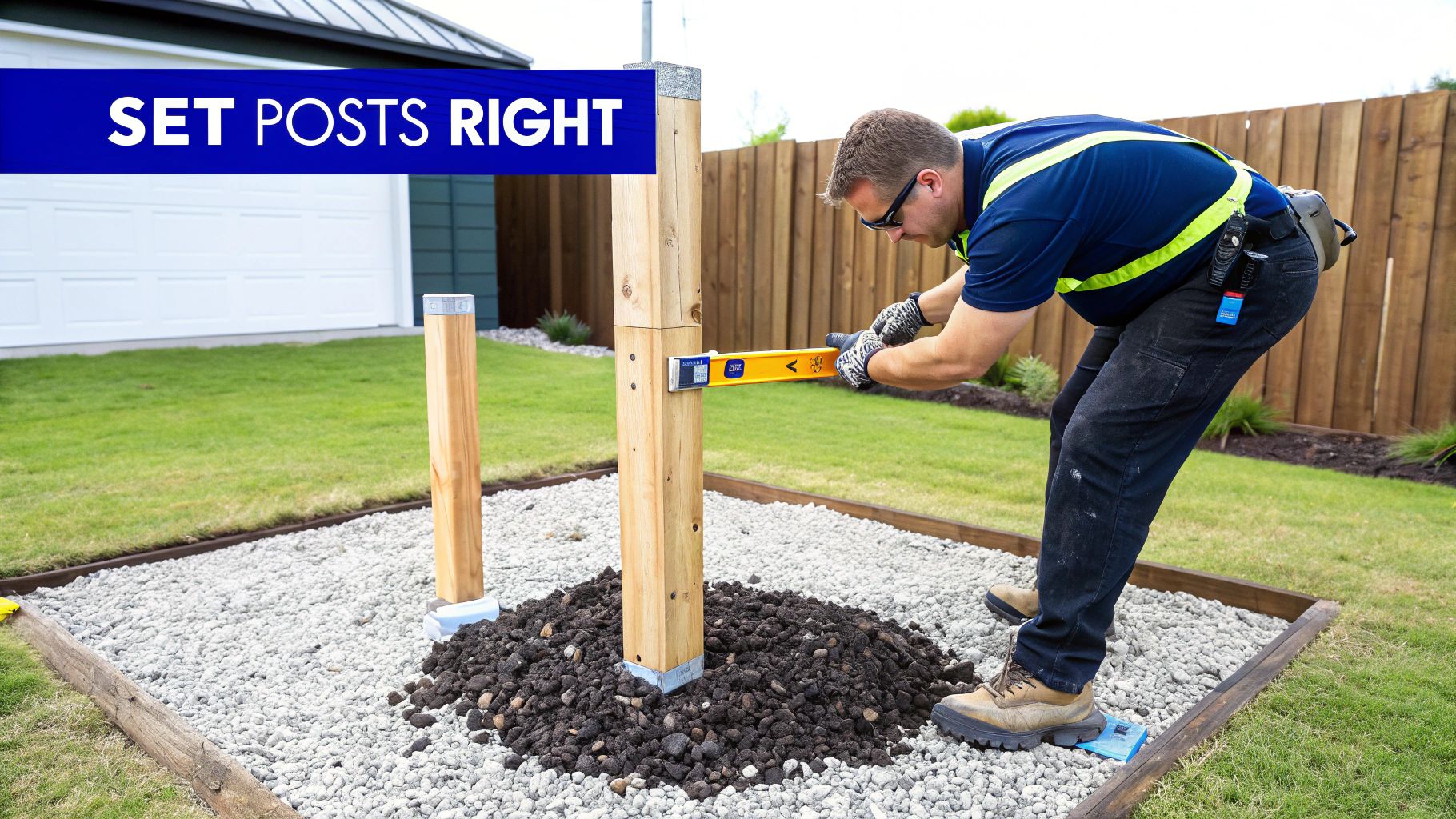
The single most important factor for longevity, especially with wood posts, is drainage. Moisture trapped against the post is the primary cause of rot. Before placing the post, create a drainage base at the bottom of the hole.
Pour 4 to 6 inches of gravel or crushed stone into the hole and compact it firmly. This layer allows water to drain away from the end grain of the post, significantly extending its service life. This is a critical step that no professional installer should skip.
Backfill vs. Concrete: Making the Call
With the drainage layer in place, you must decide between backfilling or setting the post in concrete. The choice depends on fence design, soil type, and the required level of stability.
- Soil Backfill: This involves returning the excavated dirt to the hole and compacting it in layers. It is the fastest and cheapest method but offers the least support. It is only suitable for very light-duty applications in dense, stable clay.
- Gravel Backfill: Using gravel for the entire backfill improves drainage and stability compared to soil. It's a viable middle-ground option but is not recommended for corner or gate posts, which are under constant load.
- Concrete Anchoring: For maximum strength and durability, concrete is the industry standard. It creates a solid, immovable footing that anchors the post securely. It is essential for heavy fences, all load-bearing posts (corners and gates), and any fence in loose or sandy soil.
While other methods exist, professional contractors almost exclusively use concrete. It's the only way to guarantee a long-lasting, stable installation that won't require premature repairs.
Pro Tips for a Perfect Concrete Pour
Proper technique is crucial when setting posts in concrete. For a deep dive into the specifics of residential poured concrete practices, it's worth checking out resources from the pros.
For your fence posts, begin by placing the post in the center of the hole on the gravel base. Use a level on two adjacent sides to ensure the post is perfectly plumb (vertical).
Once plumb, brace the post securely with scrap 2x4s staked to the ground. These braces are non-negotiable; they prevent any movement while the concrete cures.
With the post braced, you can mix and pour the concrete. Estimating the correct volume is key; our guide on how much Quikrete you might need can help with calculations.
Here's a tip that separates the pros from the amateurs: After pouring the concrete, shape the top into a slope or cone that directs water away from the post. This prevents pooling at the base of the post, a common point of failure due to rot.
This focus on better, more efficient installation is a trend we're seeing across the industry. Digging fence posts has evolved from pure manual labor into a specialized equipment market. As labor costs rise, contractors are increasingly turning to tools that enhance productivity. For the hydrovac industry, this trend represents a massive opportunity to position vacuum excavation as a value-added service that offers superior safety, precision, and cleanliness compared to traditional methods.
Troubleshooting Common Post Digging Problems
Even with meticulous planning, subsurface conditions can present unexpected challenges. Hitting obstructions like dense root systems or buried rocks is a common issue for any excavation crew.
How these obstacles are handled separates a stalled project from a successful one. A power auger hitting a buried boulder can kick back violently, posing a safety risk to the operator, or simply grind to a halt. This leaves you with a partially dug hole and a significant delay.
Hitting Rocks and Roots
When you encounter a solid obstruction, you must first identify it.
- Massive Rocks: If a digging bar can't dislodge it, you have two options: relocate the post or break the rock. Shifting the post location is easiest, but if the layout is fixed, a heavy-duty breaker bar or rotary hammer drill may be needed to fracture the rock.
- Thick Tree Roots: An axe or reciprocating saw can sever stubborn roots, but this risks damaging the tree.
This is where a tool like The Hydrovac Attachment demonstrates its superior problem-solving capability. Instead of ramming into an obstacle, the pressurized water jet carefully excavates around it, exposing the obstruction without the risk of mechanical kickback or equipment damage. The water can even cut through smaller roots and break down compacted soil, allowing you to work around the obstacle efficiently. This turns a project-stopping problem into a manageable task.
Dealing With Collapsing Soil
At the other end of the spectrum, sandy or loose soil can be equally problematic. The hole walls may continuously cave in, making it impossible to achieve the required depth and a clean bore for a solid footing.
The traditional fix involves using a cardboard form (sonotube), which requires over-digging the hole and adds an extra step to the process.
A hydrovac offers a much cleaner solution. By vacuuming the soil-and-water slurry as you dig, the system maintains the structural integrity of the hole, preventing the slumping and collapsing common with dry excavation methods. This often eliminates the need for a form and results in a better-quality foundation.
Whatever you run into, the goal is always to solve the problem without compromising the integrity of your fence. Taking a shortcut to get past an obstacle will almost always lead to a weak post and bigger headaches down the road.
This drive for smarter digging is changing the excavation industry. The global auger drilling market is projected to hit USD 2,251.5 million in 2025, largely because rising labor costs are pushing contractors toward more efficient tools. You can find more details in this Coherent Market Insights report.
For hydrovac crews, this market pressure creates a clear opportunity. On job sites where an auger poses a risk to utilities or landscaping, vacuum excavation offers a safer, cleaner, and more professional alternative. When facing a hidden boulder or unstable soil, a precision tool like The Hydrovac Attachment turns a potential deal-breaker into just another part of the job.
Answering Your Questions About Fence Post Holes
Even for seasoned professionals, specific site conditions can raise questions. Here are answers to some of the most common queries about digging fence post holes to ensure every project is up to standard.
How Deep Do I Really Need to Go?
The industry standard is the one-third rule: bury one-third of the post's total length in the ground.
For a standard 6-foot fence using 8-foot posts, this means digging down approximately 2.5 to 3 feet. This depth provides the necessary leverage to resist wind loads and ensure long-term stability.
However, always consult local building codes. In regions with cold climates, the frost line is the determining factor. Codes will mandate digging below the frost line to prevent posts from "heaving" or being pushed up by the freeze-thaw cycle of the soil.
What’s the Right Size Hole?
The ideal hole diameter is three times the width of the post. This provides adequate space for a strong concrete footing.
For a standard 4x4 wood post (which actually measures 3.5" x 3.5"), a hole with an 8 to 10-inch diameter is optimal.
This spacing ensures a sufficient concrete collar around the entire post, which is crucial for creating a rigid, durable anchor. A hole that is too narrow will result in a weak footing that is prone to failure.
Do I Have to Use Concrete for Every Post?
While not strictly required in all cases, it is highly recommended. Backfilling with compacted soil and gravel may suffice for very light-duty fences in stable, dense clay.
However, industry best practice dictates that corner posts, end posts, and gate posts must be set in concrete. These are load-bearing points that are under constant tension or stress. Only a concrete footing provides the necessary support to prevent sagging and maintain the fence's integrity. Any professional building a fence to last will use concrete.
Will a Hydrovac Attachment Actually Help in Hard Clay?
Excavating hard, dense clay is one of the most challenging digging scenarios. A mechanical auger will often spin in place, "walk" off-center, or fail to penetrate, causing significant delays and equipment strain.
This is a prime application where a tool like The Hydrovac Attachment excels. Instead of relying on brute mechanical force, it uses a high-pressure water jet to cut through and liquefy the stubborn clay. The vacuum then efficiently removes the slurry from the hole.
This technology transforms a back-breaking task into a quick, controlled process. It delivers a perfect hole without the physical strain or risk of equipment damage, making it a highly effective solution for hydrovac industry professionals tackling tough soil conditions.
When precision, site cleanliness, and safety around underground utilities are non-negotiable, having the right tool is paramount. The Hydrovac Attachment empowers contractors to tackle any soil condition and work confidently, delivering a professional finish every single time.
Discover how the Hydrovac Attachment can improve your digging process.