


When you’re staring down a messy job site, one number on your shop vac tells you almost everything you need to know about its real-world power: CFM, or Cubic Feet per Minute. This spec is a direct measure of how much air your vacuum moves every single minute. More air moving means more soil, slurry, and water getting cleared out, and faster.
For any kind of precision digging—from setting fence posts to safely exposing underground pipes—CFM is the king of performance metrics.
What Is Shop Vac CFM and Why It Matters for Digging
It’s easy to get distracted by big horsepower numbers on the box, but those don't tell the whole story for professional use. Think of CFM as the raw, debris-moving muscle of your vacuum. It’s a measure of airflow volume, and it’s that volume that actually picks up material, carries it through the wet vac hose, and dumps it into the canister.
This is especially critical for anyone in yard care, landscaping, or residential digging. Picture yourself digging a hole for a fence post next to a sensitive irrigation line. You’re dealing with a constant stream of soil, grass, small rocks, and water. You need a machine that can pull all of that in without choking. A high CFM rating is your guarantee that the vacuum has enough airflow to keep that material moving and avoid damaging the pipe.
From Sawdust to Soil
A lot of people think of shop vacs as tools for cleaning up sawdust in a woodshop, and they’re great for that. But their real test comes outdoors. A vacuum that’s perfectly fine for light dust will bog down immediately when it hits wet, heavy clay or a muddy slurry from digging.
Why? Because moving heavier materials requires sustained airflow, not just a quick burst of suction.
Here’s an analogy I like to use to make it clear:
- CFM (Airflow): Imagine a wide, fast-flowing river. It has the sheer volume and speed to sweep away everything in its path—leaves, soil, gravel, and standing water. This is exactly what you need for clearing a post hole or a trench without damaging underground assets.
- Water Lift (Sealed Suction): This is more like a narrow, high-pressure jet of water. It has immense focused power to lift a single heavy object (like how some vacs can lift a bowling ball), but it can't move a large volume of mixed material quickly.
When you're digging a fence post hole or trying to carefully expose a buried utility line, you need the river, not the jet. You need to keep the material flowing.
The bottom line is simple: the more air you can move per minute, the more material you can clear from your worksite. For any professional doing yard care or residential digging, paying attention to shop vac CFM means finishing jobs faster, safer, and with less manual labor.
Putting That Airflow to Work
Of course, all that rated CFM is useless if it’s not being applied effectively. The power generated by your shop vac motor is only as good as the system that delivers it to the ground. This is where the right attachments make all the difference. A standard open-ended wet vac hose just can't focus the suction, leading to a huge mess and wasted power.
This is why an engineered tool like the Hydrovac Attachment is such a game-changer. It’s a mobile tool designed specifically to concentrate your shop vac’s airflow, turning it into a precision digging machine for small-scale jobs. It is NOT for large hydrovac trucks, but rather pairs with your existing wet vac and pressure washer. It creates a closed-loop system that uses every bit of your vacuum's CFM to its maximum potential, clearing debris efficiently without the usual mud and splashback. To dig deeper, you can learn more about how vacuum suction power is measured in our related article. This kind of strategic thinking ensures you’re not just buying a powerful tool, but applying that power intelligently on the job.
CFM vs. Water Lift: What Really Matters for Excavation?
When you’re staring at a wall of shop vacs, it's easy to get bogged down in the numbers. Two specs that cause the most confusion are CFM and water lift (sometimes called sealed suction). They sound similar, but they measure two completely different things. Getting this right is crucial for anyone doing serious yard work, residential digging, or locating underground pipes.
Think of water lift as pure, brute strength. It's a lab measurement of how high a vacuum can pull a column of water up a sealed tube. It's like a weightlifter deadlifting a massive barbell—a huge display of power in one spot, but not very practical for moving a whole pile of wet soil out of a hole.
High water lift is fantastic for one thing: yanking a single, heavy, stuck object out of a hose. But for digging around pipes or clearing a trench, you need a different kind of power.
Why Air Volume Beats Brute Force for Digging
This is where CFM (Cubic Feet per Minute) steals the show. CFM isn't about raw lifting power; it's about airflow volume. It tells you how much air the vacuum is actually moving every minute through the wet vac hose.
Forget the weightlifter. Picture a wide, fast-moving river. It's the sheer volume and relentless flow of the water that sweeps away soil, gravel, and debris—not its ability to lift one giant boulder.
For any kind of digging, you need that constant, high-volume flow. A machine with a high CFM rating will continuously pull a slurry of soil and water through the hose and into the tank, making your work go significantly faster. A vac with impressive water lift but weak CFM might get that first clump moving but will struggle to keep the flow going, bogging down almost immediately.
Simply put: water lift is for lifting, but CFM is for moving. And when you're excavating, your entire job is about moving massive volumes of material. That makes CFM the true indicator of real-world performance.
CFM on a Real Job Site
This isn't just theory—it makes a huge difference in how your day goes. In the landscape and utility locating industry, the shift towards prioritizing shop vac CFM ratings has been a game-changer, especially for small, mobile excavation tasks.
Real-world testing tells the story. One popular model, the Ridgid WD19560, clocked in at 108 CFM in independent tests. While that was 18.2% lower than what was printed on the box, its powerful airflow still enabled it to run circles around many competitors in actual debris pickup tests for tasks like fence post digging. If you're interested in the market trends, you can find more insights on the demand for powerful wet and dry shop vacuums.
This just goes to show that a strong CFM number is a dependable sign of a vacuum's ability to tackle tough jobs. When you combine a high-CFM vac with a specialized tool like the Hydrovac Attachment, you create a system that's built for precision digging. The attachment concentrates all that airflow, turning a standard shop vac into a powerful, efficient hydro-excavator that helps you dig up pipes without damage and get the job done right.
How Hoses and Attachments Affect Your True CFM
That CFM number printed on the side of your shop vac? Think of it as a best-case scenario, measured in a perfect lab environment. The second you snap a wet vac hose on, the real world kicks in, and that number begins to drop.
Every foot of hose, every sharp bend, and every nozzle adds friction. This friction acts like a drag on the airflow, literally choking the suction power your vacuum can deliver at the business end. It means the high-performance machine you paid for might be wheezing on the job site, struggling to move material efficiently.
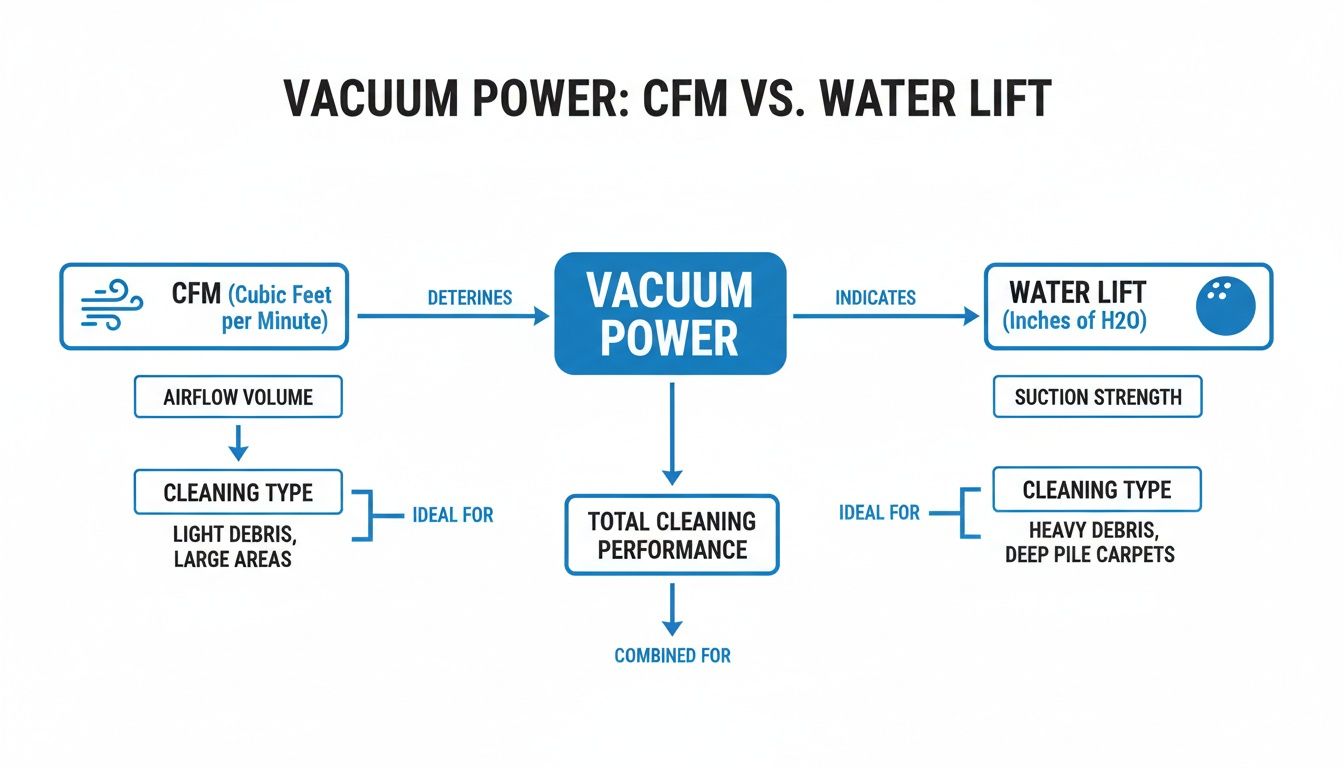
As you can see, CFM is all about the volume of air—perfect for moving lots of material quickly. Water lift is the raw muscle, the lifting force for heavy, stubborn material. When you're hydro-excavating to dig fence post holes or expose pipes, maximizing that airflow volume is what gets the job done fast and safely.
Optimizing Airflow Instead of Choking It
So, we know a standard hose can be a performance killer. But what if an attachment could do the exact opposite? A well-designed tool doesn't just stick on the end of the hose; it works with the system to focus and optimize the airflow you have left. It's not a bottleneck—it's an airflow multiplier.
This is where you see the difference between a simple accessory and a piece of engineered equipment. It’s about managing the entire suction stream to reclaim lost power.
A typical shop vac might boast 144 CFM right at the motor. But once you factor in a 10-foot hose and the resistance from the filter, you can easily lose 30-40% of that power before the nozzle even touches the ground. The right attachment helps you get that efficiency back.
The Hydrovac Attachment Tool is a great example of this principle in action. It was built from the ground up to optimize, not restrict, your vacuum's airflow. By integrating a pressure washer's water jet directly into the vacuum's suction stream, it creates a self-contained, high-efficiency excavation zone.
This design completely sidesteps the usual mess and wasted energy of residential digging. There's no wide, chaotic spray of water and mud. Instead, the combined forces of water and air are channeled into a tight space to break up soil and instantly whisk it away. If you want to dive deeper into how the right connections play a huge role, check out our guide on shop vac hoses and fittings.
At the end of the day, the right attachment completely changes the game. It turns a simple wet vac hose into a precision digging instrument, letting you excavate for fence posts or uncover sensitive utility lines with maximum power and minimal mess.
Choosing the Right Shop Vac CFM for Your Digging Tasks
Getting the job done right often comes down to matching your shop vac's CFM to the task at hand. It's the real secret behind a clean, efficient dig versus a frustrating, muddy mess. The power listed on the box means very little if your vacuum can’t handle the specific material you're trying to move without causing damage.
Think about it: digging a fence post hole in dense, wet clay is a whole different ballgame than clearing loose soil to expose a delicate fiber optic line. That heavy, sticky clay demands a continuous, powerful airflow to lift the slurry and keep the wet vac hose from clogging. In these situations, a robust shop vac CFM rating isn't just nice to have—it's non-negotiable.
How Much CFM Do You Really Need?
Not all digging jobs are created equal. Let's break down the CFM ranges you should be looking for based on common yard and excavation tasks.
-
Light-Duty Yard Care (100-140 CFM): This is your go-to range for everyday jobs. Think clearing leaves from irrigation lines, sucking standing water out of valve boxes, or cleaning up loose soil around new plantings. The airflow here is more than enough to handle lighter debris.
-
Standard Residential Digging (140-180 CFM): This is the sweet spot for most homeowners and landscapers. If you're digging fence post holes in typical soil or creating small trenches for landscape lighting, a vac in this range has the muscle to consistently move a mix of dirt, small rocks, and water.
-
Heavy-Duty Excavation (180+ CFM): When you're up against compacted clay, rocky soil, or need to safely expose a utility line (daylighting) without causing damage, you need all the airflow you can get. A higher CFM ensures you can lift and transport that heavy, dense material quickly, which makes the job faster and safer.
The power of high CFM has always been a game-changer for hydro-excavation. The entire vacuum market is projected to grow from USD 54.33 billion to a staggering USD 109.7 billion by 2034, and powerful wet/dry shop vacs are a huge part of that. In real-world tests, 6.5 HP models average a hefty 197 CFM, allowing them to pull in debris up to 50% faster than their low-CFM counterparts. That’s a massive advantage when you need to expose a utility line without damaging it. You can dive deeper into the growth of the vacuum cleaner market on fortunebusinessinsights.com.
To make it even simpler, here’s a quick-reference guide to help you match your vacuum's power to your project's needs.
Recommended Shop Vac CFM for Common Excavation Tasks
This table provides a quick reference guide for selecting the right shop vac based on the CFM required for various residential and commercial digging jobs.
| Task | Recommended CFM Range | Why This Range Works | Ideal Attachment |
|---|---|---|---|
| Potholing / Daylighting Utilities | 180+ CFM | Safely removes dense, heavy soil and rocks around sensitive lines without causing damage. Maximum airflow is critical for speed and safety. | Hydrovac Attachment |
| Digging Fence Post Holes | 140-180 CFM | Efficiently removes soil and small rocks from a confined space, speeding up the process of setting posts in various ground conditions. | Hydrovac Attachment |
| Trenching for Irrigation/Cables | 140-180 CFM | Consistently moves mixed soil, small stones, and water over longer distances, keeping the trench clean as you work. | Standard Narrow Nozzle or Hydrovac Attachment |
| Clearing Clogged Lines/Drains | 160+ CFM | Lifts and transports thick slurry, mud, and packed sediment from catch basins or drainage pipes without constant clogging. | Wide-Mouth Nozzle or Hydrovac Attachment |
Choosing the right CFM is a solid starting point, but it's how you apply that power that truly makes a difference.
The Hydrovac Attachment Advantage
Picking a vacuum with enough CFM is only half the battle. To get professional-level results, you have to apply that airflow with precision. This is where the Hydrovac Attachment Tool completely changes the game. It’s specifically engineered to take your vacuum’s raw airflow and concentrate it into a focused, high-velocity digging force.
By combining your pressure washer's jet with your vacuum's suction stream, the attachment creates a contained system. This means that a 160 CFM shop vac paired with the Hydrovac Attachment can often outperform a 200+ CFM unit with a standard, inefficient nozzle.
This brilliant system effectively turns your standard shop vac into a portable, affordable hydro-excavator. Suddenly, you can perform precise digging tasks—from setting posts to safely exposing pipes—without shelling out for a massive, expensive hydrovac truck. It’s simply the smarter way to get the job done right.
How the Hydrovac Attachment Maximizes Your Usable CFM
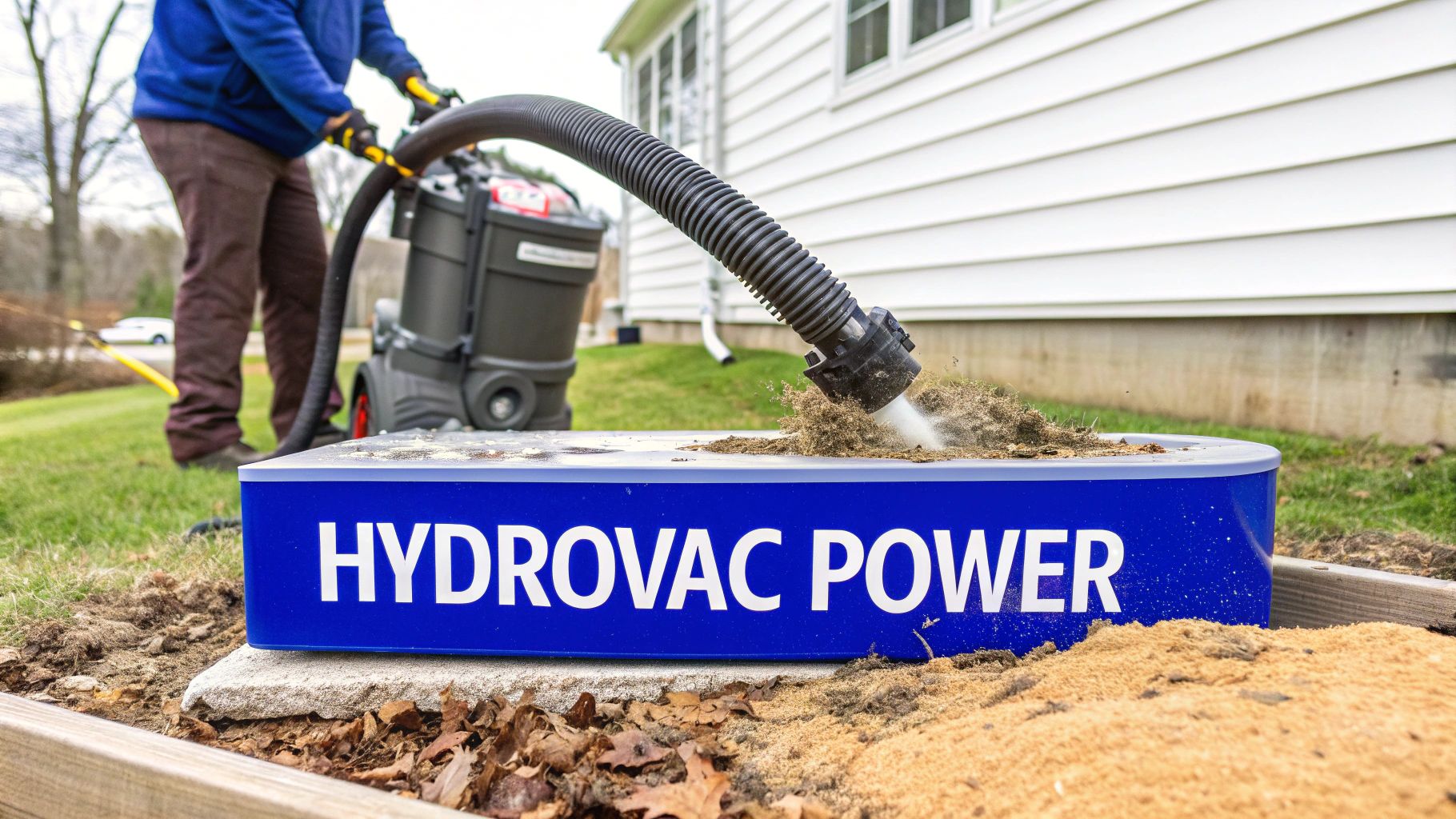 Raw power is one thing, but applied power is what gets the job done. A high shop vac CFM rating is a fantastic starting point, but it's really just potential until you focus it. The Hydrovac Attachment is engineered specifically to convert that potential into a precise, efficient digging force—think of it as a true CFM multiplier for precision work.
It is a mobile tool, not for large hydrovac trucks, that works by combining your pressure washer’s powerful water jet with your wet vac’s suction stream into a single, contained zone. This fusion of forces creates a powerful hydro-excavation effect right where you need it most: at the point of contact with the soil.
Instead of a chaotic spray of water that turns your work area into a mud pit, the attachment simultaneously breaks up compacted earth and vacuums the resulting slurry away. This eliminates the old two-step process of loosening soil and then cleaning it up, making it perfect for digging up pipes without damage or quickly setting fence posts.
The Real-World Benefits of Optimized Airflow
This smart design delivers tangible results you'll notice immediately on any residential digging or yard care project. The controlled suction zone means less splashback and flying debris, a massive advantage when working near delicate pipes, irrigation lines, or building foundations.
You’ll experience:
- Better Visibility: By immediately removing the soil and water slurry, the tool keeps your dig site clear. This lets you see exactly what you're doing, which is absolutely critical when digging near utilities to avoid costly or dangerous strikes.
- Faster Task Completion: Digging fence post holes, setting deck footings, or trenching for landscape lighting becomes significantly quicker. The simultaneous digging and clearing action cuts your labor time down dramatically.
- Reduced Water Waste and Mess: The contained system uses water far more efficiently, turning it into a cutting tool rather than just a soaking agent. This means less water to haul away and a much cleaner job site when you're all done.
Transforming Your Standard Gear into a Pro-Level Tool
The Hydrovac Attachment turns the abstract concept of optimizing shop vac CFM into a practical reality. It proves that you don't need a massive, expensive hydrovac truck for every precision digging job. By pairing a high-quality shop vac and pressure washer with this specialized tool, you create a portable, powerful, and incredibly cost-effective system for clearing small amounts of debris.
This approach is gaining serious traction. Performance stats show a massive shift in vacuum excavation workflows, with the canister vacuum segment—closely tied to shop vac tech—projected to grow from US$3.46 billion in 2024 to US$6.58 billion by 2031. Teams using shop vacs with 180+ CFM report 35% fewer incidents thanks to better visibility, proving why the Hydrovac Attachment’s quick setup is so valuable. For more on these market trends, you can review the full canister vacuum cleaner market analysis on globenewswire.com.
The attachment fundamentally changes your equipment's capability. It ensures every bit of your vacuum's airflow is put to productive use, solving the exact problems you face on residential and landscaping jobs with unmatched efficiency.
By focusing the suction power you already have, it elevates your standard gear into a professional-grade digging solution. To ensure a perfect fit with your equipment, you may also want to check out our article on choosing the right shop vac adapter for your setup.
Got Questions About Shop Vacs and Digging? We've Got Answers.
When you're out on the job site, theory is one thing, but practical questions always pop up. Let's tackle some of the most common ones we hear about shop vac CFM, horsepower, and what it all means when you’re actually digging with a tool like the Hydrovac Attachment. This is your field guide for getting the job done right.
Is a Higher Peak HP Rating Always Better for Digging?
Not by a long shot. Peak Horsepower (HP) is one of the most misleading specs out there. It’s a lab-tested number that measures the motor's absolute maximum output with no load on it—a situation that never happens in the real world. For any kind of vacuum excavation, shop vac CFM is the number that truly matters.
Think of it this way: CFM is the volume of air your machine moves. That moving air is what actually carries the dirt, rocks, and slurry from the hole, through the wet vac hose, and into your tank. While a strong motor is part of the equation, you should always look for a high CFM rating first. For serious digging, you want a vacuum that can sustain 150+ CFM to keep material flowing smoothly without constant clogs.
Can I Just Stick Any Nozzle on a High-CFM Vac and Start Digging?
You could, but you’ll probably regret it. While just about any attachment will fit onto your hose, most are built for sweeping a dry floor, not for hydro excavation. A standard open-ended nozzle is incredibly inefficient for this kind of work. It kills your suction power right at the tip and creates a chaotic mess of splashback, which is not only slow but dangerous when you're trying to locate buried utilities.
An engineered tool is a completely different ballgame.
The Hydrovac Attachment was built from the ground up to channel your vacuum's airflow. It combines a high-pressure water jet with the vacuum stream, creating a super-focused, high-velocity suction zone right where you're digging. This design puts every bit of your vacuum's CFM to work, making the entire process faster, cleaner, and a whole lot safer.
It’s all about making sure the power you paid for actually gets to the dirt.
How Do I Keep My Shop Vac Running at Peak CFM?
Maintenance is everything. If you neglect it, your powerful vacuum will quickly lose its edge. The single biggest culprit for lost suction is a dirty or clogged filter. Seriously, a filter caked with fine dust can slash your effective CFM by over 50% and put a ton of strain on the motor.
Here are a few simple habits to get into:
- Check Your Filter: Before starting any big job, give the filter a look. If it's loaded with debris, clean it out or—even better—swap in a new one.
- Empty the Tank: Don’t wait until the vacuum is screaming at you. Try to empty the canister when it's about two-thirds full. An overstuffed tank chokes off the airflow and kills your suction.
- Inspect the Hose: A clear airway is non-negotiable. Make sure your wet vac hose is free of debris, kinks, or crushed spots. Any obstruction between the nozzle and the filter will rob you of precious CFM.
Is the Hydrovac Attachment Just for Digging Fence Post Holes?
Absolutely not. While it's a champion for precision digging tasks like exposing pipes without damage or setting fence posts, its focused power is useful for so much more. It's designed to break up and vacuum away heavy, wet materials simultaneously.
Here are a few other jobs where it really shines:
- Clearing out clogged storm drains and culverts.
- Sucking out thick sediment from catch basins, pits, or sumps.
- Cleaning up contained industrial spills where you need to remove slurry quickly.
Basically, any job where you need to blast material loose and vacuum it up at the same time is a perfect fit for this mobile tool, which is designed for wet vac hoses, not hydrovac trucks.
Ready to turn your shop vac into a precision digging machine? The Hydrovac Attachment is the key to maximizing your usable CFM and getting professional results on every job.