


A standard power washer setup, often used for surface cleaning, can be transformed into a powerful and precise digging instrument. This isn't about blasting drains; it's about turning your pressure washer into a mobile hydro excavation system, perfect for delicate yard care and residential digging tasks. By pairing it with a specialized tool and a wet vac hose, you can liquefy soil and remove it simultaneously, offering a safe and efficient alternative to manual digging.
From Power Washing to Precision Excavating
Imagine digging fence post holes or carefully exposing delicate utility pipes without the back-breaking labor of a shovel or the risk of damage from a mechanical auger. This is now a reality for professionals in landscaping, irrigation, and utility location. By connecting a specialized tool like the Hydrovac Attachment Tool between your power washer and a wet vac hose, you create a portable, precise hydro excavation system.
This approach is not for large-scale hydrovac trucks but is a brilliant mobile solution for smaller jobs. It leverages equipment most contractors already own. The high-pressure water stream turns the soil to mud, and the wet vac hose, connected to the same tool, immediately vacuums up the slurry. This is perfect for digging up pipes without damage or setting fence posts with minimal site disruption.
A Smarter Solution for Small-Scale Digging
This method is a game-changer for several industries. For landscapers, digging for fence posts or installing irrigation lines becomes a cleaner, more controlled process. For plumbers and utility locators, it allows for the careful uncovering of buried pipes and cables without the constant worry of causing expensive damage.
The efficiency of this technique is driving demand. The global pressure washer industry was valued at USD 3.07 billion in 2023 and is expected to climb to USD 3.96 billion by 2029. This growth fuels innovation in accessories that adapt power washers for specialized tasks, such as pairing them with wet vacs for low-mess digging.
The Hydrovac Attachment Tool creates a contained work environment. Forget messy piles of dirt. This method vacuums the soil away as you dig, leaving a clean, visible, and safer area to work in.
Beyond Digging: The Versatility of a Power Washer
The real beauty of this setup is its flexibility. One moment you're meticulously digging a hole for a new fence post, and the next, you can disconnect the attachment and switch back to general cleaning tasks.
While the specialized tool is your go-to for focused digging, the power washer itself remains a powerhouse for cleaning large surfaces. The same machine you used to excavate a trench is perfect for other property maintenance jobs—for instance, you can clean pool decks like a pro. This adaptability makes your equipment far more valuable and lets you tackle a much wider range of jobs with one core system.
Selecting the Right Power Washer and Hose
Getting your gear right is half the battle. For small-scale hydro excavation, success hinges on the synergy between your power washer, hose, nozzle, and wet vac system. The wrong combination leads to inefficiency or, worse, damaging the very utilities you're trying to expose.
The key is finding the right pressure. For tasks like liquefying soil around fragile pipes or digging fence post holes, a power washer delivering between 1,501-3,000 PSI is ideal. It has enough force to break up compacted dirt but isn't so aggressive that it will tear into PVC or utility lines. Too much pressure is asking for trouble, and too little will leave you making mud pies instead of progress.
Matching Pressure and Flow for Optimal Performance
Think of it this way: PSI (pounds per square inch) is your cutting force, and GPM (gallons per minute) is your flushing power. They must work in harmony. The PSI slices into the soil, while a healthy GPM is crucial for turning it into a vacuum-able slurry. If these are out of sync, your hole will fill with thick sludge, and your wet vac hose will struggle to keep up.
This is precisely why purpose-built solutions like the Hydrovac Attachment Tool are so effective. They are engineered to work within this ideal pressure range, creating a closed-loop system where the soil is liquefied and instantly vacuumed out.
Imagine a crew exposing utility lines in a tight backyard. Their entire operation depends on this synergy. It's no surprise that the global high-pressure washer market hit USD 4 billion in 2023 and is expected to grow at a 4.1% CAGR through 2032. The 1,501-3,000 PSI segment, which powers this kind of work, makes up a whopping 50% of that market.
To help you match your equipment to the job, here's a quick reference guide.
Power Washer and Hose Compatibility Guide
This table breaks down how to match your power washer's PSI and GPM with the right hose for common hydro excavation tasks. Getting this right saves a ton of headaches on site.
| PSI Range | Ideal GPM | Hose Type | Best For (Application) |
|---|---|---|---|
| 1,500-2,000 PSI | 1.5-2.0 GPM | 1/8" Thermoplastic | Exposing delicate fiber optic lines, irrigation systems. |
| 2,000-2,500 PSI | 2.0-3.0 GPM | 1/4" Thermoplastic | General utility daylighting, digging post holes in softer soil. |
| 2,500-3,000 PSI | 3.0-4.0 GPM | 1/4" Reinforced Rubber | Breaking up compacted clay, trenching for electrical conduits. |
| 3,000+ PSI | 4.0+ GPM | 3/8" Reinforced Rubber | Not recommended for precision digging; better for surface cleaning. |
As you can see, the specific application dictates the gear. You wouldn't use a sledgehammer to hang a picture frame, and the same logic applies here.
Choosing the Right Hose Material and Size
Picking the right jetter hose for your power washer is just as critical as the washer itself. The hose material makes a big difference.
- Reinforced Rubber: This is the workhorse for tough job sites. It's durable and resists abrasion from being dragged across gravel or concrete.
- Thermoplastic: Lighter and more flexible. This is ideal for working in tight quarters or maneuvering around delicate landscaping without causing damage.
Hose length and diameter also matter. Pressure drops over distance. For most residential work like digging fence posts, a 50-foot hose with a 1/4-inch diameter offers a great balance of reach and minimal pressure loss.
Ultimately, knowing your equipment is key. Even reading a general guide on cleaning with a pressure washer can provide useful tips. But the final piece shaping the water stream is the nozzle. To dial in your setup perfectly, see our guide on how to choose the perfect water jetting nozzle.
Tying It All Together With the Hydrovac Attachment Tool
This is where the system comes together. You have your power washer, its hose, and a wet vac. The Hydrovac Attachment Tool is the key that integrates them into a single, efficient hydro excavation unit for clearing small amounts of debris.
The setup is simple. First, secure the attachment's base onto your 2.5-inch wet vac hose. Then, the nozzle cap slides over your power washer wand. You’ve just created a sealed system that digs and vacuums simultaneously.
Why a Sealed Suction System Matters
That sealed environment is the core of this system's effectiveness. By containing the high-pressure water spray and the resulting slurry, the Hydrovac Attachment Tool eliminates the messy, dangerous splashback common with other methods.
Imagine digging fence post holes next to a client's home. The last thing you want is a mud-splattered mess. This integrated tool liquefies the soil precisely where you want it, and the wet vac hose removes it instantly. No mess, no fuss, and a much safer, more visible work area.
Getting the combination of washer, hose, and nozzle right is the key to this whole process, as this flowchart shows.
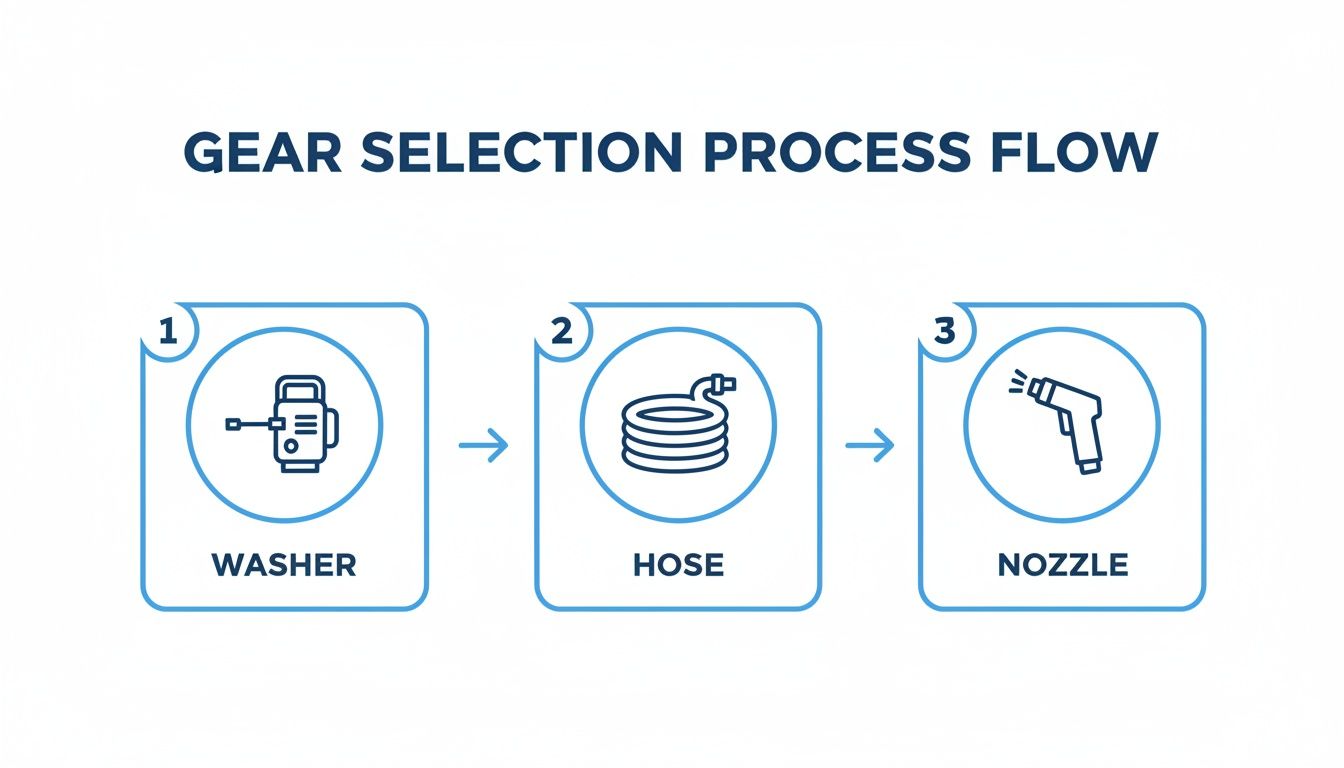
Each part of that chain—the washer, the hose, and the nozzle—has to be up to the task for the system to work at its peak.
Field Tips for a Leak-Free Connection
Maximum suction power comes from a perfect seal. It's a simple truth that can make or break your day. Before starting, take 30 seconds to run a quick check.
Here are a few things to ensure the setup is airtight:
- Crank Down the Hose Clamp: The most common spot for a vacuum leak is where the attachment base meets the wet vac hose. Make sure that clamp is snug.
- Check Your O-Rings: These small rubber rings are critical. Before assembly, inspect the O-rings in the nozzle cap and any other fittings. A cracked or missing O-ring will kill your suction.
- Get the Angle Right: When digging, don't point the tool straight down. Angle it slightly. This lets the high-pressure water blast into the soil effectively while giving the vacuum a clear path to pull the debris out.
Let’s say you’re carefully digging up a pipe to repair it. With the right angle, you can peel back layers of soil with total control, keeping the pipe in sight the entire time. You’re not just digging; you’re performing surgical excavation, which is something you could never do with a shovel.
Nailing these small details makes every job smoother. You get faster debris removal and a clean site that keeps clients happy. And if you're working with different hose sizes, our guide on choosing the right vacuum hose adapter can be a real lifesaver.
Mastering Safe and Effective Digging Techniques
Having the right gear is one thing, but knowing how to use it is everything. True skill in small-scale hydro excavation comes from technique, not just raw power. Using your power washer and the Hydrovac Attachment Tool effectively is a learned skill, a balance of water pressure and careful movement that lets you dig faster, cleaner, and with more confidence.
You have to learn to "feel" the soil through the wand. Blasting away at full power is a rookie mistake, especially when digging near a sensitive PVC pipe or a fiber optic cable. The smart move is to start with low pressure and slowly dial it up. This lets you turn dense soil into a liquid slurry without the blunt force that could cause thousands of dollars in damage.
Fine-Tuning Your Approach on the Job
Your angle of attack is critical. Many people mistakenly hold the wand straight down. This just drills a narrow, muddy hole.
For much faster soil liquefaction, use a slight angle—around 70 to 80 degrees. This lets the high-pressure stream undercut the soil, breaking it apart more efficiently and giving your wet vac a clear shot at sucking up the slurry.
When you're working in tight spaces, like a narrow trench or against a foundation wall, you'll need to adjust. Here, short, controlled bursts of water work much better than a continuous stream. It gives you surgical precision, so you don't over-excavate or disturb anything you're not supposed to.
The best operators make it look effortless, but that efficiency comes from practice. They understand that hydro excavation is a finesse game, closer to surgical removal than demolition. This skilled approach unlocks the potential of the Hydrovac Attachment Tool, turning a standard power washer into a precision digging tool.
This level of precision is why the US pressure washer market grew from USD 584.3 million and is projected to skyrocket to USD 916.1 million by 2034. For pros digging fence posts or repairing foundations, this means better tools that use 80% less water than a garden hose but can finish a job in half the time—all with minimal messy splashback.
Common Digging Scenarios and Recommended Techniques
Not every digging job is the same. Adjusting your technique based on the soil, utilities, and task is key to working safely and efficiently. This table breaks down common situations.
| Scenario | Recommended PSI Setting | Wand Angle and Motion | Key Safety Precaution |
|---|---|---|---|
| Digging a fence post hole | 1,500 - 2,000 PSI | 75-degree angle, circular motion to widen the hole | Confirm there are no underground sprinkler lines or cables |
| Exposing a PVC water line | Start low, 800 - 1,200 PSI | 60-degree angle, sweep gently side-to-side | Never direct the spray head-on at the pipe; expose it from the sides |
| Trenching for an electrical conduit | 2,000 - 2,500 PSI | 80-degree angle, sweeping motion along the trench line | Always have utilities marked beforehand (Call 811) |
| Clearing soil from a foundation wall | 1,000 - 1,500 PSI | 45-degree angle, aim away from the structure | Watch for back-spray and protect the foundation's weatherproofing |
Mastering these adjustments will make you faster and safer on site, turning tricky jobs into routine work.
Operator Safety Is Non-Negotiable
All this power and precision is useless if you're not working safely. High-pressure water equipment is a serious tool and demands respect.
- Personal Protective Equipment (PPE) is a must. This means safety glasses or a full face shield, waterproof gloves, and steel-toed, slip-resistant boots.
- Plant your feet and get a stable stance. The kickback from a power washer wand can catch you off guard. Stand with your feet shoulder-width apart and use your whole body to absorb the force.
- Keep your work area tidy. Make sure the power washer hose and wet vac hose stay untangled to avoid tripping hazards. Always be mindful of where the high-pressure spray is pointed.
By making these techniques second nature, you can tackle any residential digging job with confidence. To better understand the core principles, check out our guide on the fundamentals of vacuum excavation. Ultimately, it's the combination of skill and the right equipment that sets a professional apart.
Maintaining Your Equipment for Peak Performance
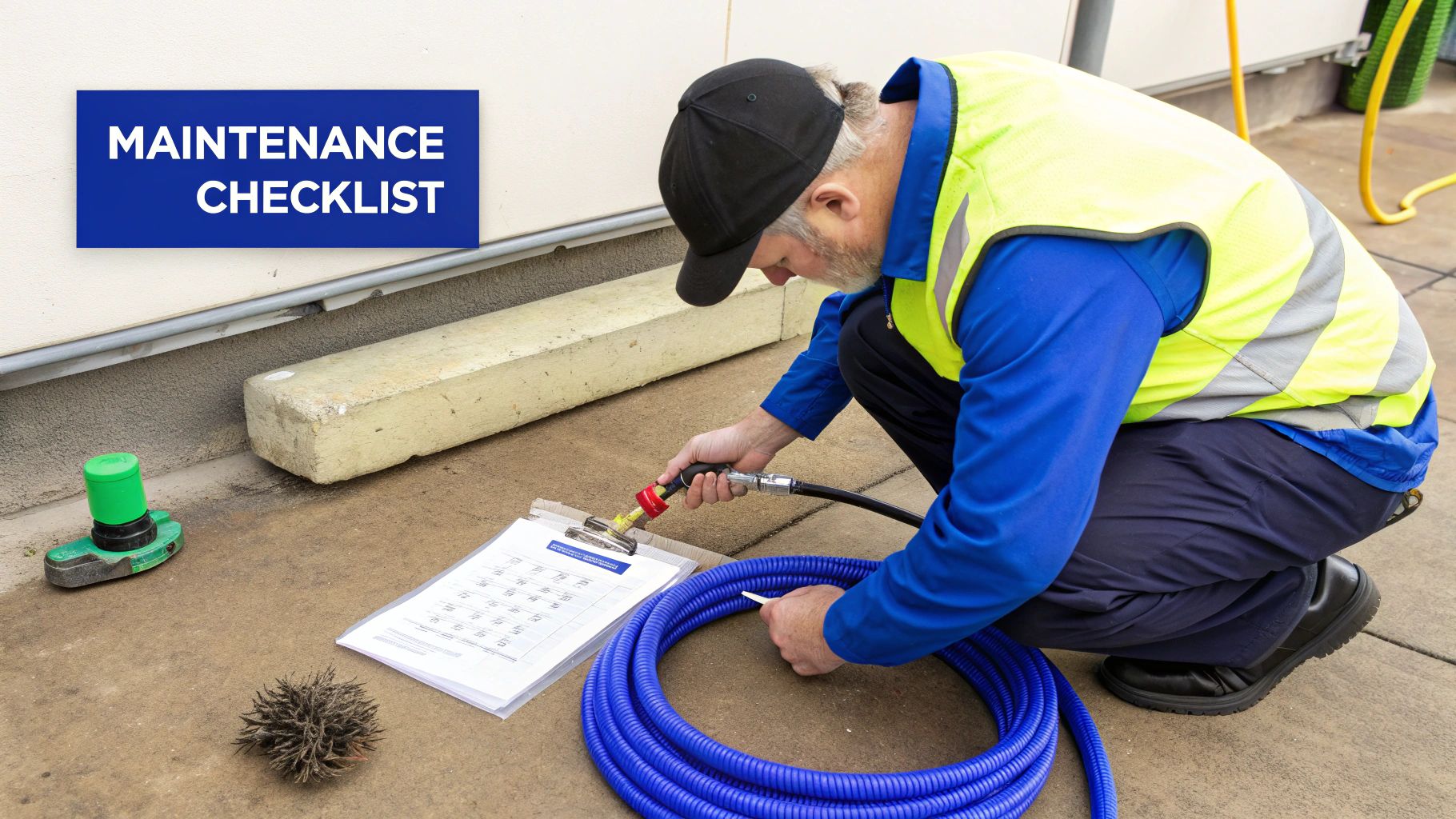
Reliable gear is the backbone of consistent results. The simplest way to keep everything running smoothly is a solid pre- and post-job inspection routine. This applies to everything from the jetter hose for your power washer to the wet vac hose. Skipping this step is the fastest way to unexpected downtime, which costs money.
Think of it as a pilot's pre-flight checklist. It’s a habit that catches small issues before they become major problems mid-dig. For anyone in residential digging or yard care, these few minutes ensure your entire system—power washer, hoses, and the Hydrovac Attachment Tool—is ready to perform.
Your Essential Maintenance Checklist
A routine is everything. Before heading to a job, run through these key points. This checklist covers the most common failure points and can save you from a breakdown when you can least afford it.
- Hose Inspection: First, check the hoses. With the machine off, run your gloved hands along the entire length of the pressure hose. Feel for any bulges, deep cuts, or heavy abrasion. A hose failure under pressure is dangerous.
- Nozzle and Fitting Check: Ensure your nozzles are clear. A tiny pebble can disrupt the jet pattern and kill your cutting power. Also, give every threaded connection a quick twist to make sure it's tight.
- Wet Vac Hose and Filter: Inspect the wet vac hose for punctures or cracks that will kill suction power. Critically, ensure your vacuum's filter is clean and set up for wet use—you don't want to fry the motor.
On-the-Job Troubleshooting Guide
Even the best-maintained equipment can have issues. The real test is how quickly you can diagnose and fix the problem to keep the project moving.
When your equipment goes down, the clock is still ticking. The ability to troubleshoot common problems on the spot is what separates experienced operators from amateurs. A five-minute fix is always better than a two-hour trip for a replacement part.
Here’s a quick guide for the problems that pop up most often in the field:
| Common Problem | Likely Cause | Quick Solution |
|---|---|---|
| Sudden Drop in Water Pressure | Clogged nozzle or kinked pressure hose | Disconnect power and clear the nozzle tip with a small pin. Straighten out any kinks in the hose. |
| Weak or No Vacuum Suction | Loose hose connection or full vac tank | Tighten the clamp connecting the wet vac hose to the Hydrovac Attachment Tool. Empty the vacuum tank. |
| Excessive Splashback | Improper tool angle or poor seal | Adjust your wand to a 60-75 degree angle. Check that the nozzle cap is securely fitted over the wand. |
Answering Your Hydro Excavation Questions
When you're looking to bring mobile hydro excavation into your yard care or residential digging business, questions are natural. Understanding the gear and process is the first step to working smarter—whether you're setting fence posts or digging up pipes without damage.
Let's dive into some of the most common questions.
Can I Just Use Any Hose With My Power Washer?
Absolutely not, and this is a critical safety point. You cannot use just any hose. The jetter hose for your power washer must have a PSI rating that matches or exceeds your machine's output. Using an underrated hose is asking for a burst, which is a dangerous situation.
For the kind of hydro excavation work discussed here, look for a hose rated for at least 3,000 PSI. Also, double-check your fittings to ensure everything—the hose, the power washer wand, and your Hydrovac Attachment—connects securely.
Will This Method Damage Buried Plastic Pipes or Utility Cables?
When done correctly, this is one of the safest ways to dig around buried utilities. A shovel or auger uses brute force, which can easily crack a pipe or slice a cable. Pressurized water, on the other hand, gently turns the soil into a liquid slurry.
The key is to start with a lower pressure and gradually increase it. Keep the nozzle moving constantly. The Hydrovac Attachment Tool is a huge help here because its instant vacuum keeps your line of sight clear, allowing you to see exactly what you're doing and avoid hitting anything.
The real advantage here is control. You're not blindly swinging a tool; you're methodically peeling back layers of soil, which dramatically reduces the risk of costly damage. This precision is invaluable for any residential digging project, from fence post installation to pipe repair.
Why Not Just Use a Power Washer and a Wet Vac Separately?
You could, but you would create a huge mess and waste time. Using a power washer alone blasts soil around, creating a muddy pit that you then have to vacuum out. You're dealing with splashback, you can't see what you're doing, and you're essentially doing the job twice.
The Hydrovac Attachment Tool combines these steps into one clean, efficient motion. It creates a sealed suction zone right where you're digging, pulling the slurry out the instant it's created. This integration makes the process fast and effective for jobs like digging fence post holes or trenching.
What Kind of Wet Vac Works Best for This?
A powerful shop-style wet/dry vacuum is what you need. Key specs are a high CFM (cubic feet per minute) rating for strong suction and a decent-sized tank—at least 10-16 gallons.
The Hydrovac Attachment Tool is designed to fit a standard 2.5-inch wet vac hose, found on most contractor-grade vacuums. Just make sure your vacuum's filter is rated for wet use to avoid burning out the motor. For a typical job like digging a few fence post holes, you'll likely only need to fill the tank once.
Ready to transform your digging process? The Hydrovac Attachment Tool is the key to unlocking a faster, cleaner, and safer method for all your residential excavation needs.
Learn more and get your Hydrovac Attachment today.