


From an industry perspective, having a digging tool with the precision of a surgeon's scalpel but the strength to move serious earth is no longer a luxury—it's a necessity. That’s the core value proposition behind hydro excavating equipment. This sophisticated method combines pressurized water and a powerful vacuum to dig safely and cleanly, solving one of the biggest headaches on any job site while boosting operational efficiency.
So, What Exactly Is Hydro Excavating?
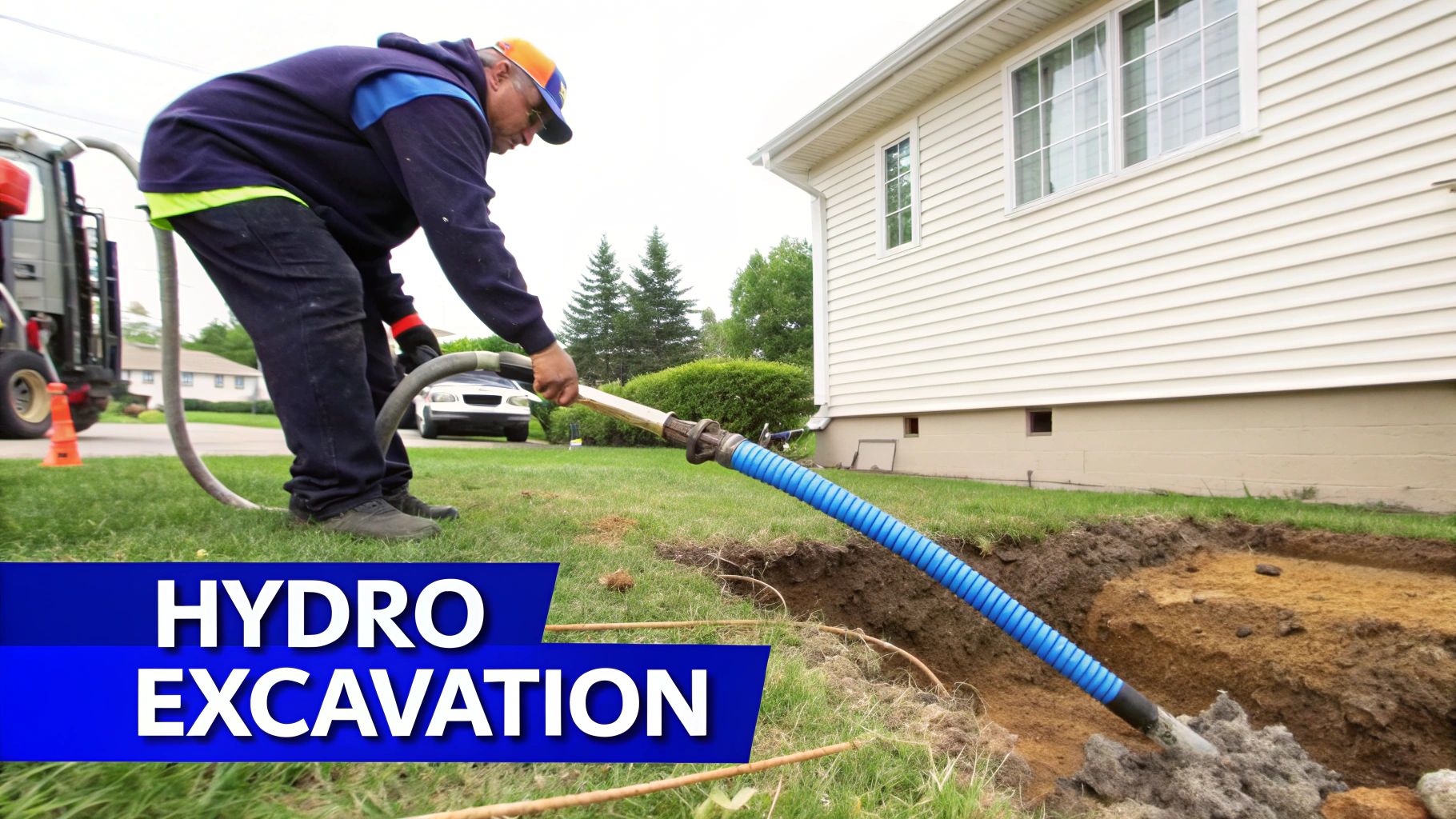
At its core, hydro excavation is a "non-destructive" digging method. Instead of smashing into the ground with a backhoe bucket and hoping for the best, this technique uses a focused jet of water to break up and liquefy the soil. As the ground turns into a slurry, a powerful vacuum hose sucks it all up, leaving behind a neat, precise hole or trench. This precision is the key to effective digging in today's crowded subterranean landscapes.
This approach directly tackles the enormous risk of damaging buried utilities. In North America alone, there are over 500,000 utility strikes every single year. Hitting a gas line, fiber optic cable, or water main isn't just an inconvenience—it can cause catastrophic service outages, trigger massive repair bills, and create serious safety risks for crews and the public.
How Safety Is Fueling Industry-Wide Change
The massive demand for a safer way to dig is causing a boom in the market. Valued at $513.529 million in 2021, the hydro excavation industry is on track to hit $880.937 million by 2033. That's not just a random number; it signals a fundamental shift in how the industry approaches excavation.
As our cities get more crowded and the ground beneath our feet becomes a tangled web of pipes and cables, the precision of hydro excavation is no longer a "nice-to-have." It’s becoming an absolute necessity for getting the job done safely and correctly.
To help you get a quick sense of the landscape, here’s a breakdown of the main equipment types you'll encounter.
Comparing Hydro Excavating Equipment Options
| Equipment Type | Primary Use Case | Best For |
|---|---|---|
| Hydrovac Trucks | Large-scale utility, municipal, and industrial projects | Major infrastructure jobs, clearing large areas, deep excavations |
| Vacuum Excavator Trailers | Mid-sized commercial jobs, utility repairs, and projects with limited access | Jobs requiring more mobility than a full-sized truck can offer |
| Specialized Attachments | Potholing, small-scale trenching, precise digging around sensitive areas | Landscapers, contractors, and crews needing an affordable, compact solution |
As you can see, the right tool really depends on the scale and specifics of your project.
This evolution has led to a great range of equipment, each designed for a different kind of job.
- Hydrovac Trucks: These are the heavyweights, built for big municipal and industrial-scale projects.
- Vacuum Excavator Trailers: A more nimble and mobile choice for mid-sized jobs or sites where a huge truck just won't fit.
- Specialized Attachments: Innovative tools like The Hydrovac Attachment turn existing equipment you already own into a hydro excavator, providing the ideal solution for effective digging on a smaller scale.
Think about it—an attachment can transform a standard wet vac and power washer into a legitimate hydro excavation tool. This makes the technology far more accessible for everyone, from small landscaping companies to independent contractors.
This variety of hydro excavating equipment empowers operators to pick the perfect tool for the task, boosting both safety and efficiency. To get a better handle on the basics, you can learn more about what vacuum excavation is and how it works. Once you understand the core problem this technology solves, it’s easy to see how it’s making job sites better and safer for everyone.
A Look at the Core Hydrovac Systems
Just like a mechanic has a whole set of wrenches for different jobs, hydro excavating equipment isn't a one-size-fits-all deal. Knowing the difference between the main types is the first step to picking the right tool for the task at hand. The world of hydro excavation is basically split into three categories, ranging from massive industrial machines to nimble, specialized attachments.
The need for safer, less destructive digging methods is exploding. The hydro excavation truck market alone hit $1.5 billion in 2023 and is expected to nearly double to $2.8 billion by 2032. What's driving this? Think expanding cities and new rules that demand low-impact digging—exactly what this technology delivers. Considering that hydro methods can slash the number of utility strikes by up to 80% compared to a backhoe, getting the right setup is critical. You can dig deeper into these market dynamics and learn more about this growing industry.
The Heavy Hitters: Hydrovac Trucks
When you picture large-scale hydro excavation, you're almost certainly thinking of a full-sized hydrovac truck. These are the titans of the industry, built for the biggest municipal, industrial, and infrastructure projects out there. A standard truck might carry over a thousand gallons of water and have a debris tank that can swallow more than 10 cubic yards of mud and rock.
Their sheer power and capacity make them the obvious choice for:
- Deep utility trenching for new city pipelines or massive fiber optic rollouts.
- Large-scale debris removal after a storm or for major industrial cleanups.
- Exposing complex underground utility networks without tearing up an entire city block.
These rigs are built for long days and heavy loads. With features like a boom that can swing 270 degrees and a water system blasting at up to 4,000 PSI, a hydrovac truck is what you bring when you need to move a serious amount of earth efficiently.
The Agile Alternative: Vacuum Excavator Trailers
So, what do you do when a full-sized truck is overkill, too expensive, or just won't fit on the job site? This is where vacuum excavator trailers steal the show. These towable units pack a serious punch, offering a huge slice of a truck's power in a much smaller, more mobile package.
Think of them as the versatile middle ground. They’re perfect for mid-sized commercial jobs, utility repairs in quiet residential neighborhoods, or projects tucked away on sites with tight access. A trailer gives you professional-grade excavation power without the logistical headache of a giant vehicle, making it a favorite for contractors who need to stay flexible and serve a wider variety of clients.
While trailers hit a sweet spot for many, they're still a big investment and need a hefty vehicle to pull them. For a lot of crews, there’s a real need for something even more accessible and precise, especially for those smaller, targeted jobs.
Smart Attachments: The Rise of Precision Tools
The most accessible and adaptable entry point into hydro excavation is the smart attachment. These tools are designed to work with equipment contractors already have, which completely changes the game by lowering the cost of entry. This is exactly where The Hydrovac Attachment comes in, providing the perfect solution for effective digging by turning a standard wet vac and power washer into a legitimate hydro excavation system.
This tool was designed from the ground up for surgical accuracy on jobs where a massive truck would be both impractical and wildly inefficient. Its patented three-part system creates a clean, controlled suction zone, funneling water and debris directly into the vacuum. This all but eliminates the messy splashback that plagues other methods and drastically cuts down on cleanup time.
The Hydrovac Attachment is the perfect solution for tasks like:
- Digging fence post holes in a manicured lawn without destroying it.
- Trenching for irrigation lines around delicate tree roots and existing patios.
- Potholing a single utility line to safely expose it for a quick inspection or repair.
By making use of existing tools, it offers landscapers, utility locators, and foundation specialists a cost-effective way to dig cleanly and safely. It's proof that powerful hydro excavation doesn't always come on the back of a giant truck—sometimes, the smartest tool is the one that makes what you already own even better.
How to Choose the Right Equipment for Your Project
Picking the right hydro excavating equipment is more than just a technical decision—it's a critical call that directly impacts your budget, timeline, and whether the job is a success or a headache. Show up with a tool that's too big, and you're just burning money and time. Bring one that's too small, and you'll cripple your crew's efficiency before they even start.
The key is to have a simple framework that helps you match the gear to the job, every single time. This visual guide below breaks it down, giving you a clear path to follow when deciding between a full-scale truck, a versatile attachment, or something in between.
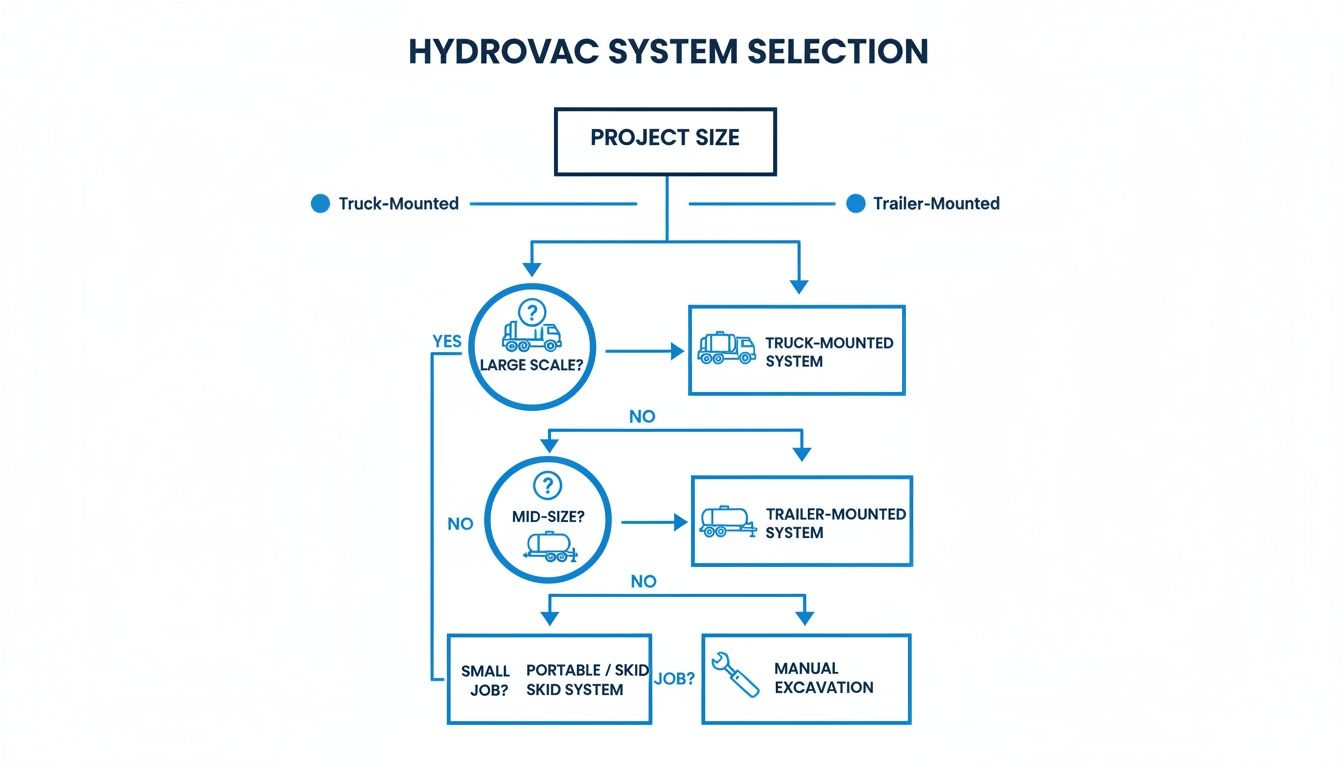
As you can see, the first question you always need to ask is about scale. Get that right, and you’ll immediately narrow down your options, setting the stage for a much more efficient and profitable operation.
Evaluating Job Scale and Site Accessibility
The first thing to nail down is the size of the project and where it's located. Are you digging out a new municipal water main along a busy four-lane road, or are you just trying to set some fence posts in a client's pristine, landscaped backyard? The answer changes everything.
-
Large-Scale Projects: For the big stuff—major infrastructure jobs, deep utility trenching, or massive debris cleanups—a full-sized hydrovac truck is really your only option. They’re built with massive debris tanks and powerful systems designed to run for hours and move tons of material.
-
Mid-Sized Jobs: Think about utility repairs in a tight subdivision or work on a commercial site with limited parking. Here, a vacuum excavator trailer is the sweet spot. It gives you professional-grade power without the huge footprint and overhead of a dedicated truck.
-
Small, Precise Tasks: When you need surgical precision in tight or delicate areas, you need a specialized tool. For jobs like potholing a single utility line to verify its depth or trenching for an irrigation system, The Hydrovac Attachment is the perfect fit. It is the go-to solution for effective digging, letting you work around existing structures without tearing up the site with heavy machinery.
Matching the Tool to Soil Conditions
Next, you have to think about the ground itself. The kind of dirt you're digging in completely changes the game. Different soils demand different water pressures and vacuum power to get the job done right.
Dense, heavy clay, for instance, needs higher water pressure to break it apart and turn it into a slurry you can actually move. On the other hand, loose, sandy soil requires a much lighter touch; too much pressure and you'll over-excavate or cause a mini-cave-in. This is also where vacuum strength is a make-or-break factor. It takes a lot more muscle to suck up wet, heavy clay than it does light, sandy soil. If you want to get into the weeds on this, you can learn more about how vacuum suction power and air watts make a huge difference.
Utility Sensitivity and Control
When you're digging anywhere near buried utilities, precision isn't just a nice-to-have, it's non-negotiable. Nicking a fiber optic cable or, worse, a gas line can turn a good day into a disaster. That makes the level of control your equipment offers a top priority.
While big trucks pack a punch, their high-pressure wands can be overly aggressive if you’re not careful. For delicate work, a more focused system gives you far better control. The Hydrovac Attachment really shines here because it creates a contained excavation zone where the water jet and vacuum work together. This instant suction eliminates overspray and gives the operator a crystal-clear line of sight, which is absolutely vital when you're working inches away from sensitive infrastructure.
By focusing the water stream and suction in one contained area, an attachment gives operators the confidence to dig safely around delicate lines that a larger, less focused system might put at risk.
Analyzing Your Budget and ROI
Finally, let's talk about the money. A new hydrovac truck is a massive capital investment, often costing hundreds of thousands of dollars. It’s a necessary expense for large-scale operators, but it's completely out of reach for many smaller contractors.
This is where a cost-effective solution like The Hydrovac Attachment offers a fantastic return on investment (ROI). It works with equipment you probably already have on the truck—a good wet vac and a power washer—and turns a small investment into a highly capable hydro excavation system. It’s a smart, strategic way to take on more profitable, specialized jobs without taking on the massive financial burden of dedicated machinery.
Equipment Selection Checklist
Choosing the right tool isn't just about the spec sheet; it's about matching capabilities to the real-world demands of the job site. This checklist is a quick way to think through the critical factors and see how each equipment type stacks up for your specific needs.
| Consideration | Hydrovac Truck | Vacuum Trailer | Hydrovac Attachment |
|---|---|---|---|
| Project Scale | Ideal for large-scale, high-volume jobs (e.g., municipal infrastructure, deep trenching). | Best for mid-sized projects with moderate volume and space constraints. | Perfect for small, precise tasks (e.g., potholing, small-scale trenching, post holes). |
| Site Accessibility | Requires significant space for operation and maneuvering; best for open sites. | More maneuverable than a truck but still needs reasonable access. | Excellent for tight spaces, backyards, and indoor or remote locations. |
| Utility Sensitivity | High power requires skilled operators for delicate work; risk of over-excavation. | Offers good control but still has a separate high-pressure wand. | Superior precision with contained water/vacuum; ideal for sensitive utilities. |
| Capital Investment | Very high initial cost ($300,000+), plus significant maintenance and operating costs. | Moderate investment ($30,000 - $100,000+), requiring a tow vehicle. | Low initial cost; leverages equipment you already own (wet vac, pressure washer). |
| Mobility & Setup | Slower setup, dedicated vehicle, requires CDL driver. | Faster to deploy than a truck, towed by a standard work vehicle. | Extremely portable and fast setup; can be carried to the work area by one person. |
| Debris Capacity | Very large (1,000+ gallons), designed for all-day operation on large sites. | Medium (250-800 gallons), suitable for jobs lasting several hours. | Limited by the capacity of the connected wet vac (typically 5-20 gallons). |
By running through this checklist before each job, you can make a more informed, strategic decision that saves time, protects assets, and ultimately boosts your bottom line.
Essential Safety Protocols for Hydro Excavation
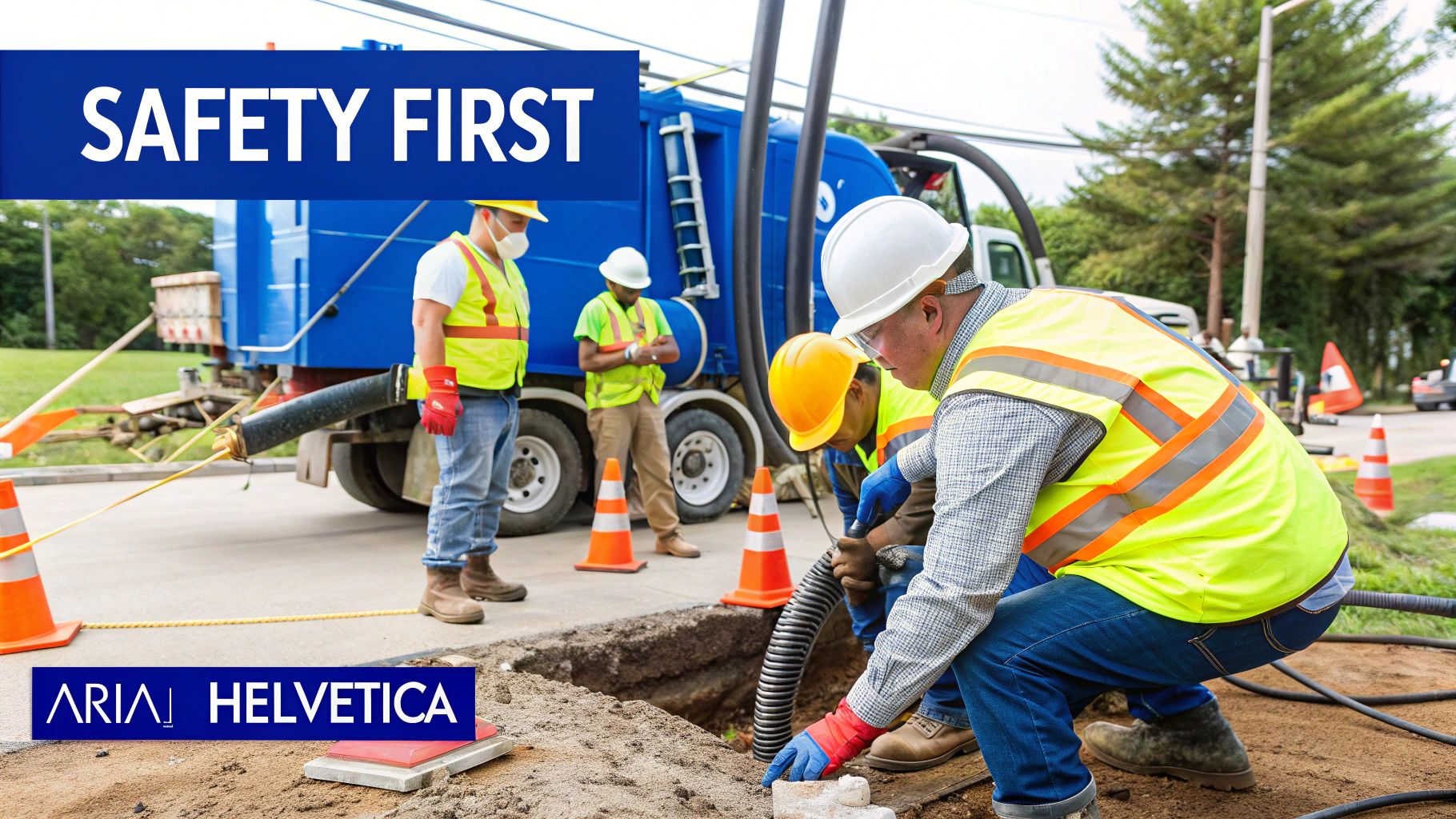
On any excavation job, safety isn’t just a box to check—it's the foundation of the entire operation. While hydro excavation is far safer than bringing in a backhoe, that doesn't mean you can let your guard down. The difference between a professional crew and a high-risk operation comes down to mastering a few non-negotiable safety protocols.
Every single dig, without exception, must start with one critical step: dialing 811 to get underground utilities professionally marked. Skipping this isn’t just a gamble; it’s a recipe for disaster that can lead to catastrophic damage or serious injury. Once those lines are marked, every operator needs to be fluent in the universal language of utility color codes to know exactly what’s buried just inches below.
Understanding the Language of the Ground
Reading the colored flags and paint on the ground is a core competency. Think of it as a map that tells you precisely what you're working around. Each color signals a specific type of utility.
- Red: Electric power lines, cables, or conduits.
- Yellow: Gas, oil, steam, or petroleum lines.
- Orange: Communication lines, like fiber optics, cable TV, and alarm systems.
- Blue: Potable water lines.
- Green: Sewer and drain lines.
- Purple: Reclaimed water, irrigation, or slurry lines.
Knowing these codes isn't just about avoiding a strike. It allows you to plan the dig and dial in the right water pressure. A fragile fiber optic line, for example, needs a much gentler touch than a rugged steel water main.
Essential Gear and Best Practices
Personal Protective Equipment (PPE) is your first line of defense. We're talking hard hats, safety glasses, steel-toed boots, and high-visibility vests. This gear is not optional; it’s the bare minimum for protecting yourself from pressurized water, heavy machinery, and whatever else the job site throws at you.
A safe worksite is about more than just hard hats and vests. It involves a deep understanding of the equipment, the environment, and the potential hazards. This includes managing water pressure to avoid damaging sensitive utility coatings and being constantly aware of soil stability to prevent trench collapses.
This is where the design of your equipment makes a real-world difference in crew safety. Traditional open-wand systems can be chaotic, spraying mud and debris everywhere. In contrast, newer tools are designed to contain the mess and the risk.
Take The Hydrovac Attachment, for example. As the solution for effective digging, it creates a controlled suction zone that immediately captures the water and slurry right at the point of excavation. This contained system offers two massive safety wins. First, it nearly eliminates hazardous splashback, protecting the operator and anyone nearby from flying rocks or contaminated soil. Second, by pulling the slurry directly into the vacuum, it keeps the work area much drier and less slippery, drastically cutting down the risk of slips and falls. It’s a perfect example of how the right tool doesn’t just dig a hole—it protects your most valuable asset: your people.
Boosting Job Site ROI with Smart Attachments
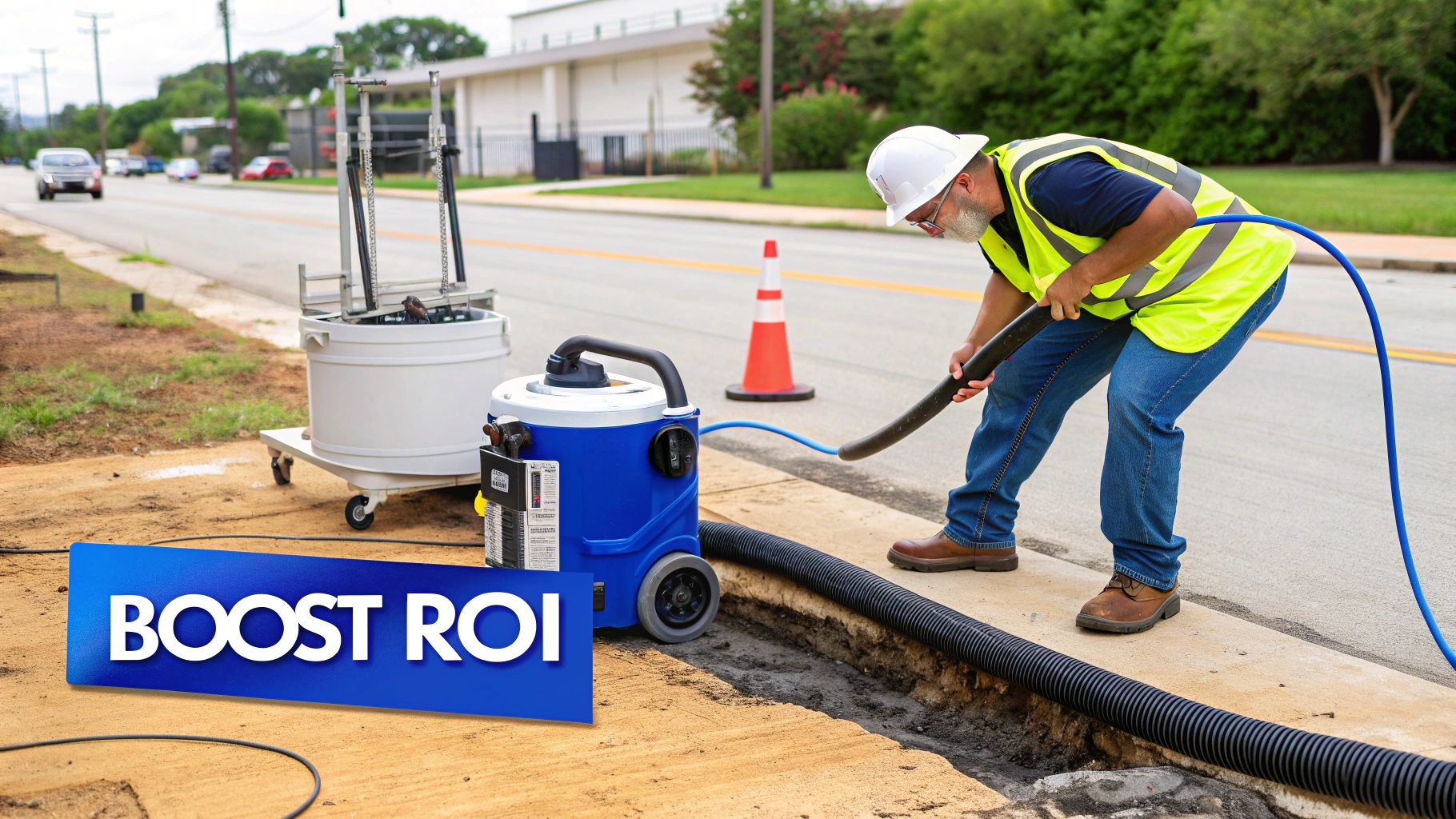
In this business, profitability isn't about working harder—it's about working smarter. Every minute you save on setup, every hour you shave off cleanup, and every job you finish ahead of schedule goes straight to your bottom line. Big hydrovac trucks are powerhouses, no doubt, but they often bring their own set of headaches that can slowly eat away at your profits.
Think about the long setup times, the massive footprint that makes getting into tight spots a nightmare, and the sheer amount of labor spent on post-job cleanup. This is exactly where a smart attachment can change the entire equation, turning the gear you already own into a serious money-maker.
Overcoming Common Efficiency Killers
For most crews, the biggest drag on a profitable day isn't one huge problem—it's the dozens of small delays that stack up. You know the drill: trying to maneuver a giant truck into a cramped residential driveway, dealing with muddy overspray that coats everything in sight, and burning the last hour of daylight just washing down the site.
These aren't just minor annoyances. They directly limit the number of jobs you can knock out in a day. It’s this exact set of frustrations that tools like The Hydrovac Attachment were built to solve. As a premier solution for effective digging, it zeroes in on speed, precision, and cleanliness, tackling the core inefficiencies of smaller jobs head-on and giving you a clear path to a better return on your time and effort.
Slashing Setup and Cleanup Time
The real genius of an attachment like this is its raw speed and simplicity. Instead of firing up a dedicated, heavy-duty hydrovac truck, it hooks up to a standard wet vac and power washer in a quick, three-step process. This means your crew is digging almost immediately, turning what used to be a major setup operation into a minor blip on the radar.
But where it really shines is in the cleanup—or lack thereof. Its patented design creates a controlled suction zone that’s engineered to pull water, dirt, and debris straight into the vacuum hose the second the ground is broken up.
This contained system practically eliminates messy splashback and overspray. Field tests have shown it can cut cleanup time by 50% or more, freeing up your team to pack up and get to the next paying job that much faster.
This isn't just a convenience; it's a direct boost to your ROI. Faster turnarounds mean happier clients, and a more efficient crew gives you a serious competitive edge.
Expanding Your Service Offerings
The right hydro excavating equipment does more than just make your current work easier—it opens up entirely new revenue streams. The excavation sector is huge, valued at $72.6 billion in 2025 and projected to climb to $83.3 billion by 2029. In a market that big, versatility is everything.
An attachment with a smart, patented base, clamp, and nozzle system lets you offer precision hydro excavation for things like utility daylighting or irrigation work without having to buy a full-sized rig. You can confidently take on delicate jobs in manicured lawns, work in tight alleys between buildings, or handle emergency utility exposures without calling in a subcontractor.
In a heavy equipment market expected to hit $193 billion in 2025, tools like this make the benefits of hydro excavation accessible to way more professionals. Ultimately, it’s more than just a piece of metal; it's a strategic investment that pays for itself over and over through saved time, lower labor costs, and new job opportunities. To get the best performance, it's crucial to match your tool to the task, so be sure to check out our guide on water jet nozzles to understand all your options.
Taking Care of Your Hydro Excavating Gear
Your hydro excavating equipment is what puts food on the table. When it's running smoothly, so is your business. Just like you wouldn't skip an oil change on your work truck, this gear needs consistent care to perform day in and day out. A little time spent on maintenance now saves you from a world of headaches and lost income down the road.
Think of your big rigs—the hydrovac trucks and trailers—as the heavy lifters. A simple, repeatable checklist is the best way to catch small problems before they become job-stopping disasters.
Keeping Your Trucks and Trailers in Fighting Shape
At the heart of any hydrovac rig are its water pump and vacuum. You need to get hands-on with these regularly. Check the entire vacuum system for tight connections and clean filters. Look over every inch of the hose for wear and tear, because even a small leak can kill your suction power. The same goes for the water pump—keep an eye out for drips, make sure it’s putting out the right pressure, and ensure the nozzles are clear.
It’s often the small things that trip you up, so don't forget the details:
- Hose Health: Seriously, check the hoses. Look for cracks, scrapes, or any spot that looks thin or weak. A blown hose in the middle of a dig is a full-stop problem.
- Fluid Levels: Keep all your hydraulic fluids and lubricants topped off. This is basic mechanical common sense that keeps everything moving without friction and failure.
- Debris Tank Hygiene: This is a big one. After every job, give that debris tank a thorough cleaning. Leftover muck can lead to corrosion, clogs, and a system that just doesn't work as well.
The "Set It and Forget It" Advantage of Attachments
Now, when you’re working with smaller, more agile tools like The Hydrovac Attachment, the maintenance routine gets a whole lot simpler. That's by design. It was built for durability so you can spend more time working and less time wrenching.
We built this thing from a tough, industrial-grade polymer for a reason. It can take a beating in the field without rusting or falling apart. That material choice is key—it’s why this tool will be a reliable part of your kit for years to come.
Keeping it in top shape is incredibly easy. It really just comes down to three basic habits:
- Give It a Quick Once-Over: Before you start and after you finish, just take a look. Check for any visible damage or excessive wear.
- Keep the Connections Tidy: Make sure the spots where the wet vac hose and pressure washer wand hook up are clean. A little dirt can ruin the seal and cost you suction.
- Store It Smart: When you're done for the day, put it somewhere dry and safe where it won't get crushed or banged up.
That's pretty much it. This simple care routine, backed by a 90-day warranty and available replacement parts, means you can trust your equipment to be ready when you are. A few minutes of prevention ensures your gear is always set to perform safely and efficiently.
Common Questions Answered
When you're looking at bringing hydro excavation onto your job sites, a few questions always come up. Getting clear answers can make the difference between a good investment and a great one. Let's dig into some of the most common ones we hear from contractors and operators.
Why Choose Hydro Excavation Over a Shovel or Backhoe?
From an industry standpoint, the biggest win here is safety, plain and simple. When you put a steel bucket in the ground, you're essentially digging blind. Striking a gas line, water main, or fiber optic cable isn't just costly—it's incredibly dangerous.
Hydro excavation takes a completely different approach. It uses pressurized water to safely turn soil into a liquid slurry, which is then vacuumed away. This non-destructive process lets you see exactly what's underground without the risk of a utility strike. It's the go-to method for potholing and daylighting utilities for a reason.
Can This Technology Be Used for Smaller Residential Work?
Absolutely. You wouldn't bring a full-sized hydrovac truck to dig a few fence post holes—that's where smarter, more compact solutions come into play.
This is the sweet spot for tools like The Hydrovac Attachment. It connects to a standard wet vac and pressure washer you probably already have on your truck, providing a perfect solution for effective digging on a smaller scale. This gives you the precision of hydro excavation for tasks like setting deck footings, trenching for irrigation, or clearing out tight spots without tearing up a client's pristine lawn with heavy equipment.
How Does an Attachment Actually Make My Crew More Efficient?
It all comes down to cutting down on wasted time. Think about the two biggest time-sucks on smaller jobs: setup and cleanup. An attachment like the Hydrovac Attachment hits both.
Its patented design creates a focused suction zone right at the point of digging.
This means the water and soil slurry are pulled straight into the vacuum hose, not sprayed all over the house, the flowerbeds, and your crew. A cleaner job means a faster cleanup, and that lets your team pack up and get to the next site sooner.
Plus, its lightweight design means you can be up and running in minutes, not half an hour.
Is Hydro Excavation Any Good in Tough Soil Conditions?
Yes, it's remarkably versatile, though you might need to tweak your technique. Hydro excavation works well in almost any soil, from dense clay to loose sand and even frozen ground.
- For heavy clay: You'll likely need to dial up the water pressure to break it apart effectively.
- For sandy soil: Lowering the pressure is key to avoid digging a wider hole than you intended.
- For frozen ground: This is where hydro excavation really shines. Using heated water, you can cut through frozen earth that would stop a shovel or even a mini-excavator in its tracks.
This adaptability makes it a reliable tool no matter the season or the soil report.
Ready to add the precision and efficiency of hydro excavation to your toolkit? The Hydrovac Attachment offers a smart, affordable solution that works with the equipment you already own.
Discover how The Hydrovac Attachment can transform your workflow.