


If you’ve ever wrestled a heavy wet vac hose around a client's pristine landscaping, you know the struggle. The hose snags on corners, damages garden beds, and fights you every inch of the way, turning a simple job like digging fence post holes into a frustrating workout. Hose guide rollers are the professional solution to this common headache, creating a smooth, low-friction path that lets your hose glide effortlessly, protecting property and equipment.
Stop Fighting Your Hose and Start Working Smarter
Fighting with a stubborn wet vac hose is more than a minor annoyance; it’s a direct hit to your efficiency and profitability in the yard care and residential digging industry. Every time your hose catches on a foundation, a curb, or a sprinkler head, you have to stop what you're doing—whether that's digging up pipes or clearing debris. Those lost minutes add up quickly, eating into your bottom line on jobs like fence post digging or small trenching projects.
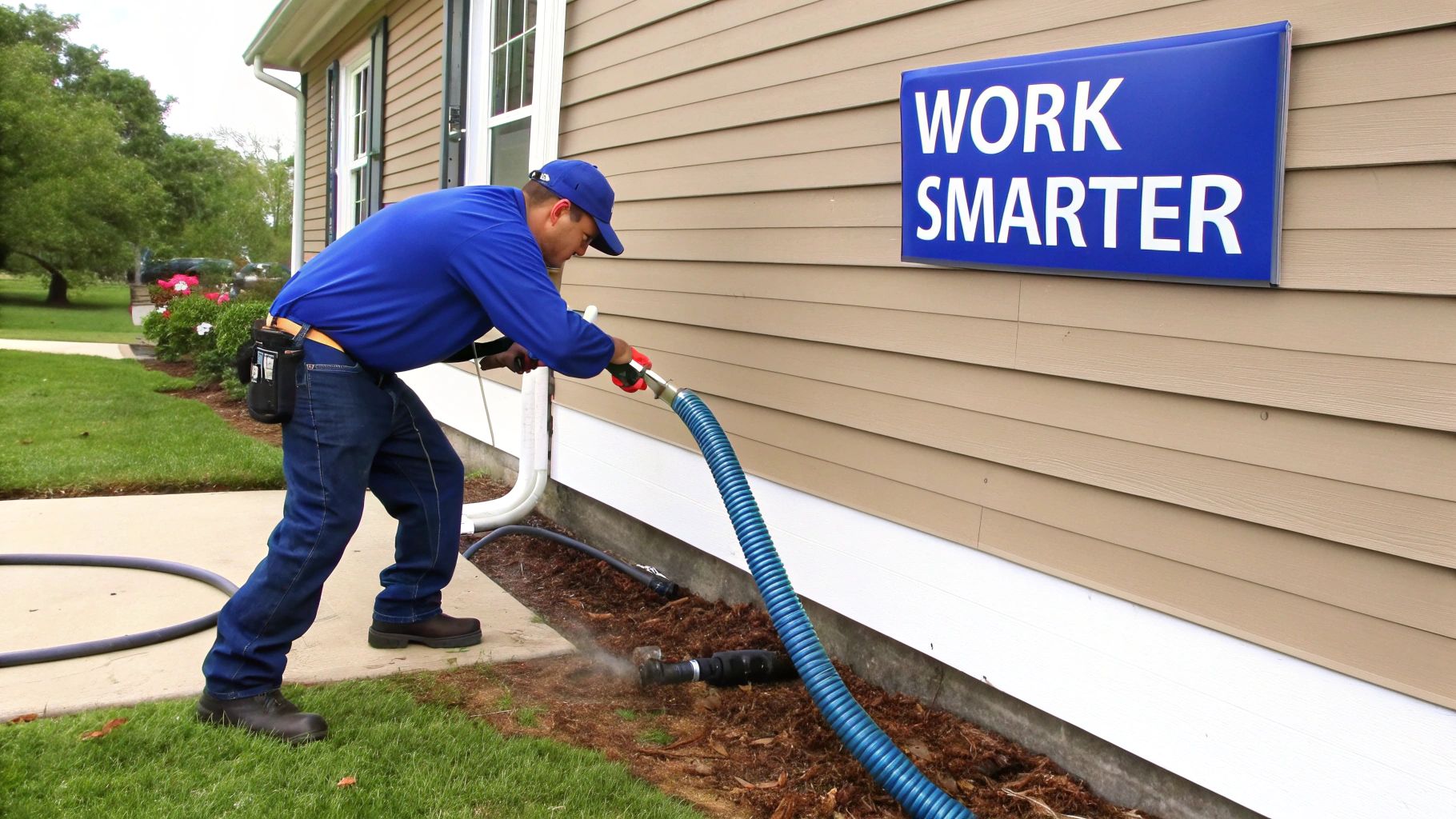
This constant tug-of-war isn't just about lost time. It puts significant physical strain on your crew, leading to fatigue and increasing the risk of injury. A dragging hose can also cause serious damage to a client's property, scuffing siding, tearing up lawns, or breaking delicate irrigation components. That kind of damage can ruin your professional reputation in a competitive market.
Protect Your Assets and Your Reputation
Hose guide rollers are the unsung heroes of any residential digging or yard care job. They provide a simple, effective solution to these everyday frustrations. By giving your wet vac hose a smooth path to follow, they prevent the constant abrasion that destroys expensive equipment. This means your hoses last longer, and you spend less money on replacements. It’s not just about making the job easier; it’s about operating with professional precision.
Think of it as an investment in smooth operations. When you prevent property damage and show clients you respect their space, you're building trust that leads to repeat business and great referrals. A clean, efficient job site says everything about the quality of your work.
The Foundation of Efficient Digging
For precise work like digging fence post holes or carefully excavating around fragile pipes without causing damage, hose control is absolutely critical. A snag-free hose ensures you have consistent, uninterrupted suction and power exactly where you need it. This is where specialized tools elevate your service.
Pairing a smooth hose setup with a tool like the Hydrovac Attachment provides a level of control for mess-free, precise digging that’s impossible when you're constantly fighting your equipment. This mobile tool, designed for wet vac hoses, is the key to effective small-scale digging. To stay ahead, it's wise to keep up with new methods; you can explore industry insights to stay current. The right tools are the bedrock of control and professionalism.
How Hose Guide Rollers Actually Work
At its core, a hose guide roller is a brilliantly simple piece of equipment. Its entire purpose is to create a low-friction pivot point, allowing your wet vac hose to glide smoothly around obstacles instead of grinding against them.
Imagine trying to drag a heavy, rigid hose around the sharp corner of a brick retaining wall. It's a struggle. The hose catches, frays, and grinds to a halt. Now, picture a pulley on that same corner. Suddenly, the hose moves effortlessly. That pulley perfectly illustrates how a hose guide roller works for your vacuum hose on a residential job site.
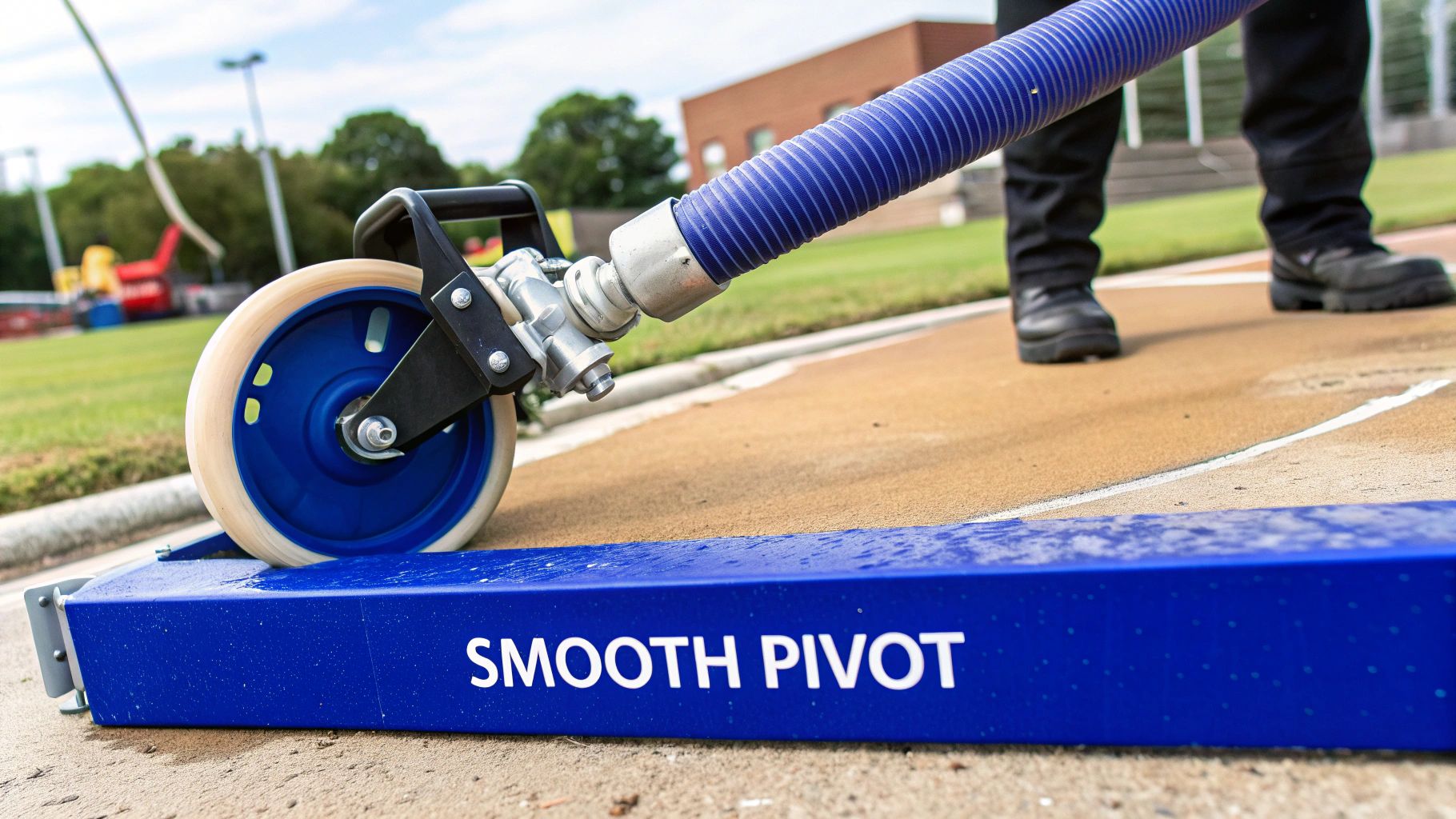
When you place these guides at strategic points—like building corners, across rough concrete driveways, or through narrow fence gates—you completely change the physics of the job. You prevent the hose jacket from getting chewed up and stop those frustrating kinks that kill your suction power right when you need it for clearing debris.
From Friction to Fluid Motion
This simple mechanical advantage makes a massive difference. It drastically reduces the force needed to pull the hose, turning what could be a two-person wrestling match into an easy one-person task. This isn't just about convenience; it's about maintaining job momentum, which is crucial when you're digging a series of post holes or carefully exposing buried pipes without causing damage.
It's no surprise that more and more yard care and residential digging crews are relying on these tools. Market research shows the global Hose Roller Guide market is set to grow from US$291 million in 2025 to US$337 million by 2031. This trend is fueled by crews in construction and landscaping who need to guide heavy 2.5-inch vac hoses without abrasion, boosting both safety and efficiency on the job site. You can dig into this market trend over at Infinity Market Research.
A System for Effortless Management
Effective hose management isn't about using a single roller; it's about creating a complete system. By combining different types of rollers, you can build a seamless path from your truck all the way to the excavation point.
Some of the go-to options for residential sites include:
- Stake-in-Ground Guides: Perfect for open areas like lawns or garden beds. You can stake them into the ground to create gentle, sweeping curves, protecting turf and plants.
- Corner-Mounted Rollers: Absolutely essential for navigating building foundations, retaining walls, and other sharp 90-degree corners without scuffing the property or damaging the wet vac hose.
- Flat Rollers: These lie flat on surfaces like driveways and sidewalks, preventing a hose from getting snagged or crushed under a wheelbarrow or other low-clearance obstacles.
By setting up a system of these guides, you create a predictable, low-resistance path for the hose to follow. This frees you up to concentrate on the real work—the precision digging—instead of constantly fighting with your equipment.
This level of control is fundamental. Once the hose is managed, a specialized mobile tool like the Hydrovac Attachment can take over, providing surgical precision at the point of excavation. Understanding your gear is also key; learn more by checking out our guide on flexible vacuum hoses. Ultimately, smart hose management from start to finish separates a professional operation from an amateur one.
How Hose Guide Rollers Actually Benefit Your Business
So, let's get down to the bottom line. What do these hose guide rollers really do for your business on a day-to-day basis? If you're running a landscaping, fencing, or irrigation crew, the answer is simple: they make you more money by solving some of your most common headaches.
Protect Your Pricey Equipment
First, you're protecting a significant investment. A high-quality wet vac hose isn’t cheap, and dragging it across rough concrete, the sharp corner of a retaining wall, or a gravel driveway is the fastest way to destroy it. Hose guide rollers prevent all that friction and abrasion.
By keeping your hose off the ground and away from sharp edges, you can dramatically extend its life. That means fewer replacements, less downtime waiting for new equipment, and more profit. Think of it as a small investment to protect a much larger one. This proactive care is smart business and helps avoid major failures that could lead to claims against your equipment breakdown insurance policy.
Make the Job Site Safer for Your Crew
Next, let's talk safety. A properly guided hose lays flat and moves predictably. This simple change instantly eliminates the trip hazards that arise when a hose twists and snakes across a yard.
It also saves your team's backs. Constantly fighting a snagged hose—yanking and pulling to get it unstuck—is exhausting and a recipe for muscle strain. When the hose glides along smoothly, your crew can work with far less effort, keeping them fresh and focused on the actual job, whether it's digging up pipes or setting posts.
An efficient job site is a safe job site. When your crew isn't fighting their equipment, they can dedicate their full attention to the precision work of digging around utilities or setting fence posts, reducing the chance of costly mistakes.
Unlock Some Serious Efficiency
Finally, you'll see a major boost in job site speed. When your team can pull the hose without a fight, they move quicker. Imagine digging a long trench for an irrigation line or clearing out a dozen post holes for a fence. A smooth hose pull shaves precious time off every single step.
Those minutes add up. A job that used to take a full day might now finish early, giving you the chance to schedule another client. That’s how you grow your business. This is especially true as the industrial hose market, which hit USD 16.1 billion, is projected to grow by 9.44% annually through 2031, with clients demanding faster, more reliable service. You can discover more insights about these industrial hose market trends.
Cost Analysis: The Impact of Hose Guide Rollers
Don't just take our word for it—the numbers speak for themselves. Here’s a look at how these small tools can have a big impact on your annual operational costs for a typical small crew.
| Cost Factor | Without Hose Guide Rollers (Annual Estimate) | With Hose Guide Rollers (Annual Estimate) | Annual Savings |
|---|---|---|---|
| Hose Replacements | $2,000 (2-3 hoses) | $700 (1 hose) | $1,300 |
| Downtime Costs | $1,500 | $250 | $1,250 |
| Labor (Fatigue/Injury) | $1,200 | $300 | $900 |
| Total Annual Cost | $4,700 | $1,250 | $3,450 |
As you can see, the initial investment in a few rollers pays for itself many times over within the first year, leading to thousands in savings.
Ultimately, hose guide rollers are a foundational part of running a professional and profitable operation. Once your hose is managed, it sets the stage for specialized tools like the Hydrovac Attachment to perform precise digging, giving you the clean finish that makes your work stand out.
Choosing the Right Hose Guide Rollers for the Job
Picking the right hose guide rollers isn't a one-size-fits-all decision. The best choice always depends on the specific demands of your job site. Whether you're carefully navigating a manicured lawn for a yard care project or dragging a hose around a rough concrete foundation for fence post digging, building a versatile kit is key to working efficiently without causing damage.
Matching Rollers to Your Task
First, consider the material. For most residential jobs, you can't go wrong with durable, non-marring polymer rollers. They're lightweight, won't rust, and are gentle on both your hose and the client's property. For more demanding industrial sites or constant heavy use, heavy-duty metal rollers offer superior strength and can withstand significant abuse.
Next, you need to think about size and compatibility, especially if you’re running a standard 2.5-inch wet vac hose. The roller's channel must be wide and deep enough for the hose to glide through without being pinched. A roller that's too small creates more friction and defeats the purpose. Always verify it can comfortably handle your hose diameter, which is crucial for smooth operation when digging post holes or clearing out a deep pipe.
The mounting type is the most critical factor, as it dictates where you can use the roller. A well-stocked kit should provide options for any scenario:
- Stake-in-Ground Rollers: Your best friend in open spaces like lawns and gardens. Push them into the ground to create a smooth, curved path, keeping the hose from crushing flower beds or tearing up grass.
- Corner-Mounted Guides: Essential for any job involving a building. These guides attach to or brace against foundations, retaining walls, or steps, allowing the hose to make sharp 90-degree turns without being damaged by abrasive concrete or siding.
- Vehicle-Mounted Options: For crews working directly from a truck or trailer, these rollers prevent the hose from becoming a tangled mess as it's pulled out and reeled back in, saving time and frustration.
The growing variety in these accessories reflects the expansion of the broader hose management market. The hose reels market, valued at USD 1.35 billion, is expected to hit USD 2.20 billion by 2033. For any professional using a wet vac to daylight utilities or dig around sensitive foundations, these rollers are non-negotiable for tangle-free work where a simple snag could lead to a costly mistake. You can read the full research about the hose reels market to learn more.
This decision tree breaks down how picking the right roller pays off in asset protection, worker safety, and overall job site efficiency.
As you can see, every benefit circles back to the same core function: reducing friction and preventing snags. It all leads to a smarter, safer, and more profitable way of working. While rollers handle the hose's path, a mobile tool like the Hydrovac Attachment takes over at the destination, giving you pinpoint control for the digging itself.
The Hydrovac Attachment: A Partner in Precision Digging
While hose guide rollers are about getting the wet vac hose to the job site smoothly, the Hydrovac Attachment is about what happens when it gets there. This tool is not for large hydrovac trucks; it's a mobile attachment designed to be paired with a standard wet vac for small-scale residential projects. It’s a powerful partner that revolutionizes precision digging.
The attachment’s design focuses on giving you incredible control right at the point of excavation. It brilliantly combines your pressure washer and a standard 2.5-inch wet vac hose into one ergonomic tool. This creates a clean, contained, and highly accurate digging system, effectively turning your shop vac into a portable hydro-excavator. It’s the perfect solution for tight residential and yard care jobs where heavy machinery is not an option.
Mastering Precision Tasks
This tool truly shines when accuracy is non-negotiable. Imagine having to carefully dig up pipes without causing damage, or creating perfectly clean fence post holes without wrecking the surrounding lawn. These are the kinds of jobs where a single slip-up can lead to expensive repairs and lost time.
It’s also a game-changer for other common tasks:
- Trenching through established garden beds without making a huge mess or disturbing nearby plants.
- Cleaning out clogged window wells or drains without blasting mud and grime all over the side of the house.
- Safely excavating around pipes for repairs, eliminating the risk of damage from a clumsy shovel strike.
The Problem It Solves
Let's be honest: trying to juggle a pressure washer wand and a separate vacuum hose is messy and inefficient. You're constantly fighting splash-back, your view is obscured by flying debris, and the job site ends up looking like a disaster zone. It’s unprofessional, and working blind increases the risk of damaging what you’re trying to uncover.
The Hydrovac Attachment solves this by uniting the high-pressure water jet and the vacuum suction into a single, focused stream. It allows you to perform surgical-style excavation, clearing only the small amounts of debris necessary and leaving the surrounding area clean. That’s a level of control you just can't get otherwise.
When you pair the smooth hose management from guide rollers with the pinpoint accuracy of this attachment, you create a complete system for efficient, professional-grade work. If you're ready to add this precision tool to your workflow, you can see all the specs and details. You’re effectively turning a sloppy, two-handed struggle into a clean, one-tool solution for countless residential digging and cleanup jobs.
2. Rollers vs. The Hydrovac Attachment: Choosing Your Weapon
When deciding between hose guide rollers and the Hydrovac Attachment, it's not an either/or situation. The best professionals in yard care and residential digging understand the job in two parts: the journey and the destination.
Each tool is designed to master one of those phases. Using them together allows you to work smarter, not harder.
Hose guide rollers are all about the journey. Their entire purpose is to solve the problem of getting your heavy wet vac hose from the truck to the work area without a fight. Think about those long runs, sharp corners around a house, or dragging it over a rough concrete path.
Without rollers, you're wrestling with snags that burn energy and shred expensive hoses.
The Macro View: Taming the Hose Run
Picture a classic job: you’re digging post holes for a new fence along a property line. Before you start digging, you have to get 100 feet of hose from the street, through a gate, around the side of the house, and past the AC unit without tearing up the client's garden.
This is where rollers prove their worth. They handle the big-picture logistics.
- Stop Property Damage: A well-placed roller keeps the hose from grinding against house siding or ripping out flower beds.
- Save Your Back: They eliminate the grunt work of dragging a stuck hose across a large lawn.
- Protect Your Gear: By creating a smooth path, you prevent the nicks and scrapes that lead to premature hose replacement.
The Micro View: Surgical Precision on Site
Once your hose is in position thanks to the rollers, the Hydrovac Attachment steps in to handle the "micro" task—the actual digging. It's all about precision.
This is the mobile tool you grab when you need to dig clean, expose a pipe without damage, or work in a tight spot where you can't make a mess. It's your surgical instrument for small-scale jobs.
The ultimate professional setup uses both tools together. The rollers handle the long-distance travel, getting your wet vac hose to the site ready to work. Then, the Hydrovac Attachment takes over to do the job with incredible precision, leaving you with a clean site and a happy customer.
When you combine them, you can confidently tackle anything from tricky residential projects to sensitive utility locations. It transforms what could be a messy, chaotic job into a smooth, professional operation.
Got Questions? We've Got Answers
Even the most seasoned pros have questions when new gear comes along. Let's tackle some common queries about hose guide rollers and the Hydrovac Attachment, so you can work with confidence on your next residential digging or yard care project.
Do I Really Need Rollers for Short Hose Runs?
Absolutely. Even on a short 30-foot run across a driveway, a single sharp corner—like the edge of a concrete porch or an air conditioning unit—creates a friction point that scuffs and wears down your wet vac hose over time.
Using one or two hose guide rollers on those corners protects your expensive hoses from that constant abrasion. It’s a small step that extends the life of your gear and makes pulling the hose around tight spots surprisingly easier.
What About a DIY Hose Roller? Can't I Just Build My own?
It’s tempting, but it can easily backfire. Professional rollers are engineered with slick, non-abrasive polymer materials that let the hose glide without catching. They also have quality bearings for a smooth, frictionless pull.
A homemade guide can end up creating more friction and damage than using nothing at all. In the long run, investing in purpose-built tools is almost always the smarter, more cost-effective choice for a professional operation.
Is the Hydrovac Attachment Just for Digging Holes?
Not at all. While it's excellent for digging precise, clean holes for fence posts and deck footings, its true value lies in its versatility for small-scale jobs.
You can use this mobile tool to safely clear debris from around delicate pipes without the risk of impact damage. It's perfect for trenching for irrigation systems in a pristine lawn or cleaning out gunked-up window wells with virtually no mess. Any residential job that calls for careful, controlled digging with a wet vac is a perfect fit for this attachment.
How Many Rollers Do I Need for a Typical Job Site?
For most residential jobs, a good starting point is a kit with 2-3 corner guides and 3-4 stake-in-ground rollers.
This combination usually provides enough coverage to handle the corners of a house foundation and create a smooth path for the hose across the yard. It's the perfect setup to prevent snags and keep the job moving efficiently. You can always add more for larger or more complex properties.
Ready to stop wrestling with your hose and start digging with pinpoint accuracy? The Hydrovac Attachment was built to make your small-scale excavation work faster, cleaner, and a whole lot more professional.